


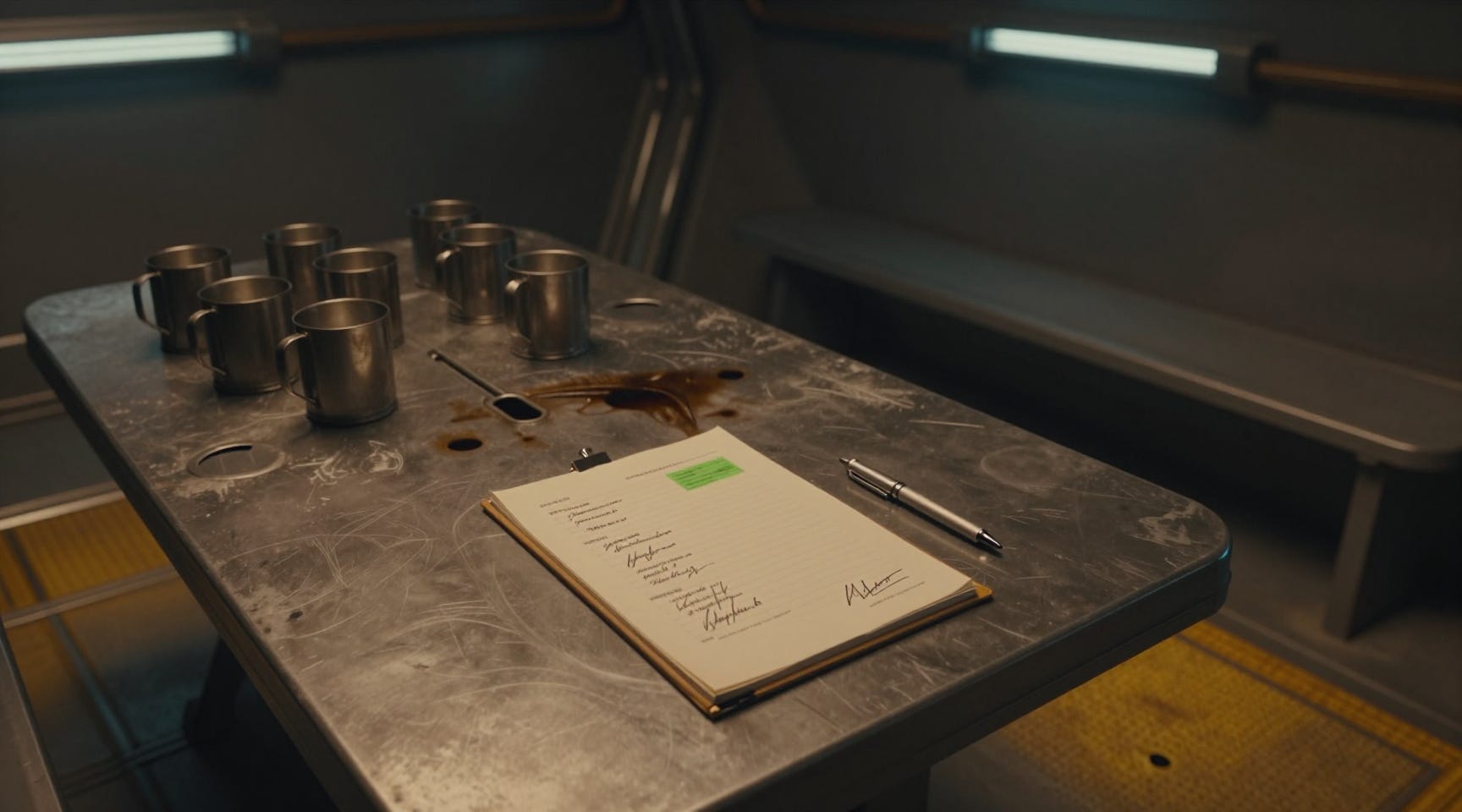
The meeting room on the third deck of the Mimas storage bay had not been built for ceremony. It had been built for crew briefings during the second-shift handover, back when the bay was a UEN-leased recovery dock and the table had been a salvage-manifest table. The table was still the same table. Three years of coffee rings on it. A scorch mark near the south end where someone had set down a cutting torch and forgotten it for a half-second too long. Davit had wiped the table with a station rag an hour ago, in the way a person tidies their hands before a thing they cannot tidy.
The document sat in the middle of the table.
Eight pages. Bound at the left margin with a single titanium clip Bero had pulled out of a parts bin that morning, already organizing the small material weight of the thing without being asked. Six clauses. The pages were printed on cheap fiber stock from the Mimas administrative annex, because nobody had built a press for this yet, and that was the right scale. An institution that began on annex paper.
The room held seven people standing. One sitting, who was Bero, on the bench against the wall, because Davit had asked him to witness from a place where he would not be expected to speak. Bero had nodded once and taken the bench and not moved since.
Davit stood at the head of the table. His good coat was on. He had not worn it for the brother’s stone last week; he had worn the plain one for that. He had decided, then, that this one was for the public moment and the other was for the private one, and he had not asked Anya whether she agreed with the distinction. He had been right not to ask.
He spoke first.
“The Protocol’s been read by everyone in this room. We’re not reading it again. We’re signing it. Order is mine, then the captains in seniority, then Tomasz for the Seam, then Constanza for the couriers, and Anya last. Bero witnesses for the record.”
No applause. No swelling. The room stayed at the small attentive hum of a working space that had agreed to be solemn for an hour.
Davit took the pen.
It was a stylus, technically. Cheap. Anodized aluminum body. Anya had bought a six-pack of them on the Pallas run two months ago, in the habit she had now of buying small redundancies. The stylus paired to the document’s authentication block by short-range tap. Davit tapped it. The block flared green. He signed his name on the dotted line above it. Davit Kade. His hand was steady. His hand had not been steady at the brother’s wall last week, and the difference, Anya thought, was telling on him. He cared more about this than he wanted to.
He passed the stylus to Leif Bergström.
Leif had captained recovery skiffs in the rings since before the invasion. Sixty-one, built like an EVA tether: long, frayed at the ends, still load-bearing. Third crew into the cooperative on Day 8 of the original wake. He tapped, signed without speaking, passed the stylus along. Leif Bergström.
Renan Carvalho took it next. Thirty-two, born ring-side at Iapetus. He had brought his three-crew skiff into the cooperative on Day 11. He had buried two of those crew at the Bonecrack Field on Day 16. He had stayed. He signed. Renan Carvalho. He set the stylus down for a second before passing it. Nobody asked him to hurry.
The other three captains signed in turn. The ink landed clean. Two surnames Anya had known since the cooperative’s first wake. One she had known for fourteen months. Each of them had brought a crew, a skiff, and a name onto the memorial wall in the last three years. Each of them had also moved a line they would not have moved on the day they signed in. That was the thing the Protocol was for. The Protocol was the line they were drawing now, because they could no longer trust themselves to draw it later.
Tomasz Adamczyk signed for the Hollow Seam. Sixty-four, the Polish-Wrocław metallurgist around whom the Seam’s authentication library had crystallized. He had refused, on three separate occasions over the last year, to authenticate a piece Anya brought him because he did not like where it was going. The Protocol gave him the right to do that on paper now, and Anya had wanted it. If Tomasz could refuse her, someone could refuse Bero later. That was the architecture she was buying with the signature she had not yet put down. Tomasz Adamczyk.
Constanza Vega signed for the couriers. She had run the Enceladus relay since the contract closed in Month 2, and she had not lost a package in the ten months since. Constanza Vega.
The stylus came to Anya.
She took it.
The room was quiet in a way that was specifically not theatrical. Nobody was watching her. The captains were looking at the table. Tomasz was looking at the wall. Bero, on the bench, was looking at the document. Davit was looking at the stylus in her hand and not at her face, which was kind of him.
She tapped the corner of the page. The block flared green. The last line above it was empty, and she signed it. Anya Rask. The serial on the authentication block ran underneath the signature in a small monospace string nobody would ever again read in full. The document would be filed, and the only thing anyone would remember from this page was the name and the eleven names with it. She closed the cover of the binder. She set the stylus down on the table next to the document.
“Done,” she said.
Davit had a flask. The same flask he had used at Maren’s wake and at the cooperative’s first audit-pass and at the wake-day for the Bonecrack crews. He poured into the eight steel mugs laid out on a side bench. Bero stood up to take his, and Davit stopped him with a look. Bero sat back down. He was the witness. He did not drink.
The seven of them lifted their mugs.
Davit said, “To the work.”
“To the work,” Anya said, and the others said it under her, and the room was quiet again for a long second while the seven of them drank.
It was over.
The captains and Tomasz and Constanza left in twos and threes. Bero stayed on the bench until Davit waved him toward the door, and he went without saying anything because he was already learning that silence after a thing was its own form of speech.
Davit closed the door behind them. He came back to the table. The document was where Anya had left it. The eleven names ran down the last page in the order they had signed. He stood across the table from her with his hands flat on the wood.
“We did a thing,” he said.
“We started a thing,” she said. “The thing isn’t done.”
He nodded. He did not argue. He had known her three years now, and he had built the document on the understanding that she was the kind of person who could not be celebrated at, only worked beside.
He picked up the document. He tucked it under his arm.
“I’ll file it,” he said. “Storage Three, sealed shelf, two backups to the Pallas archive. Then I’m going to find Bero and buy him a coffee, because the boy was holding himself like a wire for an hour and a half, and he deserves a sit-down.”
“Good.”
Davit went to the door.
“Anya.”
“Yes.”
“I’m glad you signed last.”
“I know.”
He went out. The door closed.
She stood alone in the briefing room with the empty mugs on the side bench, the scorch mark on the table, and the stylus where she had set it down. The deck plate under her left boot was warmer than the deck plate under her right. That was the geography of Mimas now: the warm and the less-warm, the wall down the corridor with Maren’s welding rod and her brother’s hull fragment in it, the storage bay two doors down with the Iron Wake ledger on her desk and the eleven names that were now also in a binder under Davit’s arm.
The woman who had floated EVA off the Underweight in Year 1, in a patched suit on a borrowed plasma lance, would not have wanted this. That woman had wanted a fair contract and her brother back. She had known she could not have her brother, and so she had wanted the contract harder, and the contract had broken in her hand the way contracts do. The woman she had been at the moment of the breaking would not have built this. She would have stayed in EVA and worked the rings clean and starved with her dignity in her chest pocket.
That woman would have understood, though. Three years later. She would have looked at the eleven names, and at Bero leaving the room with his hands learning what to do with themselves, and she would have understood why the building had to happen, and she would have hated that she understood, and she would not have walked away.
Anya picked up the stylus. She put it in her chest pocket, where the Polaris fragment used to live. The pocket was no longer empty. It was, instead, holding something else, which was the other thing chest pockets were for.
She turned off the lights in the briefing room.
She went to find Davit and Bero, where the coffee would be.
If you enjoyed this story, you can follow the main story arc in The Exodus Rush, the first book in The Vethrak Requiem series.