


The bridge of the UENS Hope ran differently than the other two ships, and Tanaka was not entirely certain that was a good thing.
She stood at the command position, her hands resting on the back of the chair she rarely used, watching the night shift hand over to the day watch. The navigator was reading off position data. The helm officer was running the pre-shift systems check. At the tactical station, Kira Vance was scrolling through the previous shift’s scan log with the focused attention that Tanaka had come to recognize as her default state.
The bridge was quiet. Not silent. The low hum of the Cascade Reactor transmitted through the deck plates. The soft click of console keys. The blue glow of the forward viewscreen cast everyone’s faces in the same even light.
She was talking to her crew.
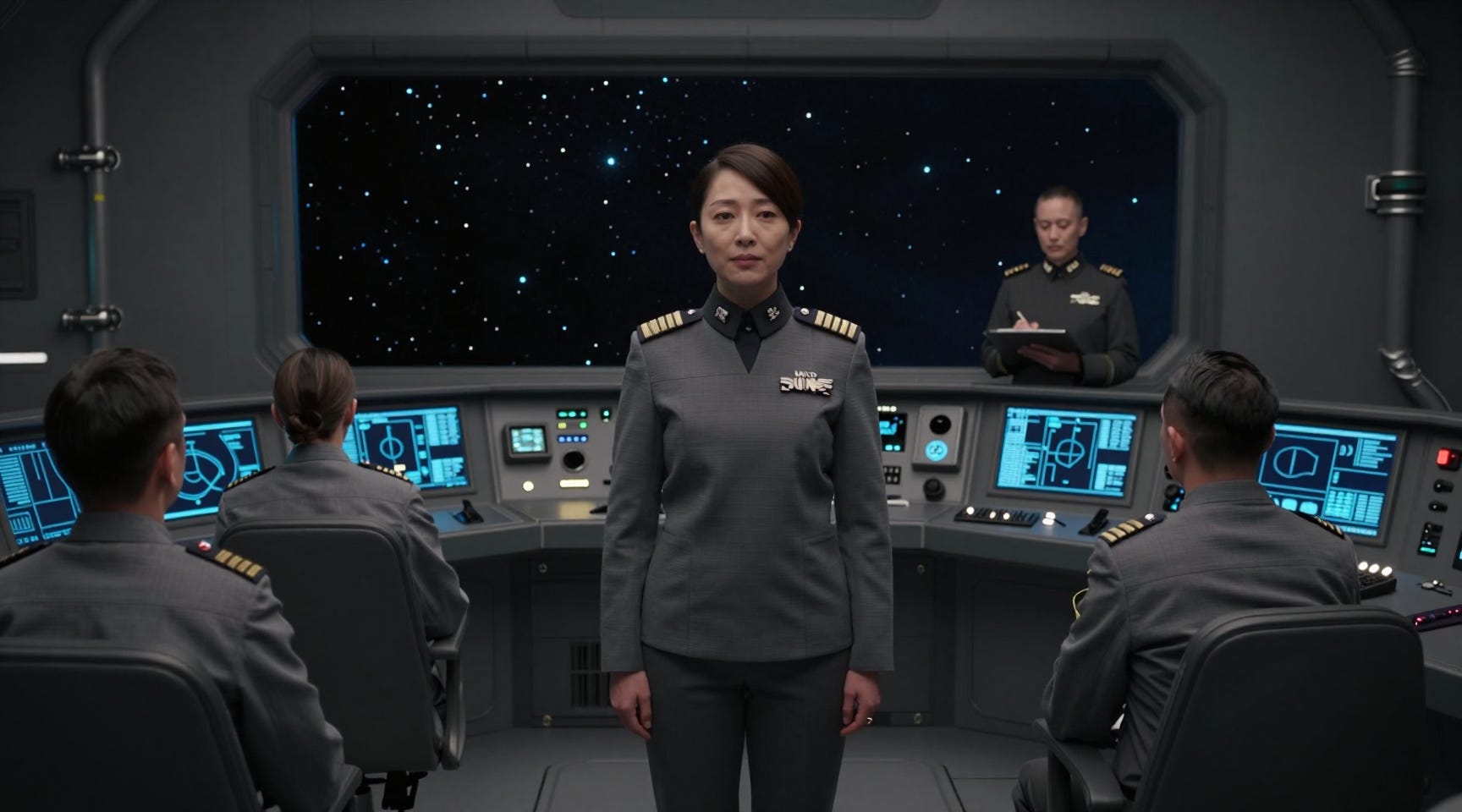
“Lieutenant Yamasaki,” she said, stepping over to the navigation station. “Any anomalies in the transit?”
The navigator looked up. She was young, the kind of ensign who sat a little straighter when the commanding officer addressed her directly. “No anomalies, Captain. The trajectory held within predicted parameters. Gravity readings matched the stellar maps within point zero three percent.”
Tanaka nodded. “Good work.”
She moved to the helm station. The helmsman was a lieutenant with eighteen years of Fleet service. He acknowledged her with a small nod and kept his hands on the controls.
“Plotting the next sector transit,” he said before she could ask. “Three-point-seven light-hours.”
“Thank you, Lieutenant.”
He paused. “Captain. May I ask something?”
“You may.”
“How long do you usually spend on each station during a shift change?”
“I suppose I had not counted.”
“You spend time, Captain. I have watched the bridge feeds from Prometheus. Captain Shaw reads the status reports and makes her acknowledgments in under a minute per station. Captain Rivera does not visit the stations at all during shift change unless there is a problem.”
“And I am slower than both of them.”
“You are different, Captain. Not slower. Different.”
She considered that. “Different is not always better, Lieutenant.”
“Different is not always worse either.”
The shift change continued. Tanaka finished the circuit of the bridge stations, stopping at each one, asking a question, listening to the answer, moving on. She did not schedule these rounds. It was simply how she ran her watch, and the crew had stopped being surprised by it.
The Fleet observer was in the back of the bridge.
Tanaka had registered her the moment the observer stepped through the hatch. A commander in a dress uniform that had never seen a combat station, standing against the rear bulkhead with a datapad and a pen. Her name was Commander Duvall. She was from Fleet Command’s readiness assessment division, evaluating the First Three’s operational integration.
The observer made notes. Tanaka did not look at her.
The watch settled into its rhythm. Tanaka took her position at the center of the bridge, the forward viewscreen showing the outer system’s slow wheel of stars. The patrol was uneventful. A quiet transit, a fleet still learning how to be a fleet.
The observer approached at the end of the watch.
“Captain Tanaka. Do you have a moment?”
“My ready room. Please.”
The ready room was small, as ready rooms on warships always were. A desk. A chair. A viewport that showed the star field. The bulkheads were bare. Tanaka had not put up any personal effects. She did not yet know who she was going to be as a captain. She did not want to commit to a version of herself that turned out to be wrong.
Commander Duvall closed the hatch behind them.
“I want to be clear,” Duvall said. “This is not a formal evaluation. But you asked me to be honest, and I owe you that honesty in return.”
“I did ask. Please.”
Duvall paused. “Your bridge style is more exploratory than tactical.”
The words hung in the small room. Tanaka said nothing.
“The way you interact with your crew,” Duvall continued. “The station visits. The questions. It is the style of a science vessel commander, not a warship captain. You treat your bridge like an expedition team. That works well on a survey mission. On a warship, it introduces delay. You lose seconds per interaction. In a combat situation, seconds matter.”
“You are saying I should change.”
“I am saying you should be aware of what you are trading. The warmth you create with your crew is real. It builds loyalty and trust. Those are combat assets. But they come at a cost to efficiency, and efficiency is also a combat asset.” Duvall closed her datapad. “That is all. The observation is offered, not filed.”
She left. Tanaka sat in the chair behind her desk and looked at the star field through the viewport.
She did not call Kira. Kira came anyway.
The hatch cycled open. Kira stepped inside, stopped at the threshold, read the room as she would read a tactical display. “The observer spoke to you.”
“She did.”
“Her assessment?”
“More exploratory than tactical.”
Kira’s expression did not change. Tanaka’s tone had carried the words before she spoke them. “And?”
“And I am asking myself whether she was right.”
Tanaka turned from the viewport. Kira was standing at the edge of the desk, not seated, a posture that said she was ready to stay for the conversation or leave if Tanaka needed the room.
“Commander,” Tanaka said. “You have been watching me command this ship for twenty-seven days. Was she right?”
“Captain. Your crew loves you. That is going to matter when something goes wrong. It is also going to slow you down by half a second on a bridge command. You will have to decide which one is worth more.”
Tanaka accepted the weight of Kira’s answer the way she would accept a course correction from her navigation officer.
“Half a second.”
“At most. Possibly less.”
“And if I change my style. If I become more efficient and less present. What do I lose?”
Kira considered the question carefully. “You lose the crew’s belief that you see them as people. It takes time to earn that back. Time you may not have if the silence ends.”
“Have you served under a captain who lost it?”
Kira’s expression flickered. “I have served under a captain who never had it to begin with.”
Tanaka nodded. She did not ask for the name. She did not need it.
Kira left. The hatch cycled closed. Tanaka turned back to the viewport.
She was the commander of a warship. She had been a scientist before she was a soldier, and the question she had not answered for herself was whether those two identities were compatible. Duvall had given her an honest observation. Kira had given her an honest assessment. The choice was hers, and she could not delegate it to a doctrine manual or a readiness review.
She thought about her mother’s origami. The crane her mother had folded for her on the morning of the invasion, the day the fleet died, the day Tanaka had stopped believing the universe was neutral. She kept it in the drawer of her desk, folded paper that had survived twelve years because someone had folded it with care.
She reached into the drawer. She did not take the crane out. She simply rested her hand near it, let the corner of the folded paper press against her fingers, and sat in the quiet of the ready room with the stars sliding past the viewport.
She would be different in a crisis than she was right now. She did not know yet what that would cost. She was certain only that the cost was worth paying, and that she would pay it when the time came, and that until then she would keep visiting each station during shift change and asking her crew the questions she would need to know the answers to when the silence ended.
If you enjoyed this story, you can follow the main story arc in The Exodus Rush, the first book in The Vethrak Requiem series.
‘