


Arash Colombo knew the color spectrum of Vethrak wreckage the way a jeweler knew gemstones. Silver-gray for structural plate. Blue-black for conduit housing. Pale green shimmer for sensor arrays. Every scrap that came through the sorting bench on Platform Kilo-9 fell into one of those categories, and every category had a price.
The fragment under his magnifier was none of those colors.
It sat in the magnetic clamp, fifteen centimeters long, roughly triangular, its surface a dark amber that shifted toward red when the work light hit it at certain angles. The edges were clean, not torn. Whatever process had separated this piece from a larger structure had been precise.
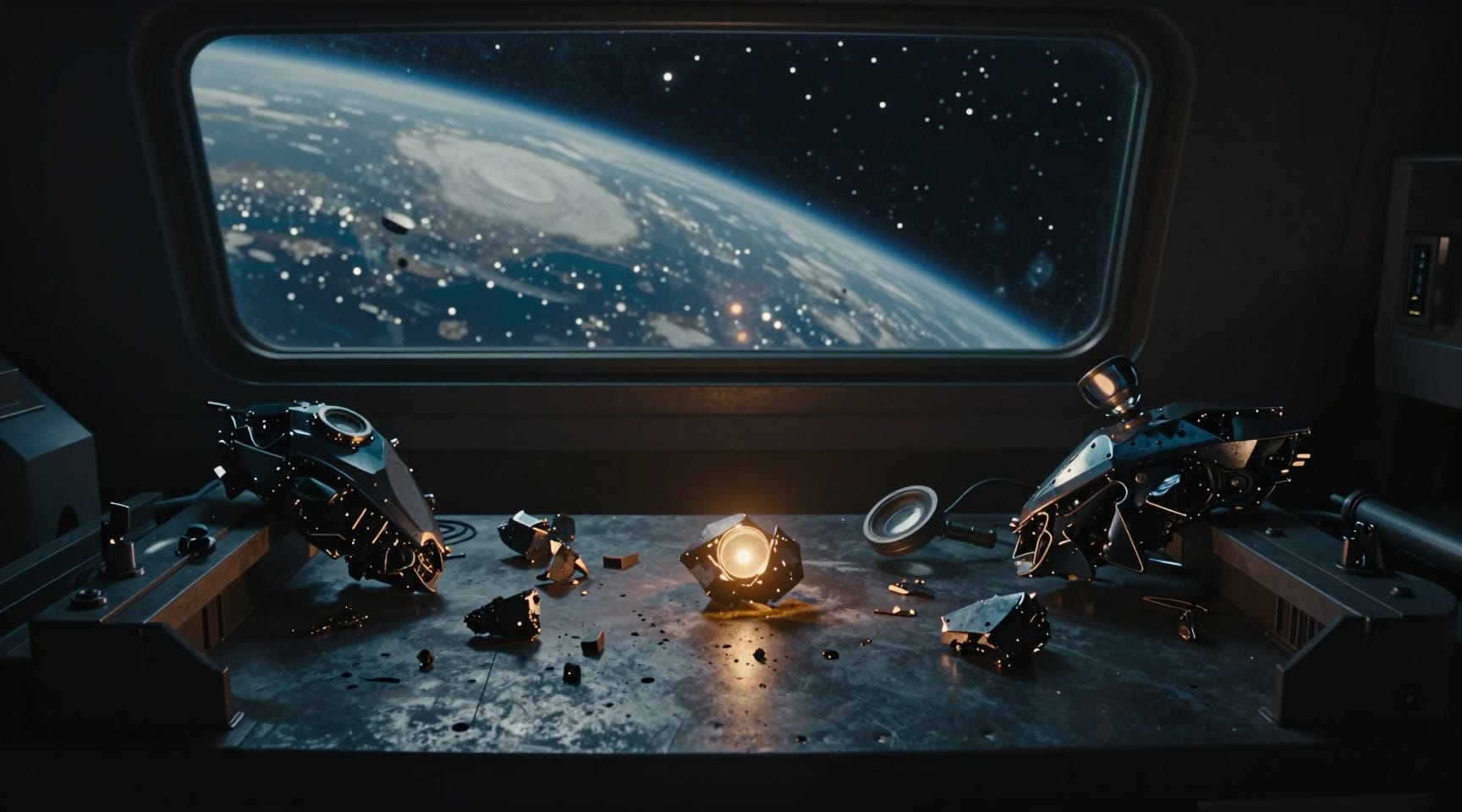
His dosimeter was silent. No radiation. The atmospheric sensors in his EVA hood showed clean. The standard protocol for unknown Vethrak material was straightforward: bag it, tag it, report it to the UEN Salvage Protocol office on Luna. In exchange, the UEN paid a finder’s fee of two hundred credits and a ninety-day extension on your salvage license.
Two hundred credits bought six days of supplemental rations.
Arash turned the fragment with his pliers. The amber surface caught light in a way that metal should not. The color deepened, brightened, shifted. Liquid behavior in a solid form. He had pulled eleven thousand pieces of Vethrak debris from the wreckage field around Earth over two years. None of them had done this.
He set his pliers down and checked the sorting bench’s local sensor array. Temperature reading: thirty-one degrees Celsius. Ambient in the work bay was fourteen. The fragment was generating its own heat.
Something was active inside it.
The sorting bay was empty. Third shift on Kilo-9 ran with a skeleton crew: four salvagers working the exterior arms, two sorters inside. His partner was on meal break in the mess, twenty minutes from returning. Twenty minutes of privacy.
Arash opened his comm to the encrypted channel. One ping. Linh Moreau answered in four seconds.
“Colombo. You’re early.”
“I pulled something.”
A pause. Linh ran the Iron Wake’s purchasing desk for the Earth-orbit debris sector. Everything the legitimate salvagers skimmed from their UEN-contracted hauls passed through her inventory before entering the network. Hull fragments became reactor shielding for unlicensed habitats. Conduit housings became components for black-market communication rigs. Sensor array pieces became the most valuable commodity of all: functional alien technology that human engineers could study, reverse-engineer, and sell to buyers who paid in resources no UEN allocation could match.
“Describe it.”
“Amber. Not metallic. Fifteen centimeters. Clean edges, not fractured. Generating heat. Thirty-one degrees against a fourteen-degree ambient.”
The silence lasted longer this time.
“Active material.” Linh’s voice dropped half a register. “You’re sure about the heat?”
“Confirmed on the bench sensor. Whatever this is, it’s powered. Internal energy source.”
“Bag it. Double containment. Electromagnetic shielding if you have it.”
“I have a standard ferrite sleeve.”
“Use it. Transit standard. I’ll have a pickup at your lock in six hours.”
“Linh.” He kept his voice even. “What is it?”
“I won’t know until I see it. Possibly a power regulation node. The Vethrak used distributed energy architecture. Each subsystem carried its own power source. The active ones are rare. We’ve recovered maybe forty across the entire debris field in two years.”
“The UEN finder’s fee for active material is different.”
“The UEN finder’s fee for active material is four hundred credits and a mandatory debriefing that includes a full audit of your salvage logs for the past six months.” Another pause. “Your logs wouldn’t survive that audit, Colombo. Neither would mine.”
His salvage logs showed eleven thousand pieces recovered and reported. The actual count was closer to fifteen thousand. Four thousand pieces had entered the Iron Wake’s pipeline, netting Arash a cumulative twenty-six thousand credits in barter value: medical supplies, food supplements, water filter cartridges, clothing, a replacement atmospheric processor for his family’s quarters on Armstrong Station. Twenty-six thousand credits worth of survival that the UEN’s tier-two allocation did not provide.
“What does the network pay for active material?”
“Depends on the component. A power node in working condition? Between eight and twelve thousand credits in trade value.”
Twelve thousand credits. His daughter Mira’s dental reconstruction had been on the Armstrong Station medical waitlist for nine months. Black-market dental work cost ten thousand. The medical officer had told him the longer they waited, the more complex the procedure became. Every month of delay added cost and risk.
“There’s a classification issue,” he said.
“There’s always a classification issue.”
“Active Vethrak technology in civilian hands. The UEN restricted it for a reason.”
“The UEN restricts everything for a reason. They restricted antibiotics for six months in Year One because the distribution logistics weren’t ready. People died of infections that a ten-credit course of amoxicillin would have cured.” Linh’s tone remained flat. Professional. The argument was rehearsed, delivered to every salvager who hesitated at the threshold. “The restriction isn’t about safety. It’s about control. The UEN wants to be the only entity that understands Vethrak technology. The Salvage Protocol labs have recovered three hundred active components. Their published research covers nine. The other two hundred ninety-one sit in classified storage while civilian engineers who could advance the science by decades wait for permission that will never come.”
Arash looked at the fragment. The amber glow pulsed, slow and steady. A heartbeat rhythm. Something inside it was alive in a way that defied the categories his training had provided: inert, degraded, hazardous, active. This piece was beyond active. It was doing something.
“Six hours,” he said.
“Six hours. Double containment. Ferrite sleeve.”
The channel closed. Arash pulled the ferrite sleeve from the equipment locker beneath the bench. The sleeve was designed for shielding sensitive electronics during transit, not for containing alien technology. It would block electromagnetic emissions. Thermal signatures would bleed through.
He bagged the fragment. The warmth pressed against his gloves through two layers of containment polymer. He sealed the bag, slid it into the sleeve, and stored the sleeve in his personal equipment locker. The lock engaged with a soft click.
His partner would return in twelve minutes. The sorting bench was clean. The work log showed eleven fragments processed during third shift, all inert, all standard classification. The amber piece did not exist in any record.
Arash returned to the bench and picked up his pliers. The next fragment in the processing queue was a silver-gray hull plate, thirty centimeters square, unremarkable. He clamped it, logged it, sorted it into the outgoing bin. Standard. Clean. Traceable.
Somewhere in his locker, the amber fragment pulsed with heat that did not belong to any system humans had built, and Arash Colombo added one more item to the list of things the official record would never contain.
Twelve thousand credits. Mira’s surgery. The math was clean.
Everything else was not.
Author’s Note: Two years after the invasion, Earth’s orbital debris field was the largest graveyard in human history and the richest salvage ground the species had ever known. Thousands of workers pulled Vethrak wreckage from orbit under UEN contract, sorting alien materials for study and repurposing. The Iron Wake, a black-market salvage network that emerged in Year One, ran its operations through the same platforms and the same workers, skimming pieces that bypassed official channels and entered a parallel economy where Vethrak technology moved based on price rather than protocol. Most of what they sold was inert. The active pieces, the components still carrying energy from power sources humanity did not understand, commanded prices that could change a family’s life. They also entered a supply chain no one controlled, moving from broker to buyer without oversight, toward purposes that ranged from legitimate research to weapons development.
If you enjoyed this story, you can follow the main story arc in The Exodus Rush, the first book in The Vethrak Requiem series.