


The manifest listed forty-eight canisters of cascade reactor coolant. Paz Blackwood counted them twice, running her hand along each pressure seal in the cargo hold of the Brisa, her fingers finding the grooves where UEN logistics had stamped batch numbers into the metal. Forty-eight canisters. Enough to keep Settlement Kairos-7’s reactor running within safe thermal margins for another eleven weeks.
The Blackshore Ring wanted six.
She closed the manifest on her datapad and sat on the cargo hold’s fold-down bench. The Brisa hummed around her, a twenty-year-old cargo shuttle that had been an ore hauler before the invasion and a refugee transport after. Now it carried whatever the UEN logistics office told it to carry, which on this run meant coolant from Titan Depot to Kairos-7, a mining settlement turned refugee camp on Titan’s northern highlands.
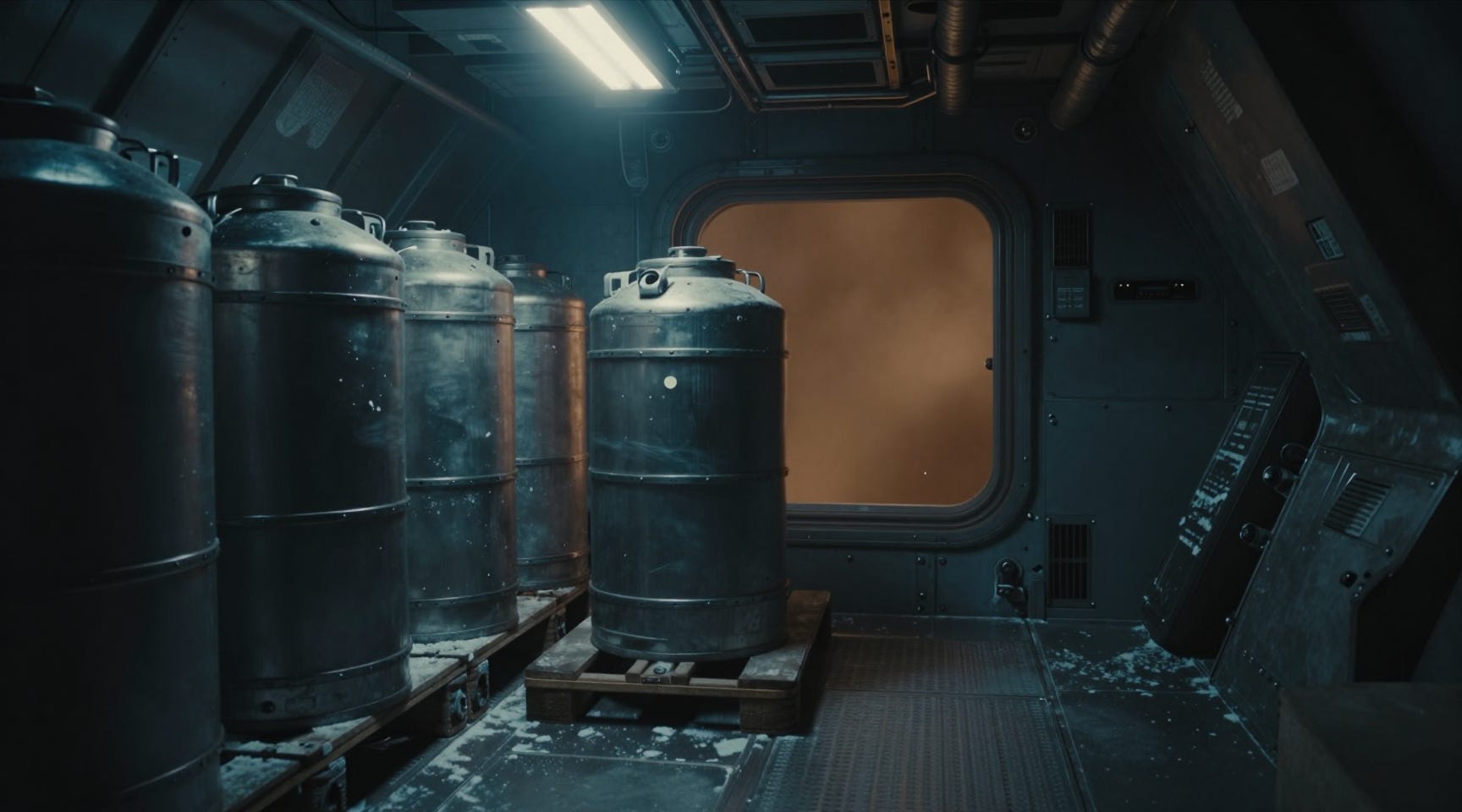
Six canisters. Twelve and a half percent of the shipment. The Blackshore Ring had calculated the number with the same precision they brought to everything: enough to matter, not enough to trigger an automatic audit. UEN logistics flagged discrepancies above fifteen percent. Below that threshold, losses were attributed to transit damage, seal failure, or handling error. The system was built on acceptable loss.
Paz had made three holdback runs before this one. Ration packs twice, water purification filters once. Each time, the math worked the same way. She filed a transit loss report. The UEN adjusted the next shipment upward by a percentage point. Kairos-7 received slightly less than expected, absorbed the shortage, and waited for the next delivery. Camp Oleander, two hundred refugees living in a decommissioned bore station forty kilometers south of any sanctioned settlement, received what the official system refused to acknowledge they needed.
The UEN did not recognize Camp Oleander. The refugees there had arrived too late for the first registration wave, filtered through a dozen temporary shelters before finding the abandoned bore station, and built something fragile in a place that did not appear on any official map. No registration meant no ration allocation. No allocation meant no supplies. The Blackshore Ring filled that gap, skimming from legitimate shipments and rerouting the margin to the camps the bureaucracy could not see.
Three runs. Ration packs and filters. Fungible goods, replaceable on the next cycle, absorbed into the noise of a logistics system already drowning in shortages. Coolant was different.
Cascade reactor coolant was manufactured at two facilities in the inner system. Production had dropped sixty percent since the invasion. Every canister in the solar system was tracked, serialized, allocated months in advance. There was no surplus. There was no noise to hide in. Six canisters missing from Kairos-7’s shipment would not be absorbed. They would be noticed.
Paz pulled up Camp Oleander’s last status report on her datapad. The Blackshore Ring maintained its own network of updates, encrypted and routed through a chain of relay nodes scattered across Titan’s surface. The report was three days old. Camp Oleander’s reactor was running at ninety-four percent thermal capacity. Safe operating range topped out at eighty-nine percent. Without fresh coolant, the reactor would cross into critical thermal territory within six days. At that point, the automated safety protocols would begin shedding load: heating first, then water recycling, then atmospheric processing. Two hundred people in a pressurized shell on a moon where the surface temperature was negative one hundred seventy-nine degrees Celsius.
Six canisters would bring the reactor back to safe margins for eight weeks. Eight weeks during which the Blackshore Ring could find another source, file fraudulent requisition papers, or negotiate with one of the other syndicates running parallel supply chains across Saturn’s moons.
Six canisters missing from Kairos-7 would reduce their eleven-week margin to nine. Tight, not critical. The settlement had engineers who knew how to optimize coolant cycling, stretch the resource further than the manufacturer’s specifications allowed. They would manage. Probably.
Paz stood and walked to the forward section of the cargo hold. The six canisters the Ring wanted were already marked. Small adhesive dots on the pressure seals, placed there by someone at Titan Depot before the shipment loaded. The Blackshore Ring had people everywhere: depot workers, shuttle mechanics, logistics clerks. The network was invisible until you knew what to look for, and then it was everywhere, threaded through the same infrastructure that kept the sanctioned settlements alive.
She peeled one of the dots off a canister and held it between her fingers. A circle of adhesive film, smaller than her thumbnail. The entire operation came down to these marks. Someone at the depot flagged the canisters. She diverted them during transit. A contact at the Oleander drop point received them. The supply chain was clean, efficient, precise.
Her comm chimed. The channel was encrypted, routed through the relay network.
“Brisa, confirm holdback.” The voice was flat, professional. No names on the relay channels. The Blackshore Ring ran clean operational security.
Paz looked at the forty-eight canisters. She looked at the adhesive dot in her fingers.
“Confirmed,” she said. “Six units. Oleander drop, standard coordinates.”
“Copy. Transit window opens in four hours. Oleander contact will be at the coordinates.”
The channel closed. Paz walked back to the marked canisters and began disconnecting their cargo locks from the main pallet. Each canister weighed thirty-one kilograms in Titan’s gravity. She could move them by hand into the secondary hold, where they would sit behind a false cargo divider installed three months ago by a mechanic who owed the Ring a favor.
She worked in silence. The Brisa’s ventilation pushed cold, recycled air through the hold. Her breath fogged as she lifted each canister free.
Six canisters. Nine weeks instead of eleven. Two hundred people alive for eight more.
The transit loss report was already drafted on her datapad. Pressure seal failure during loading. Standard form. Standard language. She had used the same template three times before. The system accepted it every time, absorbed it into the acceptable margin, and moved on.
Paz loaded the last canister into the secondary hold and sealed the divider. She returned to the main cargo bay and counted the remaining forty-two canisters. The pallet looked undisturbed. The manifest would need adjusting, numbers shifted to match the official story.
She sat on the bench and opened the report. The cursor blinked. She typed the first line of the damage narrative, the familiar fiction that kept the system from asking questions it did not want answered.
Somewhere in a decommissioned bore station forty kilometers off any map, a reactor ran hot, and two hundred people breathed recycled air that nobody in the official system knew existed.
Paz filed the report and powered up the Brisa’s engines. Camp Oleander first. Kairos-7 after. The flight plan logged as a standard delivery route, one stop, forty-two canisters. Clean.
The six in the secondary hold did not exist. They had never existed. That was the holdback’s final trick: not theft, not diversion. Erasure. The canisters vanished into a system that had no language for what happened to them, and Paz vanished with them, one more pilot running one more cargo route on a moon that had too many people and not enough of everything.
Author’s Note: By Year 3 Post-Invasion, Titan’s population had swelled far beyond its infrastructure’s capacity. Sanctioned settlements struggled with rationing, while unsanctioned camps like Oleander existed in a bureaucratic blind spot, invisible to the UEN’s allocation system. The Blackshore Ring was one of several syndicates that emerged to exploit the gap between official supply chains and actual need, building parallel distribution networks across Saturn’s moons. Their methods were criminal. Their results kept people alive. That contradiction defined the post-invasion underworld.
If you enjoyed this story, you can follow the main story arc in The Exodus Rush, the first book in The Vethrak Requiem series.