


Navid Erdem found the anomaly on a Tuesday, buried in three weeks of thermal exhaust logs that nobody else had bothered to read.
He sat in the atmospheric monitoring bay on Pallas Station’s maintenance level, surrounded by screens displaying gas mix ratios, scrubber throughput, and the steady pulse of the station’s life-support backbone. The bay smelled of ozone and the faint chemical bite of filtration medium that needed replacing two cycles ago. His shift covered Sectors 9 through 14, six residential blocks housing roughly four thousand people whose continued breathing depended on equipment older than most of their children.
The thermal exhaust data for Sector 12 was wrong. Not dramatically wrong. The kind of wrong that hid inside acceptable tolerances if you only glanced at the daily summaries. The waste heat venting from the sector’s secondary scrubber array was running six percent below expected output. Six percent didn’t trigger automated alerts. Six percent fell within the variance window that the monitoring system classified as Normal, Aging Infrastructure.
Navid didn’t glance at daily summaries. He read the raw logs. He’d been reading them for nine years, ever since Pallas Station had absorbed twelve hundred refugees from the Interamnia consolidation and his maintenance team had shrunk from eight technicians to three.
Six percent of waste heat from a secondary scrubber array. The heat had to go somewhere. Thermodynamics didn’t negotiate.
He traced the exhaust routing through the station’s infrastructure schematic. The secondary array vented through a series of thermal conduits that ran behind Sector 12’s lower residential blocks before reaching the exterior radiator panels. The conduits passed through a maintenance corridor on Level Four that Navid’s team inspected quarterly.
The last quarterly inspection had been five months ago. Budget cuts had pushed the schedule.
He pulled the corridor’s access logs. Standard maintenance traffic for the first three months. Then, eleven weeks ago, a spike. Multiple entries during third shift, all using a general-access maintenance credential that half the station’s repair staff shared. The credential was legitimate. The frequency was not.
Navid closed the log viewer and opened the scrubber performance data for Sector 12. Filtration efficiency: 91.3 percent. Acceptable. Twelve months ago, the same array had run at 94.1 percent. The decline tracked almost perfectly with the thermal anomaly.
Someone was siphoning waste heat from the conduits, and the scrubbers were working harder to compensate. Working harder meant shorter filter life. Shorter filter life meant more replacement medium. More replacement medium meant a requisition that Navid’s budget couldn’t cover, which meant Sector 12’s four hundred residents would breathe slightly dirtier air for slightly longer intervals while the procurement queue advanced at its usual glacial pace.
He should file a maintenance report. Flag the thermal discrepancy, request a corridor inspection, let the infrastructure team trace the tap. Standard procedure. Clean paperwork.
Instead, he pulled on his jacket and walked to Level Four.
The maintenance corridor behind Sector 12’s residential block was narrow, warm, and humming with the vibration of thermal conduits running at full capacity. Navid followed the overhead piping with a handheld thermal scanner, watching the temperature readings as he moved deeper into the corridor.
He found the tap sixty meters in.
Someone had welded a secondary junction onto the main exhaust conduit. Professional work. Clean seams, proper insulation wrap, a flow regulator that modulated the heat draw to stay within the monitoring system’s tolerance window. The tapped conduit ran through the corridor wall into what the station schematic listed as an abandoned storage compartment.
The compartment door was unlocked. Navid pushed it open.
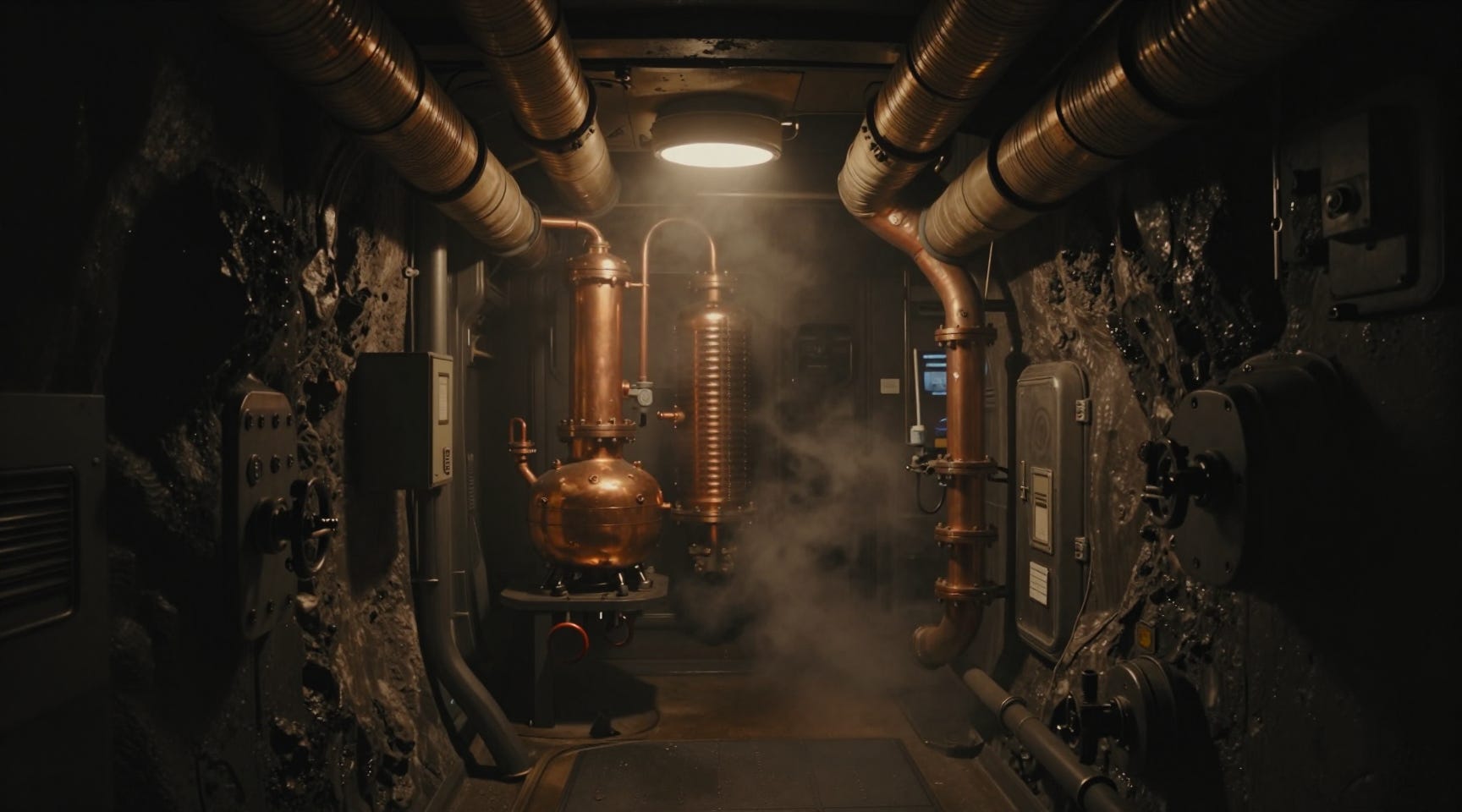
The smell hit him first. Sharp, sweet, chemical. Ethanol. The compartment had been converted into a distillation operation. Three copper-alloy stills sat on fabricated platforms, their condensation coils gleaming under low-wattage work lights. The waste heat from the tapped conduit fed a radiator array beneath the stills, maintaining the precise temperature differential that drove the distillation process. Fermentation tanks lined the far wall, their contents sourced from what looked like diverted agricultural substrate. The output collected in sealed containers marked with a stamped logo: a circle bisected by a vertical line.
Navid recognized the mark. The Meridian. A crew that had been moving barter goods through the belt stations for at least two years. He’d heard the name in the commissary, in the kind of conversations that stopped when station security walked past. They dealt in fungible commodities: things that held value regardless of which station’s ration system you were plugged into. Distilled spirits qualified. A liter of clean ethanol was worth three days of protein rations on the open market. Medicinal grade fetched more.
A woman stepped out from behind the fermentation tanks. Short, broad-shouldered, with the calloused hands of someone who worked with tools for a living. She held a wrench the way a person held a wrench when they were deciding whether it was a wrench or a weapon.
“Atmospheric maintenance,” she said. Not a question.
“Navid Erdem. Sectors 9 through 14.”
“Bontle Kiprop. You found the tap.”
“Your flow regulator is good. Your timing isn’t. The scrubbers in Sector 12 are losing efficiency. Another two months and the filtration drop will cross the threshold for automated flagging. Then it’s not me standing in your doorway. It’s station security.”
Bontle set the wrench on the nearest still. “How much efficiency?”
“Two point eight percent and falling. The scrubbers compensate for the heat loss by cycling harder, which burns through filter medium faster. I can’t requisition replacements fast enough to keep pace.”
“What if the filter medium showed up outside the requisition system?”
Navid stared at her. “You have access to atmospheric filter medium.”
“The Meridian moves what people need. Filters, medical alcohol, fermentation cultures, sealing compound. Half of what keeps this station running doesn’t come through official channels anymore. The procurement system is eighteen months behind demand. You know this.”
He did know this. He submitted requisitions that disappeared into processing queues. He filed priority requests that returned with Deferred stamps. He maintained equipment with parts that should have been replaced two years ago, and when the parts finally failed, he scavenged replacements from decommissioned hardware that the salvage teams hadn’t reached yet.
“The clinic on Level Six,” he said. “Dr. Okonkwo has been rationing isopropyl for sterilization. She told me last month she was diluting surgical prep solution to stretch her supply.”
“We deliver twelve liters of medicinal-grade ethanol to her clinic every two weeks. Gratis. No barter required. Bontle tapped the nearest still. “This one produces exclusively for medical use. The other two cover trade stock.”
“Gratis.”
“The Meridian isn’t charity. We operate on margin, same as everyone. The clinic deliveries buy goodwill. Goodwill buys silence. Silence keeps the stills running.” She paused. “It also keeps four hundred people in Sector 12 with access to a clinic that can actually sterilize its instruments.”
Navid looked at the thermal tap. Clean welds. Professional insulation. A flow regulator that someone had calibrated with precision, dialed to extract the maximum usable heat without tripping the monitoring system’s automated alerts. The work of someone who understood the infrastructure as well as he did.
“Your regulator is pulling too hard,” he said. “The six percent draw was fine when the scrubber filters were fresh. They’re degraded now. You need to drop to four percent or the efficiency loss accelerates.”
Bontle’s expression shifted. The wariness didn’t leave, but something else settled beside it. Calculation. “Four percent reduces output by a third. We’d lose one still.”
“Keep three stills and lose the sector’s scrubbers in six months, or drop to two stills and keep the air clean. The math isn’t complicated.”
“The math is never complicated. The people depending on the output are.”
Navid walked to the flow regulator. He studied the calibration settings, the pressure gauges, the thermal differential readout. The installation was competent. More than competent. Whoever had designed this system understood waste heat recovery at a level that suggested formal engineering training.
“I can recalibrate your regulator to optimize the reduced draw,” he said. “Four percent extraction with better thermal cycling will recover some of the lost output. You won’t get three stills, but you’ll get closer to two and a half.”
Bontle watched him. “Why?”
“Dr. Okonkwo dilutes her surgical prep because the procurement system failed her. Your stills fix that. My scrubbers keep four hundred people breathing. If I file a maintenance report, security shuts you down, the clinic loses its supply, and I still can’t get replacement filters through requisition. Everyone loses.”
“Everyone except the maintenance report.”
“The maintenance report doesn’t breathe.”
He adjusted the flow regulator. The thermal readout dropped, stabilized, and settled into a new rhythm. The conduit’s waste heat output would recover over the next week as the reduced draw allowed the scrubber array to cycle at closer to its designed efficiency. Sector 12’s air would improve. Not to specification. Nothing on Pallas Station ran to specification anymore. Close enough.
Bontle handed him a sealed container. Small. Half a liter. “Medical grade. For the corridor inspection you’re about to not file.”
Navid took the container. It was warm from the still’s residual heat. “I’ll need to inspect this corridor quarterly. Officially. The inspection report will note standard thermal variance within acceptable parameters.”
“And unofficially?”
“Unofficially, I’ll check your regulator calibration each time. The conduit insulation will need reinforcement before winter cycling increases the station’s baseline heat load. If the draw pushes above four percent, I’ll know.”
He walked back through the corridor, past the humming conduits and the warm metal walls, carrying half a liter of ethanol that would reach Dr. Okonkwo’s clinic by morning. Behind him, the stills continued their quiet work, converting stolen heat into liquid currency, feeding a barter economy that existed because the official one had stopped reaching the people who needed it most.
His shift report that evening noted the thermal variance in Sector 12’s exhaust logs. Cause: aging conduit insulation consistent with deferred maintenance schedule. Recommendation: monitor and reassess at next quarterly inspection.
The lie fit inside a maintenance code. It smelled like ethanol and tasted like compromise, and it would keep the air clean and the clinic supplied for another three months.
After that, he’d recalibrate again.
Author’s Note: Pallas Station sits in the asteroid belt, far enough from Earth and Mars that supply shipments arrive on schedules measured in months, not weeks. The official procurement system was designed for a smaller population with better-funded infrastructure. Fifteen years after the invasion, the system serves four times the people with half the budget, and the gaps between what’s needed and what’s delivered have become permanent features of daily life. The Meridian fills those gaps the way every syndicate crew fills them: by moving goods outside official channels, taking margin where they can, and making themselves necessary enough that the people who should report them find reasons not to. Navid’s choice isn’t heroic. It’s arithmetic. The stills produce what the procurement system won’t, and the scrubbers need to keep running either way.
If you enjoyed this story, you can follow the main story arc in The Exodus Rush, the first book in The Vethrak Requiem series.