


Thomas Okonkwo had the sample out of its housing before the technician finished putting on her gloves.
He caught the inert block against his palm, stopped its drift with his other hand, and clipped it to the bench tether. The release had moved cleanly. Nothing dragged against the guides. Behind the open housing, the joint engineering workspace carried on without taking notice: a ventilation fan, the soft knock of a secured tool against its holder, someone asking for a drawing at the far end of the room.
“That’s the removal,” he said.
The technician flexed her fingers inside the gloves. “From the beginning?”
Thomas looked at the block hanging within the short reach of its tether. He had meant to save her the explanation of something she already knew. Instead, he had removed the thing she had come to remove.
“From the beginning.”
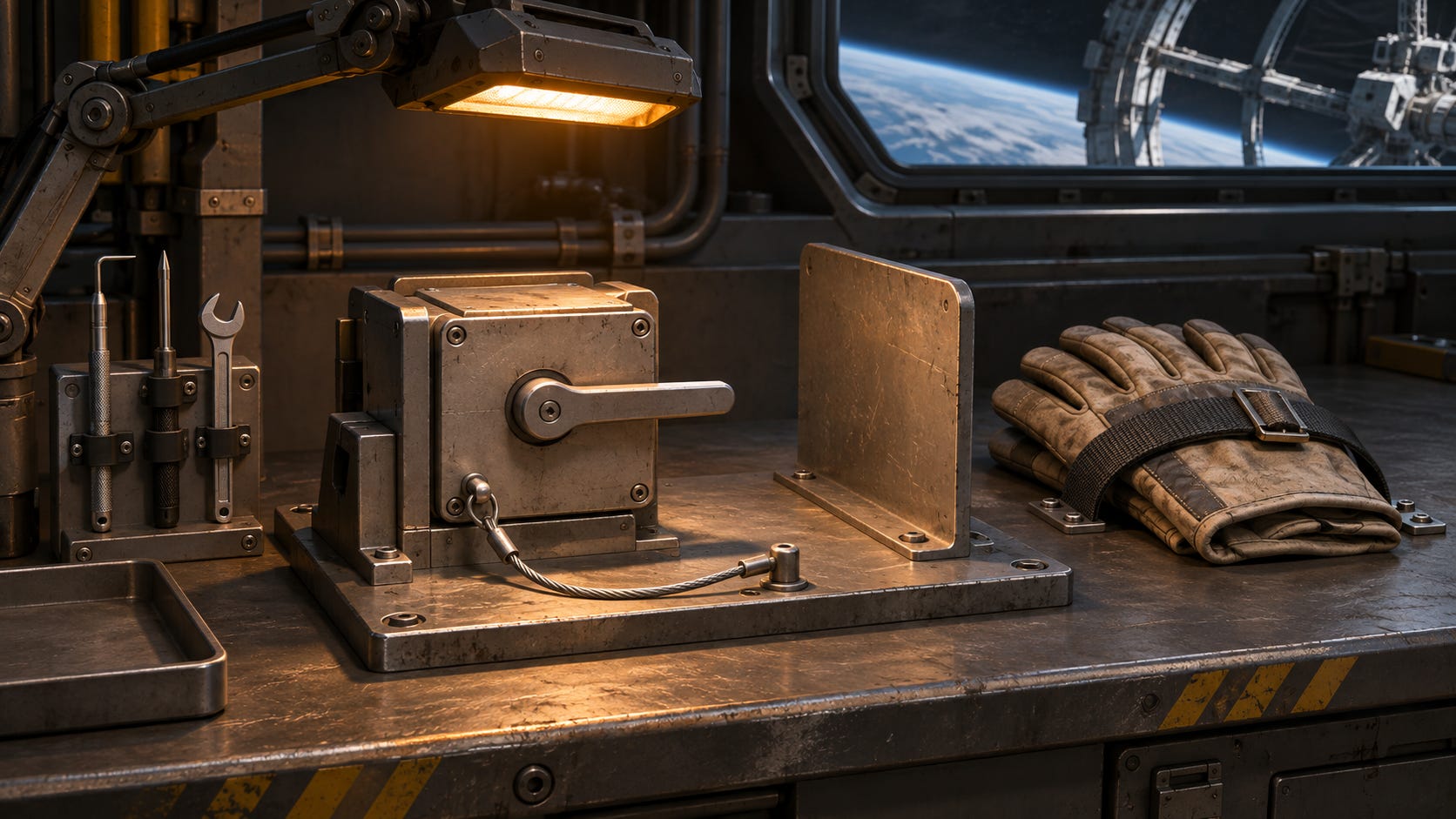
He guided the block back into the housing until the latch caught. The fixture was fastened to a bench in Prometheus’s industrial core, where an unsecured part would go on traveling after a careless touch. He checked the restraints again. His feet held in the work position beneath the bench. The technician secured herself at the adjacent position and drew the procedure toward her on its articulated holder.
The sample contained no working assembly. Its blank rear face had no connected services, and the fixture had been isolated before either of them arrived. This was an exercise in reaching, releasing, and retaining an inert shape. The difficult engineering had already happened elsewhere. Thomas had expected the demonstration to occupy the quiet space between two harder jobs.
The technician read the isolation step aloud, checked it against the fixture, and attached the retaining tether. She touched the housing’s side to steady herself. Her other hand went into the gap beside the release.
It stopped.
She withdrew it, changed the angle of her wrist, and tried again. The glove brushed the neighboring plate with a dry scraping sound. Her fingertips reached the handle, but the rest of her hand remained outside.
“Bring your thumb under,” Thomas said.
“I can’t close it there.”
“A little farther in.”
She looked at him. Then she brought her hand out and held it beside the opening, thumb extended, showing him the space it would have to occupy.
“The plate is where my thumb goes.”
Thomas reached toward the rig before he had decided to move. The technician took her hand away to give him room.
His bare fingers fitted behind the handle. The familiar catch found the joint of his index finger. He could have drawn it outward and rolled the block free in one movement. He had done it enough times while assembling the fixture that his body supplied the next motion without asking.
The technician waited.
Thomas removed his hand.
“Show me where it stops.”
She returned to the opening. This time he watched the glove rather than the latch.
The reinforced fold at her thumb met the plate before her fingers curled around the release. She could touch it. She could even move it a little by pulling with her fingertips. She could not hold it in the position needed to free the block while keeping a controlled grip.
The distinction was small enough to disappear from his demonstration. It was large enough to stop hers completely.
He brought the procedure closer. The glove requirement was there. He had read it when he prepared the exercise. He had put a pair in the equipment tray himself, fastening them beneath the retaining strap with the other items she would need.
His own pair was still under that strap.
“I left those off,” he said.
“You did.”
No accusation. Her attention had returned to the latch, which made the answer harder to dismiss.
Thomas pulled the gloves free. “Let me check the fit.”
She moved to release her foot restraint.
“Stay there,” he said. “I meant mine.”
He put on the gloves at his own station, seating each finger carefully. They fitted. Nothing bunched at the tips. When he brought his hand to the same gap, the padded thumb stopped him short.
There was a way to hook the handle with two fingers. He could feel it, an awkward variation on the movement he already knew. His wrist wanted to twist, and the edge of the opening pressed against the back of the glove. A practiced pull might do it.
He withdrew his hand before trying.
The technician was watching his wrist.
“Is that the way we’re meant to do it?” she asked.
He could have said it depended on the operator. Different hands, different habits. He could have shown her the motion slowly and let the success stand for both of them. The little bench would be available for its next user, and his exercise would join the completed work waiting on his pad.
He turned the pad away from its completion page.
“I don’t know yet.”
They left the sample latched in place while Thomas found a blank observation sheet.
The technician loosened her shoulders within the restraint. She had come with a small case of her own work, secured now against the bench leg. The case had remained closed throughout his demonstration. At the next bench, someone finished an assembly and began clearing space for the person waiting behind them.
“I can come back,” she said.
Thomas glanced at the waiting case. “Have you got another assignment?”
“Several. This was the one that needed your fixture.”
He disliked how readily the words became a defense in his head. Everyone had several assignments. Everyone was borrowing time from a larger task. He had made this fixture usable to himself before asking her to try it, which was more preparation than some exercises received.
The thought offered him nothing useful.
“How much of this did you expect to finish today?”
“The removal. The return check. Enough that I could take the notes back and explain what we’d actually tried.”
“You can take the failed attempt.”
She glanced at the empty sheet. “With what written against it?”
Thomas held the stylus above the first field. Operator unable to release sample. The wording arrived whole, convenient and ugly. It named the person who had met the obstruction and left out the person who had built it.
He wrote that the required glove prevented a full grip in the fixture’s present arrangement. Beneath it he recorded his initial bare-hand demonstration. He turned the holder so she could read both lines.
“That,” he said.
She read it twice. “The fingers get in. The thumb doesn’t. Someone reading that might think I couldn’t reach the handle at all.”
He added the distinction. “Anything else?”
“I can pull it partway. I can’t keep hold through the release.”
He recorded that too.
Across the room a tool holder clicked shut. Thomas had helped make this workspace a place where people could bring incompatible methods to the same bench. He knew how much depended on a description surviving the journey between the person who wrote it and the person who used it. Here, with a familiar latch and a human hand, he had stopped making the journey himself.
The technician pointed at the procedure. “It says maintain control of the sample. If I use my other hand to get the release, what holds the sample?”
“The tether retains it.”
“Retains it if I let go. That’s different from controlling it.”
He looked at the short tether, then at the sample’s exposed face. She had followed the instructions in the order he intended. One hand kept the block steady; the other operated the release. Borrowing the first hand to rescue the second would change the task.
“Keep that hand where the procedure puts it,” he said.
“Then I need room here.”
She held her gloved hand beside the plate again. Thomas resisted the urge to position it for her. Her thumb moved through the arc she needed, then stopped against the obstruction. The gesture gave him more information than his successful demonstration had.
He drew the housing and the neighboring plate as separate shapes. The drawing was crude, but it put the obstruction where it belonged. He asked her to mark the place her glove touched. She took the stylus without removing either glove and added a short line.
“There. After that I turn my wrist, which brings this part against the edge.”
She marked the second contact.
Thomas had planned to send a simple completion record. Now he needed a drawing, the fixture arrangement, the glove used, and a description of an attempt that had produced no removed part. He added those items to the sheet while the technician watched the housing.
“We could take the plate off,” she said.
He considered it. The plate was a removable boundary in the training fixture, not part of a live installation. Removing it would give them all the access they wanted. It would also remove the reason for the exercise.
“We’d show that the handle works in open space.”
“Which you’ve already shown.”
“With the wrong hands.”
She glanced at his gloves. A small smile reached her mouth and went away before it could soften the problem.
“We could move the housing away from it,” she said. “Keep both in the test.”
Thomas looked along the fixture’s mounting rail. There was room to change the relative position without changing the latch or pretending a nearby surface no longer existed. They could record that arrangement as a bench condition and leave the question of any actual installation to the people responsible for reviewing one.
“Yes,” he said. “After we record where it is now.”
The technician brought the measuring tool out of its keeper. He almost took it from her.
Instead, he held the drawing flat while she established the reference faces.
They did not move anything until the original arrangement existed on the sheet in terms another person could reconstruct.
Thomas checked the sketch against the fixture. The technician read back the distances she had recorded, pointing to each reference face rather than trusting that his understanding of the drawing matched hers. He caught one reversed arrow. She corrected it and checked the other arrows herself.
The exercise was taking longer than the removal ever could. That was partly the obstruction. The rest was his preparation catching up with the work.
A worker arrived at the end of the bench with a restrained tray and looked from Thomas to the secured sample.
“Are you keeping this position?”
Thomas checked the reservation on the bench display. His remaining time was shorter than the work he had now admitted needing. The next user had arrived ready, their pieces clipped in sequence along the tray. Asking them to wait would be easy. Most people did not argue when he said an engineering check needed more time.
“We need to change the fixture and make another attempt,” he said. “We won’t finish in the space I booked.”
The worker looked toward the far end of the room. “I need the mount. I can lay out over there first.”
“How long does that give us?”
They indicated their layout work, then the shared clock. A modest interval, offered with a clear limit.
Thomas entered the revised end time on his notes. “If we aren’t clear, we secure this and stop.”
The worker took the tray to the other bench.
The technician waited until they were out of easy hearing. “We can leave it failed.”
“We can.”
“I mean it. I don’t need a successful attempt for my notes.”
He understood what she was asking. She had spent the first part of the exercise trying to reproduce his success. Now she needed to know whether he would let her take back something else.
“The first arrangement failed,” he said. “A different arrangement won’t erase that.”
He put a second heading on the sheet. Proposed bench arrangement. The first heading stayed visible above it.
They retained the housing before loosening its mounts. The technician controlled the fixture while Thomas released the fasteners, keeping each captive in its fitting. In the core’s weightlessness, resistance to a push could masquerade as support. He checked the retaining line, then his own restraint, before easing the housing along the rail.
The neighboring plate remained in place. The gap widened slowly.
“Here?” he asked.
The technician brought her gloved hand toward the opening, then stopped short of touching anything.
“Secure it first.”
Thomas tightened the mounts. He tested the housing against the rail and checked that the sample was still latched.
“Ready.”
She entered the gap. Her thumb passed the plate this time. Her fingers closed around the release.
Thomas moved his hand toward the sample’s face, intending to steady it as she pulled. Her free hand was already there. He stopped himself and caught the bench rail instead.
The latch moved. The block came forward a short distance and stopped against the limits of her grip. She held it still.
“What’s stopping you?” he asked.
“My wrist. I can open the handle. I can’t bring the unit out while keeping that angle.”
From where he stood, the gap looked generous. He moved his head to the side without touching the fixture. The glove cuff met the plate as her hand followed the block outward. They had allowed room to take the grip and forgotten the space needed to use it.
She guided the block back until the latch engaged, checked it, and withdrew her hand.
Thomas put the partial movement in the second record. He wanted to cross out the new gap and move immediately to one that worked. Doing that would make the sheet cleaner and the afternoon harder to understand.
He kept the measurement.
“I was looking at the start of the movement,” he said.
“I was too.”
She drew the path of her wrist beyond the handle. The curve crossed the plate’s outline. Thomas followed it with the tip of his stylus, then stopped before adding anything.
“Show me the whole motion outside the rig.”
She did it slowly, with both gloved hands, maintaining the relationship between the hand on the release and the hand controlling the block. Without the fixture between them, the motion looked ordinary. Inside it, every part of that ordinary movement needed somewhere to go.
They marked the needed access as a proposed envelope around the working hand. No safety limit, no promise about every operator. A record of this glove, this task, and the room this attempt had lacked.
The worker at the other bench had begun fitting pieces together. Thomas checked the clock. They had time to reposition once more, secure everything, and try. They did not have time for him to make the result happen by becoming half of the operator.
He told the technician exactly that.
“Then stay on the sheet,” she said.
The third arrangement gave her hand room to travel with the sample.
Thomas verified the mounts after the move and asked her to check his work. She tested the fixture, followed the retaining line to its attachment, and read the isolation step again. Nothing in the repeated preparation was dramatic. The room had not quieted for them. Somewhere behind him, a pair of engineers disagreed about which drawing revision belonged beside a disassembled bracket.
Thomas kept the record holder against the rail in front of him. His hands rested on its edges.
The technician approached the handle.
He knew where he would put his thumb. He knew the slight pull that would take the load off the catch. The words reached the back of his teeth. He held them there.
She adjusted her grip without looking at him. The glove brushed the plate, then moved clear. Her other hand settled against the sample’s face. She operated the release, drew the block along its guides, and stopped with it fully clear of the housing.
The tether remained slack within its short reach. The block stayed between her hands.
Thomas looked at the empty housing. A moment ago he had been waiting for the task to work. Now he had to attend to what working meant: the release had traveled, the sample had cleared the guides, and she had retained control without a second operator entering the fixture.
“Complete,” she said.
He entered the result.
She clipped the sample into its keeper and eased her fingers open. The glove recovered its shape slowly where she had bent it.
“Any contact during the removal?” he asked.
“A brush at the beginning. None once I had the grip.”
“Any point you needed another hand?”
She looked at him, then at the sheet. “No.”
He wrote that as her observation, then added what he had watched. It would have been pleasing to call the procedure corrected. The fixture in front of them was a model, altered at a bench. Nobody had checked whether that space existed in an installed arrangement, or what would occupy it when other work had been completed. One successful removal did not answer those questions.
The technician read the result while he attached the revised sketch.
“It says clearance required,” she said.
Thomas followed her finger to the heading. “That was the question.”
“We know what worked here. We haven’t found the smallest space that works.”
He changed the heading to clearance used in successful bench attempt. The longer phrase crowded the field. He expanded the field instead of shortening the observation.
“Better?”
“Yes.”
He added the need for later review against the actual arrangement. The first failure and the partial release remained above the successful attempt, each with its own sketch. There was nothing elegant about the record. Someone reading it would have to follow how their understanding had changed.
The next user returned with the assembled tray. Thomas checked the time and began clearing his pad from the mount.
“We can leave the fixture secured while you use the other position,” the worker offered.
He looked at the empty housing, the retained block, the tools still in their keepers. They could linger. They could make another attempt, collect another reassuring success, and give the next user less room than they had been promised.
“We’ve finished this attempt,” he said. “We’ll clear it.”
The technician checked the copied record on her own pad before closing the file. She had arrived expecting to take away a removal sequence. She was leaving with a failed arrangement, a partial attempt, a successful one, and a question for the people who would review the installation. Her case still held the other work she had meant to reach sooner.
“I’ll attach my setup notes,” Thomas said. “The bare-hand demonstration belongs with it.”
She nodded and secured the pad.
They packed the measuring tools first. Thomas retained the outer fixture while she released its bench attachments. The inert sample had to return to its housing before the fixture could go into its storage case. He moved toward the open front, then stopped at the edge of her working space.
She checked the guides and turned the block to match them. Her gloves remained on. The next user waited with their tray held close, leaving her the room she needed.
Thomas held the case open.
She slid the sample home, checked the catch, and released it from her hands.
Author’s note: This story takes place on Prometheus in Year 14, after Kaath-Seven and before the campaign in The Reclaimed Stars. Thomas’s work brings different engineering habits into the same room.
Thomas Okonkwo’s engineering work continues in The Reclaimed Stars. Preorder Book 5 on Kindle for December 1.