


The flag came up at 09:12, between two routine updates, and Pradeep almost cleared it without looking.
He paused.
The system held the entry a hair longer than the records around it. The display read NORMAL. The latency said otherwise. Three months on this desk had taught him to read the gap, not the label.
He pulled the record.
The name was Anwar Bhatt. Date of death entered ninety-one days back, signed off by the Mars Orbital Coroner’s Office, cross-stamped by the casualty triage officer at Refugee Tier Three. The record should have been unrolled the morning after. Ration access cancelled, queue position released, biometric template archived to inactive.
The template was active.
Anwar Bhatt was, according to the system Pradeep was looking at, still drawing rations.
He scrolled.
Forty-six pulls in the last month. Two pulls a day on a regular interval, never the same intake station twice in a row. A pattern that read like a person being careful.
A pattern that read like a person who had been trained.
Pradeep filed the cross-check ticket. He did not file the anomaly flag.
He told himself he wanted the cross-check first.
He found three more by lunch.
Saira Mansoor. Date of death seventy-four days back. Active. Forty pulls.
Hashim Rauf. Date of death one hundred eight days back. Active. Sixty-two pulls.
Lila Quereshi. Date of death eleven days back. Active. Eight pulls.
The first three were paced like Anwar’s. Lila’s were not. Lila’s were clustered the way a new operator clustered before they learned the rhythm. Whoever was running Lila had not yet been trained.
Pradeep printed the four records to a paper queue, the way the office had been required to do for sensitive material since the Year 1 audit failures. He folded the queue into thirds. He put it in his interior jacket pocket.
He did not flag them in the system.
The address came off Lila Quereshi’s most recent ration pull. Mars Orbital Tier Two, Service Ring C, Berth 47. The intake station was inside a shop front that ran a legitimate appliance repair business out of the front bay.
Pradeep had walked past the shop twice that week. The signage was hand-painted, faded, the kind that suggested forty years of family operation and only seven of presence in this particular ring. He went on his lunch hour. He did not change out of his office uniform. He thought, on the long walk down the ring corridor, that he should have changed out of it. He thought a man in a clerk’s uniform walking into an appliance shop on a Tier Two service ring would be read by anyone watching.
He went in anyway.
The proprietor was an old man with a thin gray braid and stained dark hands. He looked up from a disassembled cooktop. He did not speak.
“I’m looking for repairs.”
“Repairs.”
“Yes.”
“Of what.”
“Of a personal nature.”
The old man set down his pliers. He wiped his hands on a rag that had been red, once. He stood and walked to a curtained door at the back of the shop and held the curtain aside.
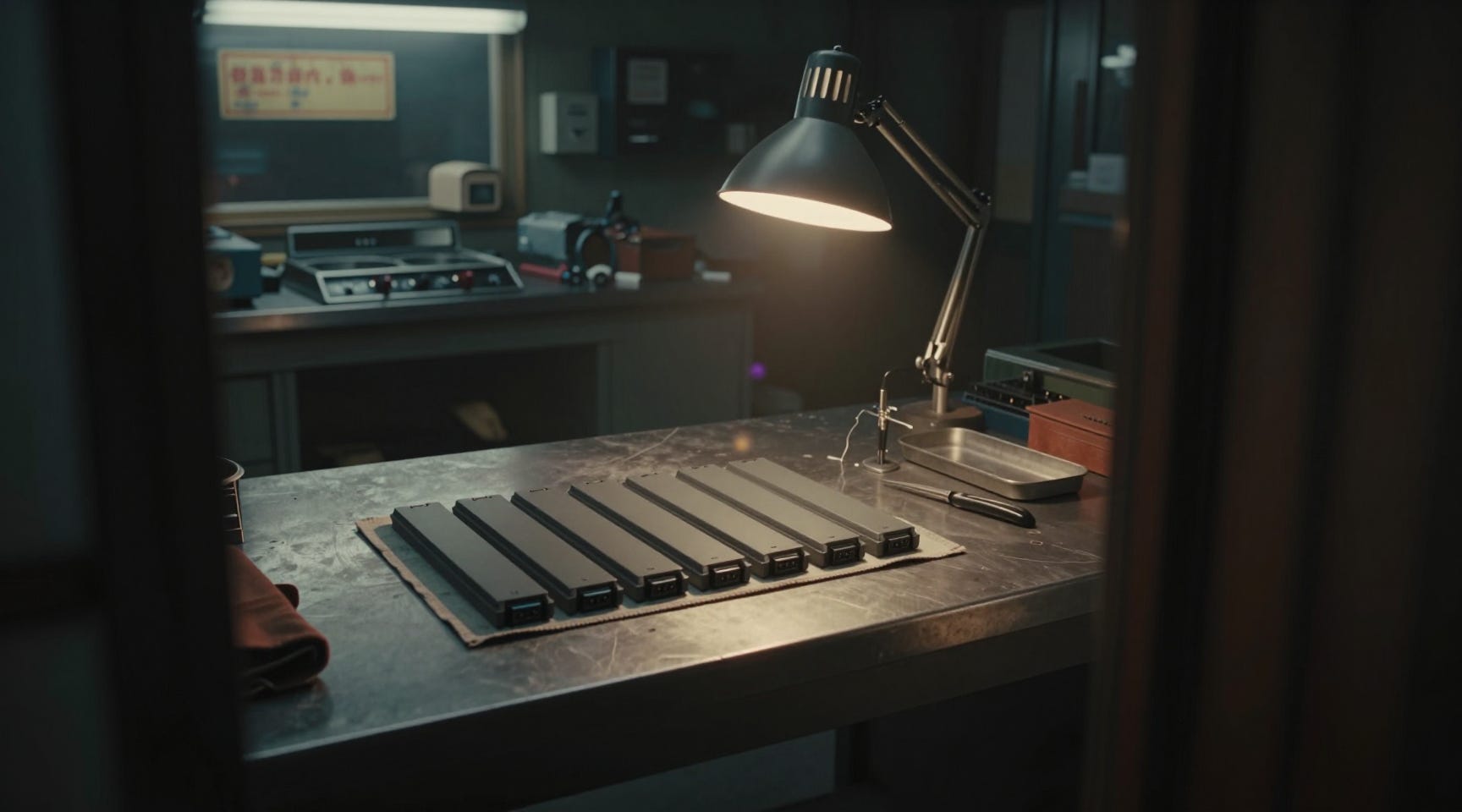
The workshop was smaller than the front room. It was scrupulously clean. The bench held no appliances. The bench held a thin steel tray, a magnification arm, a delicate solder rig, and a row of data sticks laid out on a folded cloth.
Pradeep recognized the housings.
He had not handled housings like those since the Year 1 budget review, when the office had been issued a batch of disposal samples from a UEN salvage contract that had folded. Matte gray. No manufacturer’s mark. The corner notch cut at the oblique angle the civilian standard did not use. Military-grade blanks. The kind that came off ring-belt salvage chains and ended up wherever they ended up.
The old man watched him recognize them.
“You are from the office.”
“Yes.”
“You looked at four records this morning.”
“Yes.”
“You did not flag them.”
“Not yet.”
The old man nodded, once. He picked up one of the data sticks. He set it down. He spoke without looking at Pradeep.
“Four hundred a month.”
Pradeep did not speak.
“For nothing. For a delay. The names you would have flagged today, you delay. You do not approve. You do not enter. You let them sit in your queue another week before the cross-check returns. That is all.”
“And the people drawing rations on the dead names.”
“They eat.”
Pradeep looked at the row of data sticks. He looked at the old man. He looked at the closed door behind them, the front room with its hand-painted sign and its dismantled cooktop, the long corridor of Tier Two where the queue at the Refugee Tier Three intake had been three hundred deep at sunrise.
“Where do the blanks come from.”
The old man looked at him then. He looked at him for a long moment. The look was not unkind. The look was the look of a man making a decision about whether to answer at all.
“The rings.”
“Which rings.”
“The far ones.”
Pradeep nodded.
He did not say yes. He did not say no.
He turned. He pushed through the curtain. He walked back through the front room. The cooktop was still in pieces on the bench. A younger man, the proprietor’s grandson or someone playing the role of a grandson, sat in the chair the old man had vacated, holding a soldering iron and pretending to use it.
Pradeep walked out into the ring corridor.
He was back at his station at 13:46.
The queue had grown. Forty new updates waited.
He pulled the first. Routine. A new arrival from the Phobos transfer, biometric template clean, ration access standard tier. He processed it.
He pulled the second. Routine. He processed it.
He pulled the third. The latency held a hair longer than the rest. He did not open the record.
He processed it as routine.
He kept the four paper records folded in his interior jacket pocket through the afternoon. He kept them through the evening. He took them home in the lift and laid them on the small steel table by his cot, and he did not look at them, and he did not destroy them, and he did not flag them.
The next morning he came back to his station.
He pulled the first record of the day.
He did not pull the cross-check.
Author’s note: Day Eighteen of the Iron Wake Origins arc. Year 2, Month 10. The supply chain reaches Mars. A biometric clerk in the Mars Orbital registration office finds four names that should have been unrolled and are not. He follows the trail to a quiet appliance shop on a Tier Two service ring, where an old man with a thin gray braid offers him four hundred credits a month to let the queue sit a little longer. The data sticks on the workshop bench are military-grade blanks from the Saturn rings, the first arrival of Iron Wake-supplied components on Mars. The forgery operation will be called the Greyline Parish, eleven years from now, when it has grown large enough to need a name. On its founding day, it is one clerk who does not say yes and does not say no, and who returns to his station the next morning, and pulls the first record of the day, and does not pull the cross-check. The compromise does not arrive as a decision. It arrives as a routine.
If you enjoyed this story, you can follow the main story arc in The Exodus Rush, the first book in The Vethrak Requiem series.