


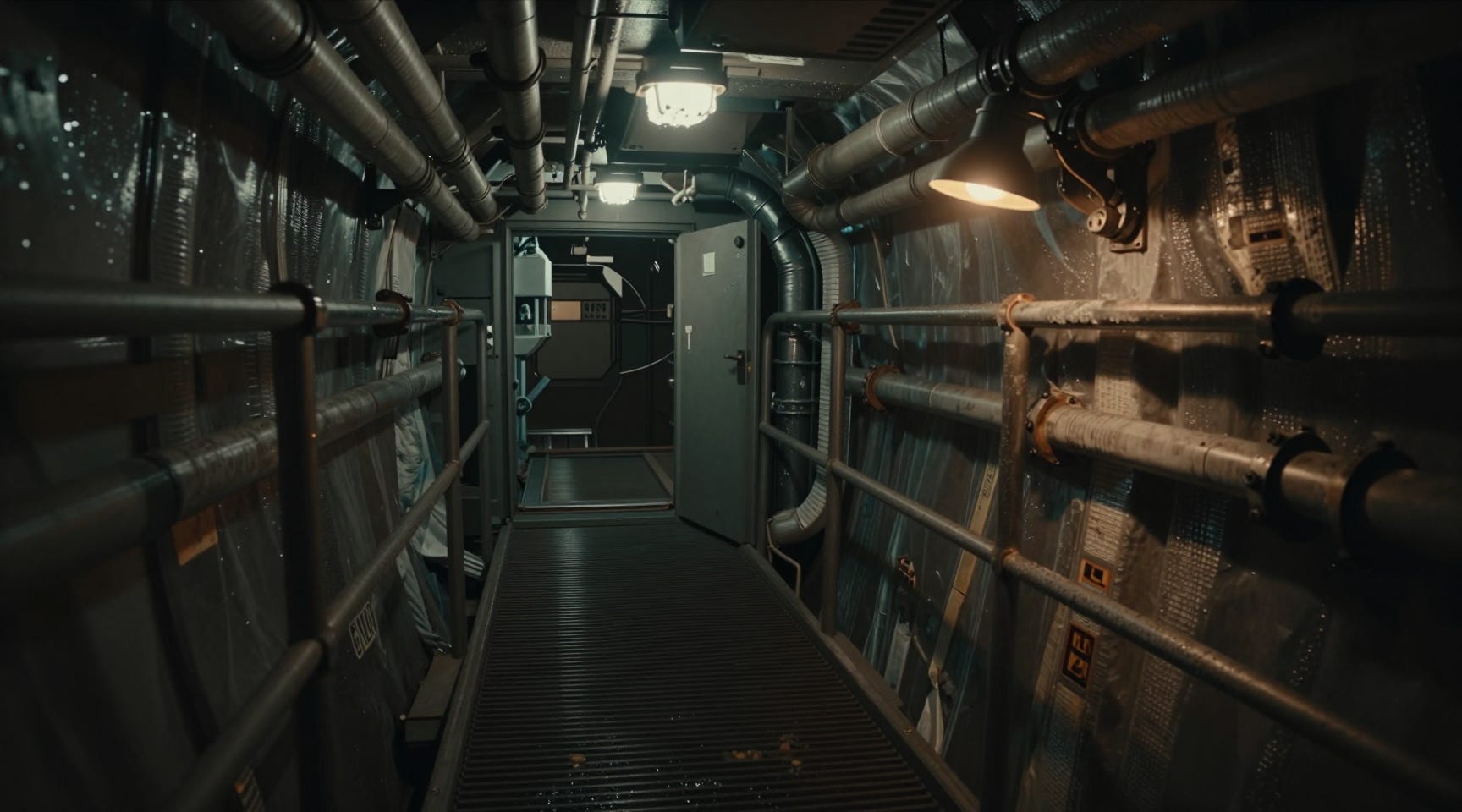
The siphon ran cold against Mónica Mendoza’s wrist, and she let it run, because cold meant the line had not picked up rust from the sleeve again. Rust meant a sick child two corridors over by the end of the week. She had learned that lesson in the second month.
She knelt in the crawlspace under Reclamation Plant Tres, three meters of insulated ducting between her shoulders and the boots of the UEN water-supervisor who had not yet figured out that one of his return-flow couplings ran a quarter-percent light. She intended to keep it that way until the supervisor rotated off the line in eight weeks. Eight weeks of clean greywater fed the seven hundred and forty unranked refugees in Sector Nine who had no allotment cards, because their evacuation manifest from Earth had been corrupted in the first Fold relay and never reconstructed.
A quarter percent. Forty liters a day. Half a cup a person.
The mathematics of survival on a colony that had not been built to hold this many people.
The crawlspace lights guttered. She froze.
A boot scraped across the access panel above her head.
Not the supervisor. The supervisor walked with a limp from the cold-shock injury he had taken in the Salvage Wars, and the rhythm above her was wrong. Heavier. Two boots planted square.
“Reclamation Tres is closed for the third shift. You should not be down there.”
The voice came through the panel low and even, the kind of voice that knew it did not have to raise itself.
She slid the siphon clip into her thigh pocket and put a smile on her face before lifting the panel.
A man crouched on the catwalk above her. Forty, perhaps forty-five, with the broad shoulders of a former cargo loader and a scar across the bridge of his nose that had been done with a clean blade and stitched without anesthesia. His coat was Mars-grey, no insignia, the cut of a man who did not need one.
“Bartosz Sikora,” he said. “I run the Long Boil. You may have heard of us.”
The Long Boil had been three women and a teenage runner in the second year, working a counterfeit ration-chip tap out of the Sector Six laundry. By the end of the second year, the three women were dead and the teenage runner had become Sikora, who had absorbed two other crews in the months since and now ran half the unlicensed water trade in the Mars equatorial belt. The name had spread through the corridors faster than the cholera.
“I have heard of you.”
“Good. That saves us time.”
She climbed the rest of the way out of the crawlspace and stood on the catwalk, wiping rust-colored grease from her palms onto her thighs. The plant hummed around them, a low industrial roar she had learned to filter the way other people filtered their own heartbeats.
“What do you want?”
“Thirty percent.”
“Of what?”
“Of the forty liters a day you are pulling out of the Tres return-flow.”
She kept her face still. He had the number exact. Either he had been watching her longer than she imagined, or someone in Sector Nine had talked, and Sector Nine talking was the worse outcome. It meant the network she had built on a foundation of mutual silence had a crack in it she would have to find before someone else did.
“Why thirty percent.”
“Take fifty, you stop pulling. Take twenty, my own people start asking why I am soft. Thirty is the number where you keep working and my crew stays quiet.”
“In exchange for?”
He smiled with the half of his mouth that the scar would let him use. “No one tells the supervisor about the quarter-percent draw. No one tells the Sector Nine block-warden that half her people are drinking off a tap that does not exist. No one rolls up your siphon and calls in a cleanup crew.”
The children in Block 9-C, the ones who already had rust marks on their gums from the bad month. The woman in 9-E who had given birth two weeks ago and had nothing for the infant that was not boiled out of the recycler twice over. The eighth-grade arithmetic she had used to calculate how many liters a day a colony of seven hundred and forty unranked needed to stay on the surviving side of dying.
Thirty percent of forty liters was twelve liters.
Twelve liters was a hundred and twenty people who would not get their half-cup tomorrow.
A hundred and twenty people who, if they did not get their half-cup, would walk to the official intake line and try to claim a chip they did not have, and the compliance officers at the intake line would log them and flag them and put them on a list, and from a list it was a short walk to a holding cell, and from a holding cell it was a shorter walk to a deportation manifest back to Luna.
Luna was full.
Mónica looked at Sikora’s hands. They were callused from real work, not the clean uncut hands of a man who had only ever ordered violence done by other people. He had carried his own weight at some point, and he had killed his own people at some point, and the line between those two things in him was a line he did not seem to mourn.
“Twenty,” she said.
“Thirty.”
“Twenty-five, and I tell you which corridor has the next soft coupling before the supervisor finds it. Tres is not the only weak return-flow in the equatorial belt. I know two more.”
Sikora went still in the way that men of his kind went still. The same stillness had lived in the eyes of the woman who ran the salvage exchange on deck twelve, the moment before that woman had decided not to kill Mónica over a misread tag in the second year.
“You know two more?”
“I know three. I will give you two.”
He laughed once, a short dry sound, and held out his hand.
“Twenty-five,” he said. “Plus the two leaks. Try to short me, and the Long Boil visits your siphon, not you.”
She took his hand. It was warm and dry and stronger than she had expected.
The Long Boil enforcer turned and walked back down the catwalk into the dim of the plant, and Mónica Mendoza knelt at the open panel and slid the siphon clip out of her thigh pocket and reset the line for a draw of thirty liters a day, because a hundred people getting their half-cup was still a hundred people, and the math of survival on Mars in Year Three did not allow for any other kind of arithmetic.
Author’s Note: Mars in Year Three carried roughly twice the population its reclamation grid had been built to support. The official allotment fed only the cardholders. Everyone else, the unranked and the manifest-corrupted and the quietly forgotten, drank from the soft couplings and the back taps that crews like the Long Boil would later consolidate into the underworld water trade that defined the inner-system corridors for the next decade. Mónica Mendoza was not the first to run a quarter-percent line out of a UEN return-flow. She was one of the few who lasted long enough to be remembered for it.
If you enjoyed this story, you can follow the main story arc in The Exodus Rush, the first book in The Vethrak Requiem series.