


UNITED NATIONS EXPEDITIONARY SCIENTIFIC CORPS
XENOBIOLOGY FIELD SURVEY
CLASSIFICATION: RESTRICTED
REPORT NUMBER: XB-23-0147
FILED BY: Dr. Wei Chen, Lead Xenobiologist, UNESC Field Team Seven
DATE: Year 0, Day 23 (Post-Invasion Calendar)
LOCATION: Harvester Beam Processing Site, Sector 7-Delta, 47 kilometers northeast of Moscow ruins
SUBJECT: First Human Examination of Active Vethrak Harvester Beam Site
EXECUTIVE SUMMARY
This report documents the first human scientific survey of a Vethrak Harvester Beam processing site while thermal signatures remain elevated. Field Team Seven accessed Site 7-Delta three hours after Vethrak withdrawal following the coordinated retreat across the European theater. Primary objectives: document harvester technology, analyze residue composition, assess processing efficiency, and recover samples for laboratory analysis.
Critical finding: Chemical signatures detected at the site do not match human biological markers. See Section 7 for implications.
SECTION 1: SITE DESCRIPTION
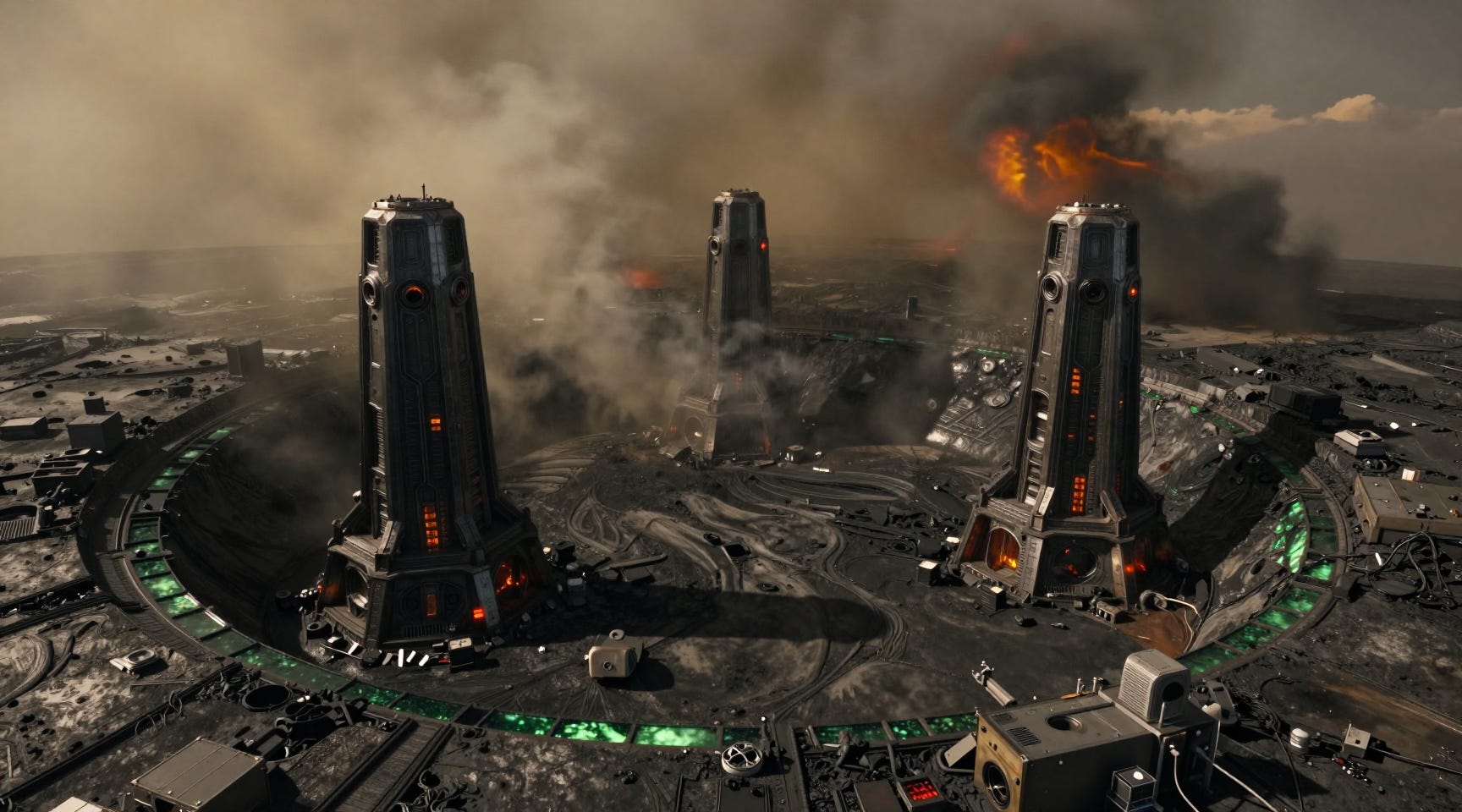
The harvester site occupies a circular depression approximately 180 meters in diameter. The depression was not present in pre-invasion satellite imagery of this location. Ground penetrating radar suggests the depression extends 40 meters below grade, with the beam having effectively excavated and transported material in a conical volume.
The site perimeter shows characteristic vitrification. Soil composition at the rim has transformed from standard Moscow-region clay and loam into a glassy, dark green substrate. Material analysis indicates temperatures exceeding 2,400 degrees Celsius during beam operation. The vitrification extends inward approximately 15 meters before transitioning to smooth, fused earth.
The depression floor is unnaturally smooth. Surface irregularities do not exceed 2 centimeters variance across the entire 180-meter span. This precision is consistent with controlled energy application rather than explosive excavation.
Three primary machinery structures remain at the site center, arranged in a triangular configuration 60 meters apart. Initial assessment: beam focusing elements, material containment fields, and processing apparatus. Structures are 12-18 meters tall, constructed from an unidentified metallic alloy that remains cool to touch despite ambient site temperature of 78 degrees Celsius.
SECTION 2: MACHINERY ANALYSIS
The northern structure appears to function as a beam emitter. Seven cylindrical apertures arranged in a hexagonal pattern with a central seventh aperture. Each aperture is 4.2 meters in diameter. Interior surfaces show microscopic scoring consistent with high-energy particle streams. Residual electromagnetic field strength: 0.4 tesla, declining approximately 2% per hour.
The eastern structure houses what we believe is a matter separation system. Internal chambers show three distinct zones with different residue compositions. First chamber: organic slurry, dark amber in color, viscosity similar to light machine oil. Second chamber: mineral sediment, fine grain, gray-white coloration. Third chamber: trace elements and exotic compounds currently under analysis.
The western structure defies immediate categorization. Hollow interior space 8 meters in diameter. Walls lined with hexagonal cells, each cell 40 centimeters across. Some cells contain residue. Others are spotless. Energy readings from the cell walls suggest data storage or transmission function, though this is speculative.
All three structures connect via underground conduits. Ground penetrating radar traces conduit paths to the depression center, where they converge at a point 12 meters below grade. Excavation of this convergence point is not recommended given structural instability and residual thermal hazards.
SECTION 3: PROCESSING EFFICIENCY
Based on depression volume, beam composition analysis, and atmospheric dispersal modeling, we estimate the harvester processed 240,000 metric tons of material during its operational period.
Time on station: 6 hours, 20 minutes (based on seismic monitoring data from Moscow-region sensors that survived the invasion).
Processing rate: 37,894 metric tons per hour. 631 metric tons per minute. 10.5 metric tons per second.
The machinery transported this mass somewhere. Presumably to orbit, though we lack tracking data to confirm destination. The energy requirements for this operation exceed any human engineering capacity by at least three orders of magnitude.
SECTION 4: RESIDUE COMPOSITION
Team Seven recovered 47 samples from various site locations. Preliminary field analysis reveals:
Organic Residue (Sample Set A, 23 samples):
Protein fragments, denatured by extreme heat
Lipid compounds, partially volatilized
Nucleic acids, degraded but identifiable
Carbon isotope ratios consistent with biological origin
Trace metals: iron, copper, zinc, calcium
Mineral Residue (Sample Set B, 18 samples):
Silicon dioxide (primary component)
Aluminum silicates
Iron oxides
Calcium carbonates
Trace elements matching local soil composition
Exotic Compounds (Sample Set C, 6 samples):
Unknown polymer chains
Metallic crystals not matching any known alloy
Organic-metallic hybrid structures
Purpose unknown; recommend immediate laboratory analysis
SECTION 5: ATMOSPHERIC ANALYSIS
Air samples collected at site center, mid-radius, and perimeter show elevated concentrations of:
Ionized particles (decreasing over time)
Ozone (4.2 parts per million at site center)
Nitrogen oxides
Carbon monoxide
Particulate matter (fine grain, 2.5 micrometers or smaller)
The atmospheric composition suggests extreme thermal events and electrical discharge. Consistent with beam operation models proposed by Dr. Kenji Yamamoto (UNESC Theoretical Physics Division).
Radiation levels: elevated but not immediately hazardous. Gamma radiation at 0.8 microsieverts per hour. Recommend exposure limits of 4 hours maximum for unshielded personnel.
SECTION 6: OBSERVED ANOMALIES
Several observations do not fit expected parameters:
The residue volume is insufficient. Based on depression size and processing estimates, we should have recovered significantly more material. The harvester appears to have transported at least 98% of processed mass off-site.
The machinery remains intact. Vethrak forces destroyed or removed most technology during their retreat. These structures were left behind. Possibly due to time constraints. Possibly because they considered them worthless once deactivated.
The precision is disturbing. Every measurement, every surface, every angle reflects intentional design. This is not experimental technology. This is mature, refined, industrial-scale operation. They have done this before.
SECTION 7: CRITICAL FINDING
This section contains information that will fundamentally alter our understanding of the invasion.
During analysis of Sample Set A (organic residue), Field Team Seven detected anomalous protein structures. Initial assumption: degradation artifacts from extreme heating. Secondary analysis disproved this hypothesis.
The protein fragments at Site 7-Delta do not match human amino acid sequences.
We ran the analysis six times. We verified equipment calibration. We compared against human tissue samples collected from Moscow-region survivors. The results are consistent and conclusive.
These proteins are not human.
Further investigation revealed that Sample Set A contains not one but six distinct biological signatures. Each signature represents a different species. None of them are Homo sapiens.
Chemical marker analysis provides the following profile:
Species Alpha: Silicon-based biochemistry, proteins incorporate silicon-oxygen bonds, unknown evolutionary origin
Species Beta: Carbon-based, amino acid chirality opposite to Earth biology (right-handed proteins instead of left-handed)
Species Gamma: Carbon-based, DNA analog uses six nucleotide bases instead of four
Species Delta: Carbon-based, proteins contain heavy metals (arsenic, selenium) in place of standard elements
Species Epsilon: Biochemistry utilizing ammonia as solvent instead of water, proteins stable at -40 degrees Celsius
Species Zeta: Carbon-based, closest to human biochemistry, but genetic markers indicate non-terrestrial origin
Six species. Six worlds. Six civilizations harvested before Earth.
The Vethrak did not invade humanity because we were special, threatening, or valuable. They invaded because this is what they do. We are the seventh harvest. This is industrial processing. This is routine.
SECTION 8: IMPLICATIONS
Site 7-Delta was not processing human remains. The beam operated in a region where 40,000 people lived before the invasion. Human casualties were extensive. The harvester should have processed primarily human biological material.
Instead, we find trace signatures from six other species.
Conclusion: The Vethrak did not clean their equipment between harvests. The residue at Site 7-Delta represents contamination from previous operations. The harvester machinery processed species Alpha through Epsilon on their home worlds, then brought the same equipment to Earth without sterilization protocols.
This tells us several things:
The Vethrak have harvested at least six other civilizations before humanity.
The harvester technology is standardized equipment, not prototype or experimental.
The Vethrak do not distinguish between species. The machinery processes all biological matter the same way.
Earth is not the first. We will not be the last.
SECTION 9: RECOMMENDATIONS
IMMEDIATE (Within 24 hours):
Preserve Site 7-Delta for extended study
Establish perimeter security to prevent contamination or unauthorized access
Deploy additional scientific teams to analyze machinery in detail
Collect additional samples before thermal decay compromises evidence
SHORT-TERM (Within 1 week):
Conduct comparative analysis of other harvester sites across the European and Asian theaters
Establish baseline biological signatures for Species Alpha through Zeta
Attempt to extract genetic information from residue samples
Begin metallurgical analysis of machinery composition
LONG-TERM (Within 1 month):
Develop methodology for identifying harvester technology patterns that might indicate Vethrak strategic targets
Correlate harvester site locations with pre-invasion population density maps
Investigate possibility of recovering functional technology from harvester machinery
Establish protocols for safely dismantling and transporting harvester structures to secure research facilities
CRITICAL PRIORITY:
We must preserve this site. The machinery represents our best opportunity to understand Vethrak harvesting technology. The residue samples provide our only evidence that other civilizations fell before us. This is not just scientific data. This is proof that we are part of a pattern. If the Vethrak harvested six species before humanity, they will harvest others after us.
Unless we learn from this site. Unless we understand their methods. Unless we find a way to turn their own technology against them.
Site 7-Delta is not just a crime scene. It is a blueprint for survival.
SECTION 10: FIELD TEAM STATUS
Field Team Seven completed site survey at 1847 hours, Day 23. All personnel accounted for. No casualties. Radiation exposure within acceptable limits. Sample collection successful. Returning to Forward Operating Base Tula for decontamination and data analysis.
Request immediate review of this report by UNESC leadership, United Nations Security Council, and Allied Military Command. The findings documented here require strategic-level decisions regarding site preservation, resource allocation, and scientific priorities.
Time-sensitive note: Vethrak forces may return to this location. Their withdrawal from the Moscow region appears tactical rather than permanent. Recommend military assets be positioned to defend Site 7-Delta against potential reclamation efforts.
PERSONAL NOTE (Off-record, for internal UNESC documentation only)
I am a scientist. I document what I observe. I analyze data. I draw conclusions based on evidence.
Standing in the center of Site 7-Delta, I felt something I have never felt in twenty years of field research: I felt small.
The harvester machinery is elegant. The beam precision is beautiful. The processing efficiency is remarkable. These are not the tools of conquerors. These are the tools of farmers.
We are not at war with an enemy. We are being harvested by an industry.
Six species before us. How many after?
I recommend we preserve this site. I recommend we study every molecule, every structure, every scrap of evidence. I recommend we learn everything we can about how they process biological matter, because someday we may need that knowledge to save ourselves.
I filed this report three hours after leaving Site 7-Delta.
I received word an hour ago that Allied Military Command ordered an airstrike on the location. Vethrak forces were reportedly advancing toward the site. The decision was made to deny them access to the machinery.
Site 7-Delta no longer exists. The harvester structures are gone. The evidence is ash. The residue that could have told us about six other civilizations has been vaporized.
I understand the military logic. I understand the strategic necessity.
I also understand that we just destroyed the only proof that we are not alone in this fight.
The Vethrak harvested six species before us. Now, no one will ever know their names.
REPORT ENDS
Dr. Wei Chen, Lead Xenobiologist
UNESC Field Team Seven
Year 0, Day 23
Author’s Note: Year 0, Day 23. Dr. Wei Chen conducts humanity’s first scientific survey of a Vethrak Harvester Beam site while it’s still warm. What begins as technical documentation of alien machinery becomes something far more disturbing when chemical analysis reveals that the residue doesn’t match human biology. Six distinct biological signatures. Six other species the Vethrak harvested before Earth. The site is destroyed three hours after Chen’s team departs, erasing the only evidence that humanity is the seventh harvest in an industrial process that spans civilizations.
If you enjoyed this story, you can follow the main story arc in The Exodus Rush, the first book in The Vethrak Requiem series.