


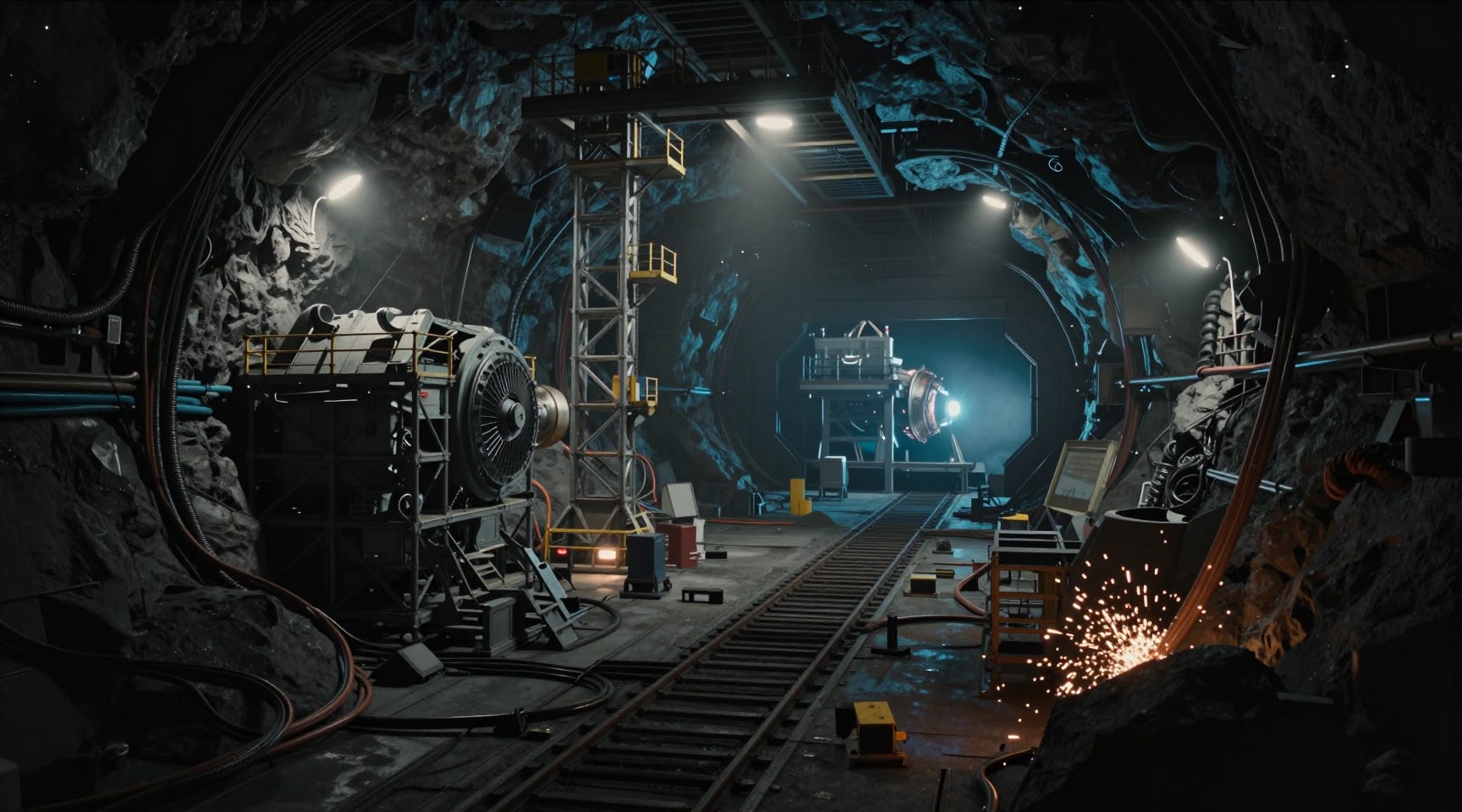
The weld seam cooled from white to orange, then dulled into a stubborn red that refused to match the rest of the hull. Tuva Hawthorne kept the torch steady anyway. A warped plate meant a ship that shook itself apart at burn. A ship that shook itself apart meant bodies.
The bay smelled like hot steel and scrubbed air. Filters worked overtime in a place that officially did not exist.
Crane tracks ran the length of the asteroid chamber, bolted into rock. Hull sections hung in their slings like ribs waiting for a spine. No markings. No registry stamps. No names.
A soft chime pulsed in Tuva’s wrist cuff.
POWER RATION: TORCH OUTPUT LIMITED.
The arc thinned. Heat wavered.
Tuva adjusted her angle and slowed her pass. The seam held. It held because she had practiced on scrap until her hands stopped shaking.
A different vibration threaded through the deck plates, low and uneven. Aurora Drive tests in Bay Three. The pitch wandered like a song that could not decide how it wanted to end.
Boots rang on the scaffold behind her. Foreman Cho stopped a meter away. His faceplate was up, his eyes rimmed with sleeplessness.
“Inspection team is coming through this ring in twenty,” he said. “Keep the line clean. No loose tools.”
“Copy.” Tuva killed the torch. Her gloves tingled from residual heat.
Cho’s gaze followed the seam, then flicked to the blank hull beside it. “Luna Station Alpha reported another Fold Drive failure. Unmanned tug. No casualties.” He spoke like a man reading numbers off a memorial wall.
Relief loosened something in Tuva’s chest.
“Good,” she said.
Cho nodded once. “Keep building.”
He climbed away, his lamp shrinking into the haze.
Tuva stared at the hull section under her boots. It did not have a name. It had a future that depended on quiet work and quieter choices.
Her cuff chimed again. This alert came with a location tag.
TOOL TRACKER: UNREGISTERED METAL MASS, DECK C, SECTION 14.
Her mouth went dry.
Unregistered mass meant somebody carried a part that had not been logged. In this yard, every bolt had a serial. Every scrap had a custody chain. Theft did not stay small. It leaked into seams, into wiring looms, into the math that kept a Fold Drive from becoming a grave.
Tuva clipped her torch to her belt and climbed down.
Deck C smelled like coolant and insulation foam. Light strips glowed low to save power. The corridors felt too narrow for the size of the thing they were building above.
Section 14 sat behind a half-open hatch.
A shadow shifted inside.
Tuva rested her palm on the hatch edge. Metal cold enough to sting.
“Close it,” a voice whispered.
The voice belonged to someone young. Fear softened the consonants.
Tuva did not move. “Identify yourself.”
Silence answered. The tracker icon on her cuff ticked between two and three kilograms.
Tuva kept her voice level. “Inspectors are on the ring. Come out.”
A scrape. A face appeared in the gap, visor up. Grease streaked his cheek. An electrician’s patch sat on his suit, blank emblem, no name.
“Tuva,” he breathed, like her name was a rope.
Recognition hit harder than it should have. The electrician from Bay Three. He had shared his lunch last week when her ration pack leaked in her bag. Nobody used full names here unless they wanted trouble.
“What did you take?” Tuva asked.
“Nothing.” His eyes flicked down the corridor.
The tracker disagreed.
Tuva stepped closer, keeping her body between him and the corridor. “Show me.”
His throat bobbed. He turned enough to reveal the cramped space beyond the hatch. Cable bundles lined the walls. A crate sat in the corner with Salvage Protocol markings, the serial blurred with solvent.
He pulled a component from under his jacket.
A coil, palm-sized, layered conductor wrapped in ceramic. Vethrak manufacturing, no question. The surface carried a faint iridescent sheen, like oil trapped under glass.
Tuva’s skin crawled.
“Where did you get it?” she asked.
“Salvage cage.” His words came fast. “Loose inventory. It is not even ours yet.” His gaze tightened on the coil. “My sister is on Luna. Med bay. Ten months’ wages for one of these. Ten months buys air filters that do not clog. Ten months buys antibiotics that are not expired.”
Ten months.
Tuva pictured Luna’s white arc over a scarred Earth.
“It buys a funeral,” Tuva said.
His jaw jumped. “People die anyway.”
The deck plates vibrated as the Aurora Drive test stand spooled up again. The pitch climbed, then stuttered.
Tuva held the coil in her mind, imagined it wired into a drive assembly with the wrong insulation, the wrong tolerances. A microfracture. A field collapse. A bay fire that ate oxygen faster than alarms could scream.
“Put it back,” she said.
“I already promised.” His voice cracked on the last word.
Promises to the black market. Promises made because the system had too many hungry mouths and too few honest paychecks.
Tuva breathed in coolant air and made herself slow down. Panic would turn him into an animal.
“Give it to me,” she said.
His grip tightened.
A single intercom chirp echoed down the corridor. Sweep team entering the ring.
The electrician shifted toward the exit.
Tuva moved first.
She stepped into the hatch, blocking his path, and caught his wrist. The coil pressed cold against her glove through his fingers. He tried to pull back. His strength ran on fear.
“Stop,” Tuva said. “They will find it. They will find you.” Her voice dropped. “You can walk out of this hatch alive.”
His breathing turned ragged. The fight drained out of his shoulders in a slow collapse.
Tuva twisted gently and took the coil. He let it go.
Her cuff chimed as the unregistered mass disappeared.
His eyes fixed on her pouch like she had stolen his future.
A choice sat in Tuva’s throat.
Reporting him meant the yard stayed clean. It also meant another worker vanished into whatever punishment secrecy required.
Saying nothing meant he tried again. The black market did not accept apologies.
Tuva keyed her cuff to a private channel.
“Foreman Cho,” she said.
Cho answered after a beat. “Hawthorne.”
“Inventory discrepancy in Section 14,” Tuva said. “Component recovered. Requesting a quiet escort for one worker. No alarm.”
Silence stretched, then Cho exhaled. “Understood. Stay put.”
Tuva lowered her cuff.
The electrician’s face drained. “You told.”
“I called Cho,” Tuva said. “You will answer questions. You will still be breathing when it ends.”
Footsteps approached, measured and heavy. Cho arrived with one security worker in a blank harness.
Cho looked past Tuva to the electrician. His gaze flicked to Tuva’s pouch.
Tuva handed the coil over without ceremony.
Cho turned to security. “No cuffs. Take him to my office.”
Security guided the electrician into the corridor. He looked back once, eyes wet with anger and relief tangled together.
The corridor swallowed him.
Tuva stood in the hatch until the footsteps faded. Her hands trembled.
The yard did not forgive mistakes. The yard also did not survive without people willing to stop one.
Tuva climbed back up to Deck E.
Inspectors in clean suits moved along the scaffolding, tablets glowing. Their boots left no prints. Their questions would be quiet and sharp.
Tuva stepped to her station and lifted the torch.
The arc flared. Light filled her helmet.
The seam brightened.
Tuva kept the line straight.
Author’s Note: The Ghost Fleet Protocol was born out of necessity in the early Post-Invasion years. This story takes place in Year 3.
If you enjoyed this story, you can follow the main story arc in The Exodus Rush, the first book in The Vethrak Requiem series.