


The console blinked 02:47. Kiran Patel had four hours and thirteen minutes left on watch.
She leaned back in her chair, the leather cracked and peeling at the edges. The deep space monitoring station on Europa barely rated new equipment. Most of it went to the fleet. What remained trickled down to the colonies, then the outposts, and finally to places like this: a converted ice mining facility buried two kilometers beneath Europa’s frozen surface.
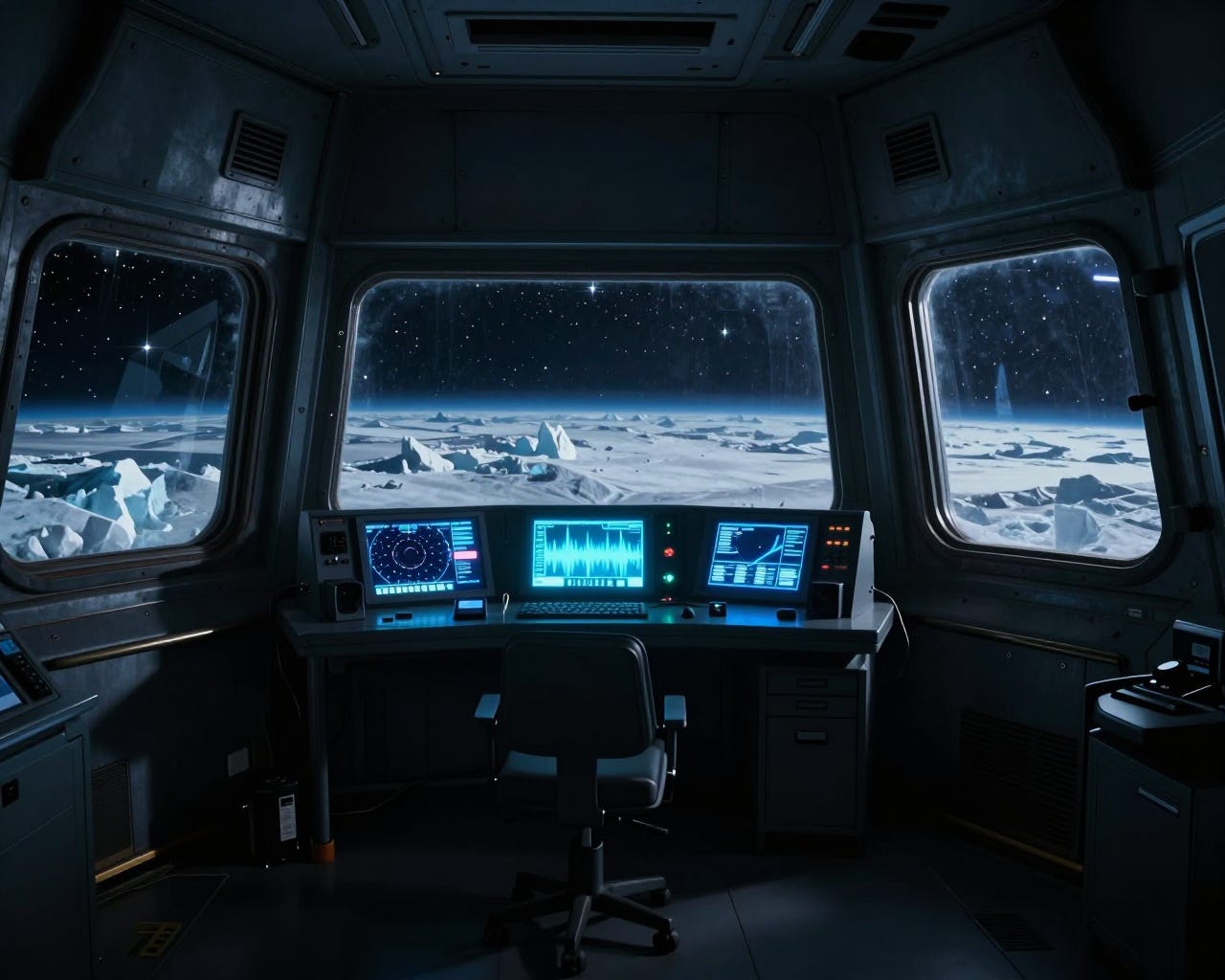
Her screens displayed the usual scatter of sensor data. Background radiation. Debris from the Invasion. Occasional asteroids tumbling through the black. Nothing remarkable. Nothing worth logging.
Kiran sipped cold coffee, grimaced, and set the cup down. The recycler must be acting up again. Everything tasted like metal these days.
She tabbed through the sensor feeds: infrared, electromagnetic, gravitational. All nominal. Another quiet night in Sector 7. Another shift where nothing happened.
The alarm sounded.
Not the proximity alarm. Not the emergency beacon. This was the anomaly detection system, a soft chime designed to flag unusual patterns in the data without triggering full alert protocols. Kiran sat up, her pulse quickening. She’d been doing this job for two years. The anomaly alarm had gone off exactly three times, twice for debris and once for a malfunctioning sensor suite.
She pulled up the flagged data. Sector 7, subsection Delta-Nine. A gravitational fluctuation, brief and localized. Duration: 1.3 seconds. Signature: unknown.
Kiran ran it through the database. The system churned for a moment, then returned no matches. She frowned. Everything had a signature: asteroids, ships, spatial anomalies. Even Vethrak vessels left gravitational echoes in their wake.
This didn’t match anything.
She ran diagnostics on the sensor array. No faults. No glitches. The equipment was functioning normally.
The alarm chimed again.
Delta-Nine. Another fluctuation. Same duration, same unknown signature. Her hands tightened on the armrests.
Kiran opened a comm channel to Central Operations. “Monitoring Station Seven to Central Ops. I have anomalous readings in Sector 7, subsection Delta-Nine. Requesting verification.”
Static crackled. Then a voice, bored and distant: “Copy, Station Seven. Running cross-check now.”
She waited. The seconds dragged. Her eyes stayed locked on the sensor feeds. Nothing moved in Delta-Nine. No ships, no debris. Just empty space and the faint shimmer of distant stars.
“Station Seven, Central Ops. No corroborating data. Suggest local equipment check.”
Kiran’s jaw tightened. “Ran diagnostics. Everything’s clean.”
“Copy. Continue monitoring. Report if it repeats.”
The comm channel closed. Kiran stared at the screens. Her gut said this wasn’t equipment failure. The signatures were too consistent, too precise. Equipment glitches were messy, random. This was something else.
The alarm chimed a third time.
Delta-Nine. Same fluctuation. 1.3 seconds. Unknown signature.
She logged the event, flagged it for analysis, and pulled up the gravitational overlay. The fluctuations appeared in a straight line, evenly spaced. Not random. Deliberate.
Her breath caught.
Three points. A trajectory.
Kiran traced the line forward. If the pattern held, the next fluctuation would appear in Delta-Eight. She switched the primary feed to that subsection and waited.
One minute passed. Then two.
The alarm chimed.
Delta-Eight. Same signature. Same duration.
Moving closer.
Her fingers flew across the console. She routed the data to the fleet’s early warning network, bypassed Central Ops entirely. Someone needed to see this. Someone with authority to act.
The comm panel lit up. Central Ops again, sharper this time: “Station Seven, what the hell are you doing? You just triggered a priority alert.”
“Anomalies are tracking inward,” Kiran said. Her voice stayed level, professional. “Unknown signature, consistent pattern. It’s not equipment failure.”
A pause. “Hold position.”
The line stayed open. She heard voices in the background, rapid and tense. Someone swore. Someone else barked orders.
Then a new voice, calm and clipped: “Station Seven, this is Commander Hayes, Fleet Intelligence. Transmit all data on those fluctuations. Now.”
Kiran sent the files. Seconds later, Hayes came back. “Good catch, Station Seven. We’re deploying a patrol to investigate. Maintain watch and report any changes.”
“Understood.”
The comm went silent. Kiran exhaled slowly, her hands trembling. She’d done her job. Logged the anomaly. Sent it up the chain. Whatever happened next was out of her control.
The alarm didn’t sound again.
She watched the feeds for the rest of her shift. Delta-Eight, Delta-Seven, the entire sector grid. Nothing. The ghost signal, whatever it was, had vanished.
At 07:00, her replacement arrived. A young tech named Ramos, still half-asleep, carrying a thermos of equally terrible coffee. “Anything happen?”
Kiran saved her logs and stood. Her back ached. Her eyes burned. “Nothing you need to worry about.”
She walked out, leaving the console blinking in the dim light.
Above, buried beneath two kilometers of ice and an ocean older than humanity, Europa turned silently in the dark. Somewhere in Sector 7, something had passed through. Something without a name.
Kiran didn’t sleep that day.
Author’s Note: Deep space monitoring stations are humanity’s first line of defense against the unknown. Most shifts pass without incident. Most anomalies are debris or equipment glitches. Most of the time, nothing happens. Kiran Patel’s story explores what happens when “most of the time” isn’t good enough.
If you enjoyed this story, you can follow the main story arc in The Exodus Rush, the first book in The Vethrak Requiem series.