


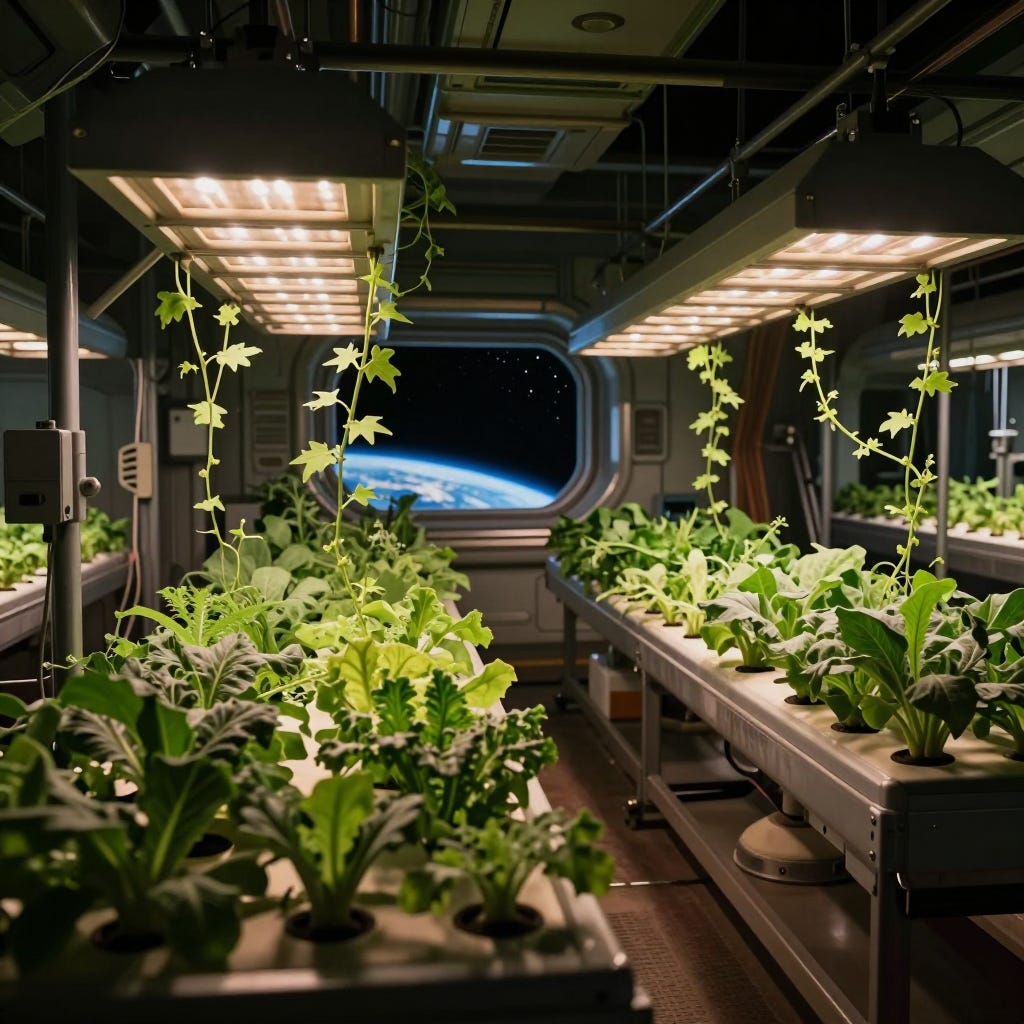
The tomatoes were coming in wrong.
Lieutenant Jaya Mehta crouched between the grow beds, examining a cluster of pale fruit that should have been red two weeks ago. The station’s agricultural AI insisted conditions were optimal. Temperature, humidity, nutrient mix, artificial sunlight calibrated to match an Earth summer that no longer existed. Everything was perfect on paper.
The tomatoes disagreed.
She plucked one and turned it in her fingers. Small, hard, stubbornly green. Like it was refusing to ripen out of spite.
“Talking to your vegetables again?”
Mehta looked up. Sergeant Tomasz Kowalski stood at the entrance to the garden deck, arms crossed, the hint of a smile pulling at his weathered face. He was dressed for deployment: tactical uniform, sidearm, the unconscious readiness of a man who had spent twenty years preparing for moments that arrived without warning.
“They’re better listeners than most of my squad,” Mehta said.
Kowalski crossed the deck, boots silent on the composite flooring. The garden was one of the quieter sections of Luna Station Gamma, tucked away from the bustle of military operations and civilian traffic. Most people forgot it existed. Mehta had found it six months ago, wandering during a sleepless night, and had been coming back ever since.
“We deploy in four hours,” Kowalski said. He stood beside her, studying the tomato plants with the same tactical assessment he applied to everything. “You should be resting.”
“I rested.”
“You slept two hours. I checked.”
“Spying on your commanding officer?” Mehta stood, brushing soil from her knees. Her uniform was already creased and worn. One more mark wouldn’t matter.
“Looking out for her.” Kowalski reached past her and picked a tomato of his own. He frowned at its stubborn greenness. “These are terrible.”
“I know.”
“Why do you keep growing them?”
Mehta considered the question. The honest answer was complicated, tangled up in memories of her grandmother’s garden in Pune, the smell of summer rain on hot earth, a world that had burned while she watched from orbit. The simple answer was easier.
“Something should grow,” she said. “Even if it grows wrong.”
Kowalski set the tomato back among its siblings, surprisingly gentle. “The mission brief came through. Full details.”
“I saw.”
“Thirty percent casualty estimate.”
“I saw that too.”
Silence settled between them. The garden deck hummed with the white noise of ventilation systems and grow lights, a mechanical approximation of nature that fooled no one but tried anyway. In the distance, through layers of hull and vacuum, Earth hung in the black. Mehta couldn’t see it from here. She didn’t need to.
“My daughter is seven now,” Kowalski said. “Or she would be. Was.”
Mehta didn’t respond. There was nothing to say. Everyone had a story like that. Everyone had someone they couldn’t save.
“She loved tomatoes,” he continued. “Ate them like apples, straight off the vine. Her mother used to scold her for it. Said she’d get sick.” A pause. “She didn’t, though. Never got sick a day in her life.”
The grow lights cycled through their programmed sequence, shifting from warm yellow to cool white. Artificial dawn on a station that had never known a real one. Mehta watched the shadows change across the grow beds, the careful rows of vegetables struggling toward a sun that was really just a bank of LEDs.
“Do you believe in what we’re doing?” Kowalski asked.
“The mission?”
“All of it. The salvage runs. The reverse engineering. The expansion. Do you believe it matters?”
Mehta thought about the briefing. A Vethrak debris field, two weeks out, containing what Intelligence believed was an intact navigation system. The kind of technology that could cut years off humanity’s learning curve, if they could reach it before the scavengers did. The kind of mission that cost lives for possibilities.
“I believe we have to try,” she said. “Whether it matters is a question for people who survive long enough to find out.”
Kowalski nodded slowly. He turned toward the exit, then stopped. “My daughter. Her name was Anya.”
“Anya,” Mehta repeated.
“I don’t say it enough. Her name. I think about her every day, but I don’t say her name.” He looked back, and for a moment the hardened sergeant was gone, replaced by a father carrying a weight that would never lift. “Someone should remember who she was. Not just that she’s gone.”
Mehta crossed the space between them and placed her hand on his arm. “I’ll remember.”
Kowalski’s jaw tightened. He nodded once, sharp and military, and walked away. His footsteps faded down the corridor, swallowed by the station’s ambient hum.
Mehta turned back to her garden. The tomatoes sat in their beds, green and stubborn and wrong in every measurable way. She picked up her watering can and moved down the rows, giving each plant exactly what the AI prescribed, knowing it wouldn’t help.
In four hours, she would lead eighteen soldiers into a debris field filled with alien wreckage and unknown dangers. Some of them would die. Perhaps she would die. The math was indifferent to hope.
She watered the tomatoes anyway.
Something should grow.
Lieutenant Jaya Mehta commanded Salvage Team Seven during Operation Glassbreaker in Year 4. The mission successfully recovered a partial Vethrak navigation array, contributing to the development of improved fold calculations. Team Seven suffered four casualties. Lieutenant Mehta received the Silver Star for her actions during the extraction and continued to serve until Year 9, when she transferred to the Agricultural Corps. She currently oversees hydroponics operations on Mars Colony Three. Sergeant Tomasz Kowalski survived Operation Glassbreaker and retired in Year 7. He volunteers at a memorial foundation for invasion victims.