


The warning tone pulled Levent Karaca from his third cup of coffee. Shift supervisor was supposed to be the easy rotation. Monitor the automated systems, respond to minor alerts, file reports. Nothing that required the kind of focus he’d needed when he was still doing field repairs on active combat vessels.
The engineering console displayed the problem in clinical detail. Fold drive containment field, generator three: efficiency dropping. Current output at eighty-two percent. Projected decay curve suggested sixty percent within twelve hours.
Levent set down his coffee and pulled up the ship’s specifications. CSV Meridian, colony transport, carrying four hundred seventeen civilians between settlements. Fold transit scheduled for 0600 hours. Eight hours from now.
Minimum safe containment for civilian fold operations: eighty-five percent across all generators.
They were already below threshold.
He triggered the comm system. “Engineering to bridge. We have a problem.”
Captain Wafaa Hassan’s voice came back immediately, tight with the kind of tension that never fully left anyone who’d survived the first five years. “Define problem.”
“Fold drive generator three is degrading. We’re below minimum safe containment for civilian transit.”
Silence on the other end. Levent knew what she was calculating. The Meridian had been scheduled to fold at dawn because the settlement they were heading to was running low on medical supplies. Antibiotics, surgical equipment, vaccines for the children born since the invasion. Every day of delay meant people died.
“Can you repair it?” Hassan asked.
“Not in eight hours.” Levent pulled up the diagnostic logs, scanning through weeks of accumulated data. “This isn’t a sudden failure. The generator’s been degrading for three weeks. Small variations, nothing that triggered automated warnings. Someone should have caught it during pre-flight inspection.”
He didn’t say that someone had been Soheila Nazari, the junior engineer who’d transferred to the Meridian six months ago. Her first solo inspection. She’d missed the subtle pattern in the data, the kind of thing that took years of experience to recognize.
Hassan’s voice stayed level. “What are our options?”
“Three choices.” Levent pulled up the technical documentation, cross-referencing containment requirements against operational parameters. “One: we delay departure until we can replace the generator. That means waiting for a supply convoy to bring a spare unit from the nearest depot. Minimum two weeks.”
“People will die waiting,” Hassan said.
“Yes.” Levent moved to the second option. “Two: we fold anyway, accepting degraded containment. The fold might complete without incident. Field collapse during transit would tear the ship apart. Thirty percent failure probability based on current decay projections.”
“Unacceptable.”
“Agreed.” Levent brought up the third option, the one that made his stomach tight. “Three: we run a hot-fold protocol. Override the safety margins, push the remaining three generators to one hundred fifteen percent output to compensate for generator three. Containment stays above minimum threshold. Higher stress on the functioning generators, increased wear, reduced operational lifetime. Fifteen percent failure probability during transit.”
The silence stretched longer this time. Levent watched the diagnostic readout, the steady downward trend of generator three’s efficiency curve. By 0600 hours they’d be at seventy-eight percent. Folding space with containment that degraded would be suicide.
“If we run the hot-fold and it works,” Hassan said slowly, “what happens to the other generators?”
“Best case, they survive with accelerated wear. We’ll need full replacement within six months instead of eighteen. Worst case, one of them burns out during transit. Same result as generator three failing. Ship comes apart at the seams.”
“Fifteen percent failure probability.”
“Approximately.” Levent pulled up the uncertainty ranges, the margins of error in salvaged Vethrak technology that humanity still didn’t fully understand. “Could be ten percent. Could be twenty. We’re working with systems we reverse-engineered, not designed. Every fold operation carries unknowns.”
Hassan was quiet for a long moment. Levent imagined her on the bridge, surrounded by crew members who all knew what this conversation meant. Four hundred seventeen civilians sleeping in the passenger decks below, trusting that the ship would get them safely to their destination.
“What would you do?” Hassan asked.
Levent looked at the diagnostic screen, at the cascade of data that represented twelve years of human desperation and improvisation. They’d learned to fly Vethrak ships because they had no choice. They’d learned to maintain salvaged equipment because the alternative was extinction. Every transit, every fold operation, every system activation carried risk that civilian spaceflight had eliminated centuries ago.
“I’d run the hot-fold,” he said quietly. “Fifteen percent risk to save lives now versus certain deaths if we wait. The math is ugly, but it’s clear.”
“Then that’s what we do.” Hassan’s voice carried the weight of command, the burden of four hundred seventeen lives. “Prepare the protocol. I’ll inform the passengers.”
Levent opened the hot-fold documentation, procedures written by engineers who’d died learning these systems the hard way. Step one: isolate generator three from the containment network. Step two: recalibrate load distribution across the remaining generators. Step three: override safety governors and push output beyond rated capacity.
Step four: pray to whatever remained of human faith that the numbers held.
The preparation took four hours. Levent worked through each calibration personally, checking and rechecking every parameter. Soheila assisted, her face pale, hands steady despite the knowledge that her missed inspection had created this crisis. She didn’t make excuses. She just worked, learning from proximity, absorbing the kind of experience that no training manual could teach.
At 0545 hours, Levent sealed the engineering bay and triggered the ship-wide announcement. “All personnel, secure for fold transit. Engineering running modified containment protocol. Stand by.”
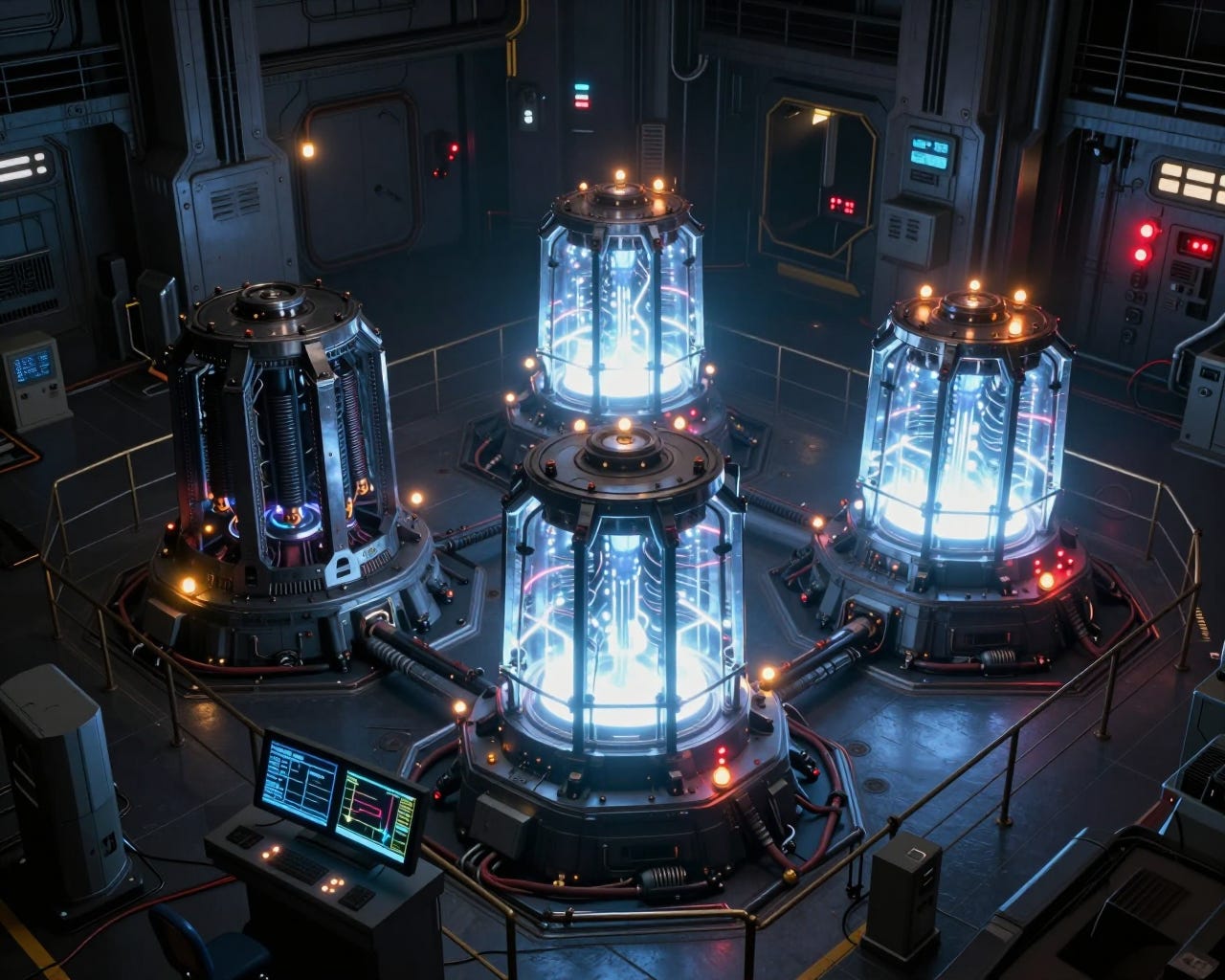
He pulled up the containment field visualization, three generators forming a triangular lattice of force that would wrap the ship in folded space. Generator three sat dark, isolated, a gap in the pattern that the other three would have to compensate for.
“Initiating hot-fold sequence,” Levent said into the comm. “Generator power increasing to one hundred fifteen percent.”
The deck vibrated as the cascade reactors fed massive power surges to the remaining generators. Levent watched the output curves climb, pushing past rated capacity, entering the red zones that the Vethrak had marked as dangerous operational ranges.
One hundred five percent. One hundred ten percent. One hundred fifteen percent.
The containment field snapped into place, a perfect triangle missing one vertex. The visualization showed the field stretching, compensating, the three generators working in concert to maintain coverage across the entire ship.
“Containment stable at eighty-seven percent,” Levent reported. “Above minimum threshold. We’re good for fold.”
“Bridge copies. Initiating fold sequence.” Hassan’s voice carried across the comm, calm and professional. “Fold drive engaging in three… two… one… mark.”
Reality twisted. The sensation was familiar after twelve years, the stomach-dropping moment when the universe folded and the ship slipped through the crease. Normal fold transit took thirty seconds. The disorientation passed quickly, training and repetition making the experience routine.
This fold felt wrong.
The vibration in the deck intensified. Warning tones began to sound across the engineering console. Generator two, temperature spiking. Generator four, output fluctuating. The containment field held, but the margins were shrinking.
“Containment at eighty-six percent,” Levent said, forcing his voice steady. “Field integrity holding.”
Fifteen seconds. Halfway through the transit.
Generator two’s temperature crossed into critical range. Automatic cooling systems engaged, flooding the generator housing with emergency coolant. The temperature stabilized. Barely.
Twenty seconds.
Generator four’s output dropped suddenly, a five percent loss that made the containment field shudder. The visualization showed the triangle distorting, stretching, compensating. Eighty-five percent. Right at minimum threshold.
Levent’s hand hovered over the emergency shutdown control. Aborting mid-fold was worse than running degraded containment, a guaranteed catastrophic failure. The only option was to let the sequence complete.
Twenty-five seconds.
The field held. Generator four’s output recovered, climbing back to required levels. Generator two’s temperature began to drop as the coolant took effect.
Thirty seconds.
Reality snapped back. The Meridian emerged from folded space, intact, whole, four hundred seventeen souls still breathing.
Levent exhaled, a breath he hadn’t realized he was holding. The engineering console showed damage across all three active generators. Stress fractures in containment housings. Thermal degradation in power conduits. Accelerated wear that would require full overhaul within months instead of years.
They’d made it. The math had held.
“Fold complete,” Hassan announced across the ship. “Transit successful. Welcome to Epsilon Station.”
Levent pulled up the generator diagnostics, documenting the damage, calculating repair requirements. Soheila stood beside him, watching the readouts, absorbing the lesson that nearly cost four hundred lives.
“The pre-flight inspection,” she said quietly. “I should have seen the pattern.”
“Yes.” Levent saved the diagnostic log, flagged it for review. “You should have. You’ll see it next time.”
“Will there be a next time?”
“There has to be.” He looked at the readouts, at the salvaged Vethrak technology that kept humanity alive, that let them move between settlements, that gave them a chance to survive. “We’re all learning as we go. The difference between good engineers and dead ones is whether you learn fast enough.”
Soheila nodded, silent.
Levent filed his report: hot-fold protocol executed successfully, containment maintained above minimum threshold, passenger safety preserved. Generators two, three, and four flagged for replacement. Estimated operational lifetime: four to six months before catastrophic failure probability exceeds acceptable risk.
Four to six months. Time enough to get the Meridian back to a depot, to find replacement parts, to keep flying.
Time enough to save more lives before the systems failed again.
He closed the report and started the post-fold checklist. Fifty-seven items, each one critical, each one a lesson learned from failures that killed people.
The coffee on his desk had gone cold. Levent picked it up anyway, drank it down, and got back to work.
One transit at a time. One repair at a time. One chance at survival at a time.
They’d get there.
Author’s Note: This story takes place in Year 9, during humanity’s ongoing struggle to maintain salvaged Vethrak technology. The fold drive systems humanity uses are reverse-engineered alien technology that crews still don’t fully understand. Every fold operation carries inherent risk, and the degradation of critical components forces impossible choices: delay and let people die, or push failing systems and risk catastrophic failure. Shift Supervisor Levent Karaca represents the thousands of engineers who keep humanity’s salvaged fleet operational through skill, experience, and calculated risk-taking. The hot-fold protocol he executes is a documented but dangerous procedure, used only when the alternative is worse. These are the choices that define survival in the post-invasion era.
If you enjoyed this story, you can follow the main story arc in The Exodus Rush, the first book in The Vethrak Requiem series.