


The plasma lance had a four-second cycle, and Anya Rask used the rhythm of it the way other people used a metronome. Cut. Pause. Reposition. Cut.
The Vethrak hull fragment hung in front of her at low rotation, a sheet of black-grey alloy the size of a kitchen table, twisting against the slow gradient of Saturn’s outer ring. She tracked its yaw through her helmet display and read the next cut. The lance flared. The seam parted. A puff of micro-debris drifted off into the ring plane and was gone.
Above her head the rings were a wide pale band, lit from below by the planet’s reflected glow. Below her, the Saturn dark went down forever. She had been doing this work for nine years. The view did not stop being the view.
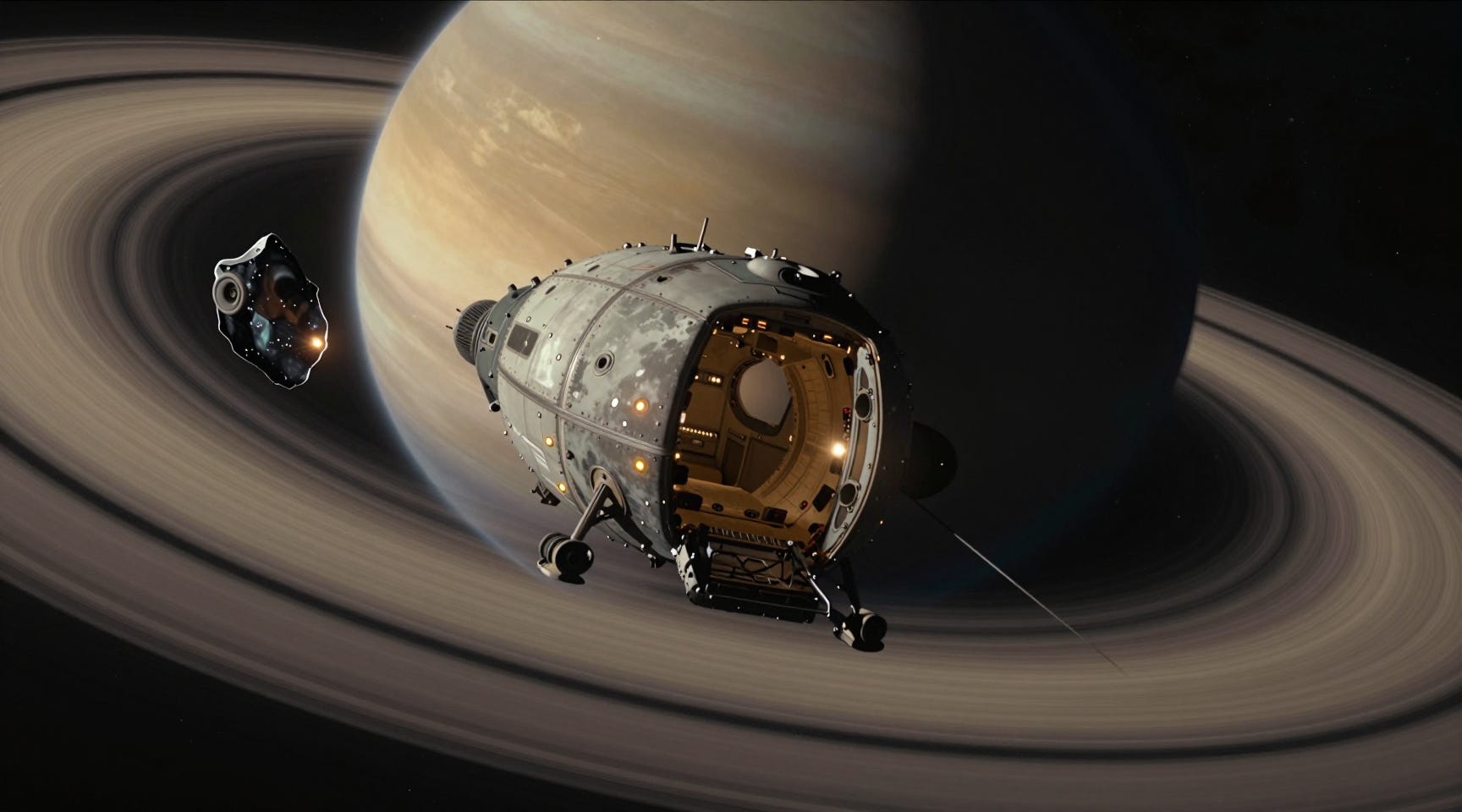
“Underweight to telemetry,” she said. The skiff did not answer. The skiff was an old skiff and answered only when asked twice. She did not ask twice. She trusted the skiff.
A second cut. The fragment separated cleanly. She let her boot magnets release for a half-second, drifted, caught the piece on her chest plate, and braced. The fragment massed forty kilos at standard. Out here, in the ring’s lazy orbital frame, it was a kindness. She walked it back to the Underweight on her tether and slid it through the cargo door her uncle had welded by hand, in 2118, when he was younger than she was now and had thought he would die in a ring colony from old age, like an honest man.
The cargo door scraped on its track. Same scrape it always made. Her uncle had told her once that the scrape was the skiff’s way of swearing at him. He had said it in Russian, and the Russian had made it funny.
He was buried on Mimas. The Underweight was hers.
She stowed the fragment, sealed the cargo bay, and pulled herself through into the cabin. The cabin was ring-belt small, four square meters of consoles and worn padding, warm in the way only a long-running scrubber could make a space warm. She unsealed her helmet. Her hair was cropped close. Helmets ate hair. She had stopped fighting it three years ago.
The metallurgical slab was bolted to the bulkhead at chest height. She fed a pinch of sample dust into the intake and watched the readout climb. The first three lines came back in the green range she had already guessed. The fourth line did not.
Vethrak alloy, structural-grade, pre-conversion.
She read the line a second time. The slab did not change its mind.
Pre-conversion. The hull plate had been part of a Vethrak ship before the ship had folded itself into whatever it had folded itself into during the invasion. Not aftermath debris. Not a wreckage cascade. An intact piece of original Vethrak engineering. Smaller pieces of this material had moved through the certified salvage pipeline at prices that paid mortgages.
She sat down on the cabin’s one chair.
Three months ago, when she had still been wearing UEN colors, this fragment would have gone to her supervisor at the Saturn Yard. The supervisor would have logged it, paid her standard hazard plus the find percentage, and added her name to a quarterly bonus pool that paid out twice a year. The number was not large. The number had been, when added across enough finds, a life.
Three months ago she had been one of forty-three salvage technicians on the Yard’s payroll. Now she was one of seven. The fleet had no money. The Salvage Protocol had no money. The Yard had told her she could keep the certifications, for what they were worth, and reapply the moment funding came back. Nobody had said when.
She took out her wrist comm and pulled up the freelance market board. The board was a dirty thing, half-anonymous, run out of a Pallas Station back office by people who did not need to put their names on anything. Pre-conversion structural alloy was listed at the top of the priority sheet. The asking rate was a number she had not let herself look at for three months.
She looked at it now.
The freelance number was four times what the Yard would have paid her, in cash, today, no holdback. Four times.
She did the arithmetic twice. The answer did not move.
The Underweight’s main display flickered through its standard idle cycle. Saturn turned outside the porthole. In the cargo bay behind her, the fragment drifted in its restraining net and bumped softly against the wall.
She had a salvage license. The license said Recover, document, deliver. Deliver to the Salvage Protocol intake on Mimas Station. The intake paid a published rate. The published rate was a quarter of the freelance number. She knew the published rate the way she knew her own pulse.
The freelance number was the rest of the year. The freelance number was the thrust upgrade the Underweight needed before its next outer-ring run. The freelance number was a real meal at the Mimas commissary, two months running, instead of recycled protein and old tea.
She put the wrist comm down.
In her chest pocket, in the suit liner she had not yet stripped off, was a piece of hull plate the size of her thumb. She took it out. It was scorched along one edge and crimped at the other, where it had been torn from something that had been torn from something else. The serial stamp was still legible.
POLARIS. UEN-CV-0114. MIMAS DRYDOCK YEAR -3.
Her brother had been third engineer on the Polaris when the colony ship had been intercepted en route to Mars. The fleet had not recovered the wreckage. Nobody had. She had pulled the fragment herself, two months ago, off-route from a contracted run, without telling anyone, because the work no one else was going to do was the work she had decided to do.
She held the Polaris fragment in one gloved hand and looked at the metallurgical slab, where the Vethrak readout was still steady on the screen.
Her parents had died in Stockholm. Her brother had died at Mars. The Yard had stopped paying her. The freelance market had not. The freelance buyers did not ask where the alloy came from. The Salvage Protocol asked, and paid a quarter as much for the asking, and said thank you for your service, and meant it, in the exhausted way of a system that had nothing else to give.
She sat for a long time in the cabin chair.
Then she put the Polaris fragment back in her chest pocket and closed the seal.
She would take the Vethrak fragment to the Salvage Protocol intake on Mimas Station. Tonight. That was the right thing. It was also the legal thing, and she had been raised, by people who were no longer alive, to do the legal thing.
She told herself that, in the cabin’s quiet, with the scrubber humming and the rings turning overhead.
She told herself that twice.
The wrist comm sat where she had put it down. The freelance number was still on the screen.
Outside, the Saturn ring band wheeled slowly past the porthole, lit from below by a planet that did not care.
She did not delete the comm message.
Author’s note: This story opens a 31-part arc tracking the slow rise of the Iron Wake, one of the dominant Vethrak salvage clearinghouses of the post-invasion economy. Anya Rask becomes its founding signatory, though she does not know it yet. In the first month of Year 1, the UEN fleet is gutted, the Salvage Protocol is bureaucratic and underfunded, and the outer ring debris fields are full of work nobody is paying for. This is the first day a former licensed salvager looks at a freelance market quote and does not look away. The compromise curve begins here.
If you enjoyed this story, you can follow the main story arc in The Exodus Rush, the first book in The Vethrak Requiem series.