


The test frame held the sample at the correct angle. Nak-Vesh adjusted the application thickness by a margin no monitoring instrument would register as relevant, then adjusted it again.
The motion of the manipulator appendages was precise, economical, the movement of someone who had performed this exact task thousands of times across three decades. The sample was a hull panel prototype. The coating on its surface was an organic-engineered compound that had consumed the better part of a working lifetime to develop. Nak-Vesh had started this program in the fifth decade post-Harvest, when the question had been purely theoretical. What if the hull did not reflect anything? What if a Skarreth vessel passing through Vethrak-patrolled space returned no sensor return at all?
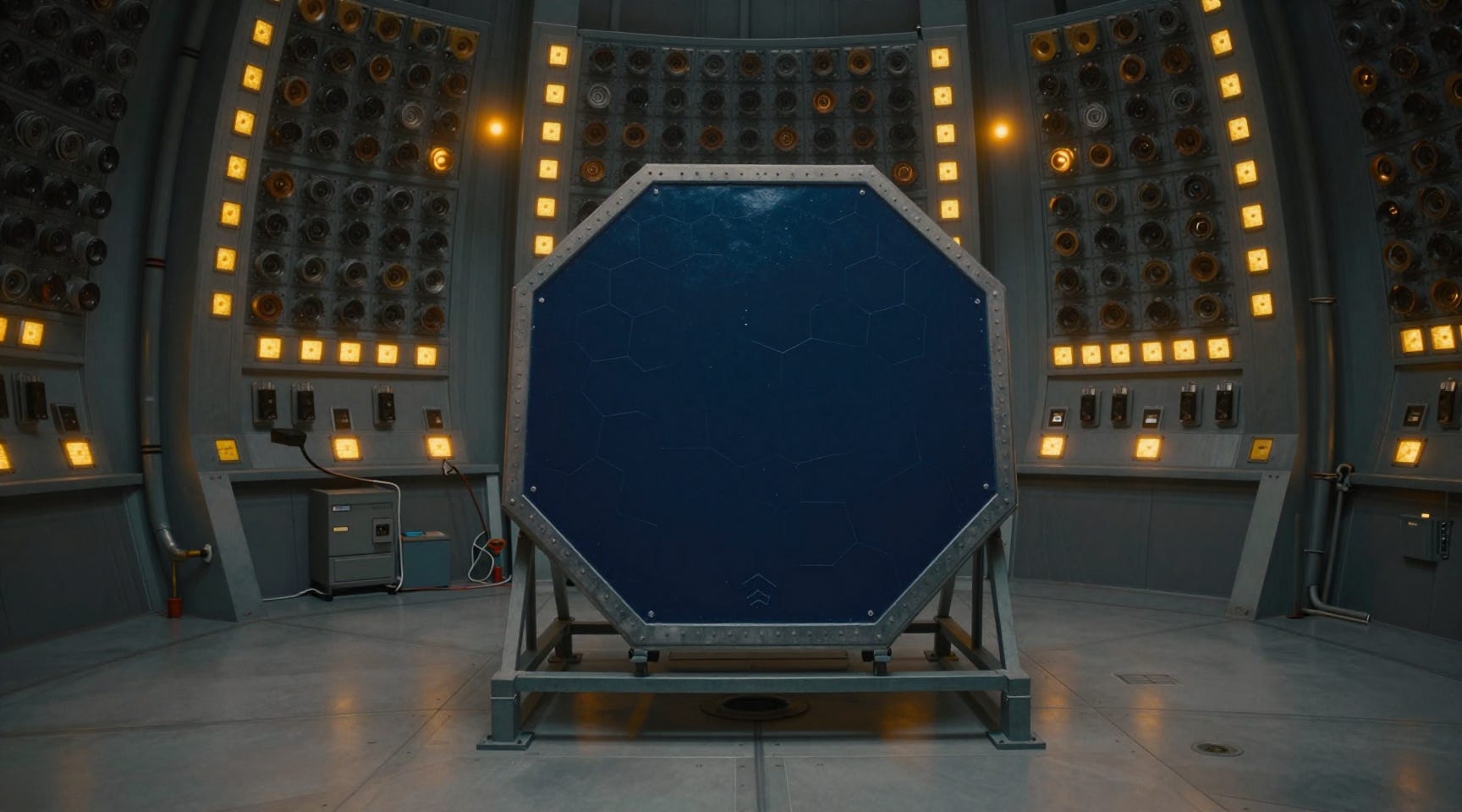
The question had seemed impossible then. It still seemed impossible. The sample on the test frame had passed every lab assay at 99.7 percent absorption across the relevant electromagnetic spectra, but lab assays were controlled environments with known variables. The live test used a simulated Vethrak sensor array reconstructed from intelligence data: the actual detection systems that Skarreth strike vessels had been evading for ninety-three years by concealment discipline rather than concealment technology. If the sample worked, the doctrine changed. If it failed, the stealth program reset by a decade.
Nak-Vesh sealed the test chamber.
The prototyping bay on Station Kresh-Var was designed for hull material evaluation. The chamber was an armored cylinder thirty meters in diameter, its interior lined with sensor emitters and receivers configured to replicate a Vethrak patrol vessel’s detection suite. The reconstruction was not perfect. Skarreth intelligence had never captured an intact Vethrak sensor array, but it was close enough that the margin of error was smaller than the margin the coating needed to succeed.
Nak-Vesh cycled the test sequence from the monitoring station. The chamber’s atmosphere was evacuated to vacuum. The thermal profile of the sample was allowed to equalize with the chamber walls. The simulated Vethrak sensor array activated at standard patrol power.
The display showed the expected return signature for the first two seconds: a clean reflection spike corresponding to an uncoated hull panel. Then the coating engaged. The spike collapsed. The display flatlined.
Zero return. No reflection. No scattering. No thermal gradient that the simulated sensors could resolve.
Nak-Vesh stood at the monitoring station for several minutes, watching the flatline display. The surface chromatophores beneath the manipulator plates shifted. Not a voluntary display. A stress response to an outcome the engineer had not fully believed was possible, manifesting as a change the engineer could not suppress and did not attempt to correct.
The test chamber cycled back to atmospheric pressure. The record was clean: absorption coating prototype successful across all test parameters at 99.7 percent or greater efficiency. There was no ambiguity in the result. The flatline was absolute.
A junior engineer in the adjacent section registered Nak-Vesh’s stillness and understood that something significant had occurred. The junior did not approach. Interruption during assessment was a failure of discipline. The junior held position, watching the senior’s stillness with the same attention they would give to any operational event, and waited for the assessment to complete.
Nak-Vesh did not celebrate. There was no protocol for celebration. The test result was a data point. The data point was positive. The next step was production integration. That was the sequence.
That night, by station cycle, Nak-Vesh returned to the prototyping bay alone.
The sample was still mounted in the test frame. The coating was intact, undamaged by the sensor sweep. Nak-Vesh approached the frame and examined the hexagonal junction pattern where the coating met the panel’s edge frame, a standard interface point designed to minimize the boundary transition between coated and structural surfaces.
The junction pattern was functional. It served its purpose. A human engineer looking at it would see correct engineering and nothing more. Another Skarreth engineer would see the same. But Nak-Vesh, who had designed the pattern, knew its geometry the way a navigator knows the contours of a withdrawal route. Every angle. Every intersection. The relationship between each hexagon and the next.
Nak-Vesh made a single modification to the junction pattern. One hexagon on the sample’s lower edge frame was rotated by twelve degrees from the alignment of the surrounding pattern. The change was not visible at operating distance. It served no functional purpose. It altered nothing about the coating’s performance, the panel’s structural integrity, or the production process.
It was a signature. A personal mark. The first Skarreth hull signature that no human eye would ever notice, and that no Skarreth would ever acknowledge aloud.
The modification took less than a minute. Nak-Vesh logged the test result into the station’s operational record. The entry read: Absorption coating prototype successful. Ready for production integration.
That was all the record contained. The name of the engineer who had spent thirty years developing the compound did not appear in the entry. The personal mark on the junction pattern was not recorded anywhere.
Nak-Vesh cycled the prototyping bay’s systems to standby and left the chamber. The sample remained in the test frame, the rotated hexagon catching no light, registering on no sensor, carrying its message in the only language the Skarreth spoke freely: a shape that served no purpose but fit the moment completely.
If you enjoyed this story, you can follow the main story arc in The Exodus Rush, the first book in The Vethrak Requiem series.