


The Mimas docking-tier hotel had the kind of lobby that had been designed for the inner system and never quite finished. Real wool carpet, badly worn at the door. Polished brass lamps, two of them mismatched because the originals had cracked in a Year 1 pressure event and management had replaced them with whatever the salvage market would sell. The lobby was empty except for the clerk at the desk and the man waiting on the far side of it.
She had walked from the storage bay in the clean jacket she had bought for the Enceladus negotiation in Month 2. There had not been a second meeting that required it. The collar still held the crease.
The buyer rose when she came in. Tall, well-fed, in a coat cut for him by someone who knew his measurements. His hair was the carefully untidy kind that took thirty minutes a morning. He smiled. The smile was professional. It was also, Anya noted, a smile that expected the room to smile back.
“Ms. Rask.”
“Mr. Holm.”
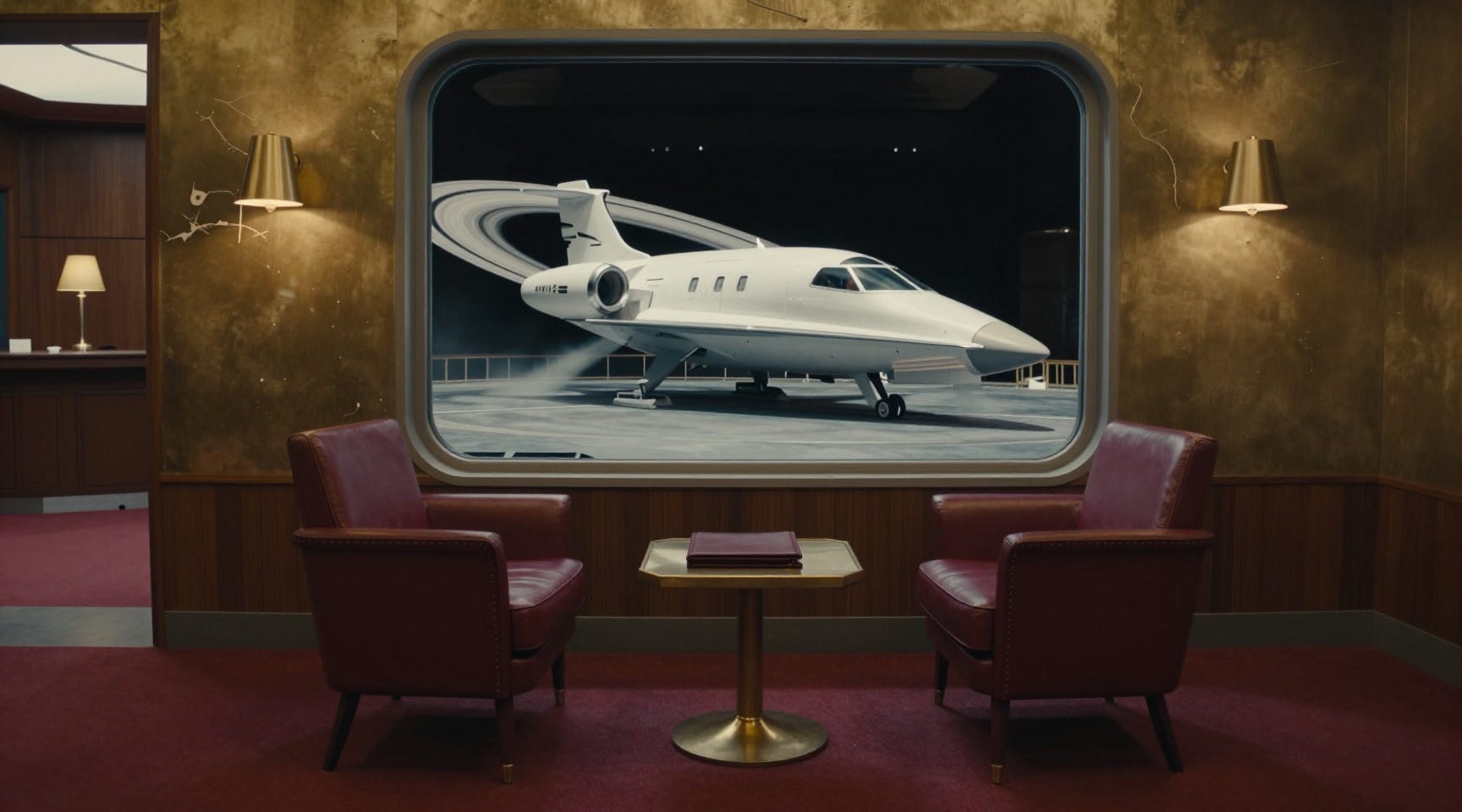
“Please.” He gestured to the small reading lounge off the lobby. Two chairs, a low table, a window that looked into the docking spar where his shuttle sat at gate four, sleek and white and registered to a private holding company on Mars. “Thank you for coming up from the bay. I appreciate the discretion.”
Anya sat. She did not unbutton the jacket. The clerk, who had taken in nothing and everything at once, returned to her terminal.
Holm settled across from her. He set a small leather folio on the table between them and did not open it. The folio was a prop. The pitch was rehearsed.
“I’ll keep this brief,” he said. “Some friends of mine on Mars are putting together a defensive consortium. Private security, perimeter assets, a small standing presence to protect investments the UEN can no longer afford to garrison. They’ve been quietly procuring equipment. They’ve reached a point in their procurement where they need a category of asset the open market does not provide.”
“Vethrak weapons-grade,” Anya said.
Holm’s smile did not shift. He had expected her to be direct. He had priced direct.
“Specifically,” he said, “the focused-emission lattice arrays from the secondary turret housings on Vethrak escort-class vessels. There are believed to be at least three intact units in the Saturn outer-ring fields. My friends would like to acquire all three. They would also like to retain a standing order on any additional units recovered over the next twenty-four months.”
“Why.”
“Why what, Ms. Rask?”
“Why a defensive consortium needs focused-emission weapons designed to cut a person in half.”
Holm folded his hands. The folded hands were also rehearsed. The folded hands meant: I am about to tell you something that sounds like the truth.
“The Vethrak are not the only threat in the system anymore. There are refugee populations on Mars that have organized in ways the government has not been able to address. There are work stoppages that have, in some districts, turned into something more durable. My friends have lost facilities. They have lost personnel. They are not interested in killing anyone they do not have to. They are interested in not having to.”
The lounge was quiet. The shuttle at gate four ran a coolant cycle that pulsed through its lower vents, a slow white plume venting and reabsorbing.
Davit’s briefings had been clear about what was happening on Mars. The refugee camps built as temporary shelters in Year 1 were, in Year 3, still standing and full and not being supplied. A strike in the orbital shipyards in Month 4 had been described by the news services as a labor disruption. Maren, on the night before the Bonecrack Field, had said the word strike did a lot of work in a sentence whose other words were fourteen dead.
“No,” Anya said.
Holm waited. He had budgeted for the pause. The pause was where the price went up.
She did not give him the pause.
“No,” she said again. “The Iron Wake will not source those components for that buyer. I am not interested in a counteroffer. I am not interested in a higher rate. I am not interested in a structured arrangement that walks the order through a third party. The answer is no, and the answer will remain no on every subsequent ask. Please do not bring it back.”
Holm’s smile finally moved. It did not vanish. It compressed. He looked at her with the careful attention of a man who had been told no in a tone he was not used to and was now revising his estimate of who he was sitting across from.
“Ms. Rask,” he said slowly. “I am offering nine hundred forty thousand thermal credits for the three units. Plus standing order. Plus, frankly, a relationship that would put your operation in a position you have not yet been in.”
“I know what you’re offering.”
“You’re refusing nine hundred forty thousand thermal credits.”
“Yes.”
He sat back. He did not rise. He did not yet understand that the meeting was over.
“May I ask why.”
“You may.”
She did not elaborate. She let him sit with the permission she had given him.
After a moment, he picked up the folio. He did not open it. He stood. The smile reassembled itself, less polished now, the seams visible.
“I’m sorry we couldn’t do business,” he said.
“I’m not.”
He left.
Anya remained in the chair. The clerk at the desk did not look at her. The shuttle at gate four undocked sixteen minutes later, the white plume gone, the dock lights cycling green-amber-green as the gantry retracted.
She walked back to the bay.
Davit was at the corner table in the back office when she came in. He had been waiting, which meant he had known about the meeting, which meant he had known about the offer.
He looked up. He did not ask. He waited for her to say.
“I turned him down.”
“I heard.”
“From whom.”
“His clerk. She drinks at the Steady Vent. She finds my courier funny.” Davit’s voice was even. “Nine forty.”
“Nine forty.”
“For three units and a standing order.”
“Yes.”
Davit was quiet for a long beat. He picked up his cup. He set it down without drinking. He did not look angry, which was the closest he ever got to angry.
“Were you sure?”
“Yes.”
He nodded. He did not push.
Anya sat across from him. She produced the small notebook from her jacket pocket. She opened it to the back, where she had begun keeping a list four months ago without telling anyone she was keeping it. The list had six names on it already. She wrote a seventh, slowly, in the small precise hand she had learned in UEN salvage training and had never quite shaken.
Holm, Garrick. Mars holding. Restricted. Weapons-grade refused 26 Six Year 3.
She closed the notebook. She put it back in the pocket. Her fingers passed, in the same pocket, the Polaris fragment and the folded Iso letter that had been in the jacket since Month 1 and would be in the jacket until the jacket no longer fit.
“There will be another one,” Davit said. Not a question.
“I know.”
“At a higher number.”
“I know.”
He nodded again. He picked up his cup and finally drank.
She sat with her hand in the chest pocket, the Polaris fragment cool against her fingers, the seventh name in the small notebook in the same pocket, and the small honest tremor under her sternum of a woman who had done the right thing today and who was learning how much harder the right thing was to do at nine hundred forty thousand thermal credits than it had been at none.
The bay was warm. The desalination plant vented through the deck plates. The tea Davit had been drinking was the cheap ring-belt black.
She did not ask for a cup. She sat with her hand in her pocket and waited for the tremor to pass, and it did, the way these things did now: a little slower than it used to, and a little more reluctantly, and a little more like something that was learning the shape of where it lived.
Author’s note: Day Twenty-Six of the Iron Wake Origins arc. Year 3, Month 6. A polished private buyer from Mars offers nine hundred forty thousand thermal credits for three intact Vethrak focused-emission lattice arrays, intended for resale to a paramilitary consortium operating against Martian refugee populations and striking shipyard workers. Anya Rask refuses. She writes the buyer’s name in a small notebook she has been keeping for four months, a private restricted-buyer ledger that will, by Year 14, be a formal Iron Wake document maintained by the Hollow Seam. The refusal is the proof that the line still exists in Year 3. The small tremor under her sternum, learning the shape of where it lives, is the proof that the line is no longer where it was.
If you enjoyed this story, you can follow the main story arc in The Exodus Rush, the first book in The Vethrak Requiem series.