


Ayanda Molefe checked the carbon-dioxide monitor against the canteen wall sensor, then clipped it to the center ring before either delegation could claim that side of the table.
The canteen had no spin. Meal pouches sat secured in wall racks, restraint seats folded beneath two serving rails, and six slates waited in clamps around a table built for workers who ate with their boots locked. Temporary scrubbers drove a low vibration through the deck. The monitor translated each pulse into a small green mark.
A Helios aide reached for the clip. “Operations needs the display in its record pane.”
Molefe covered the latch with two fingers. “The air is not management’s exhibit.”
The union recording steward floated a second clamp toward Kavita Nair’s place.
“It is not labor’s either,” Molefe said. “Center ring. Both channels.”
The steward fixed a shared feed to the table and withdrew his hand.
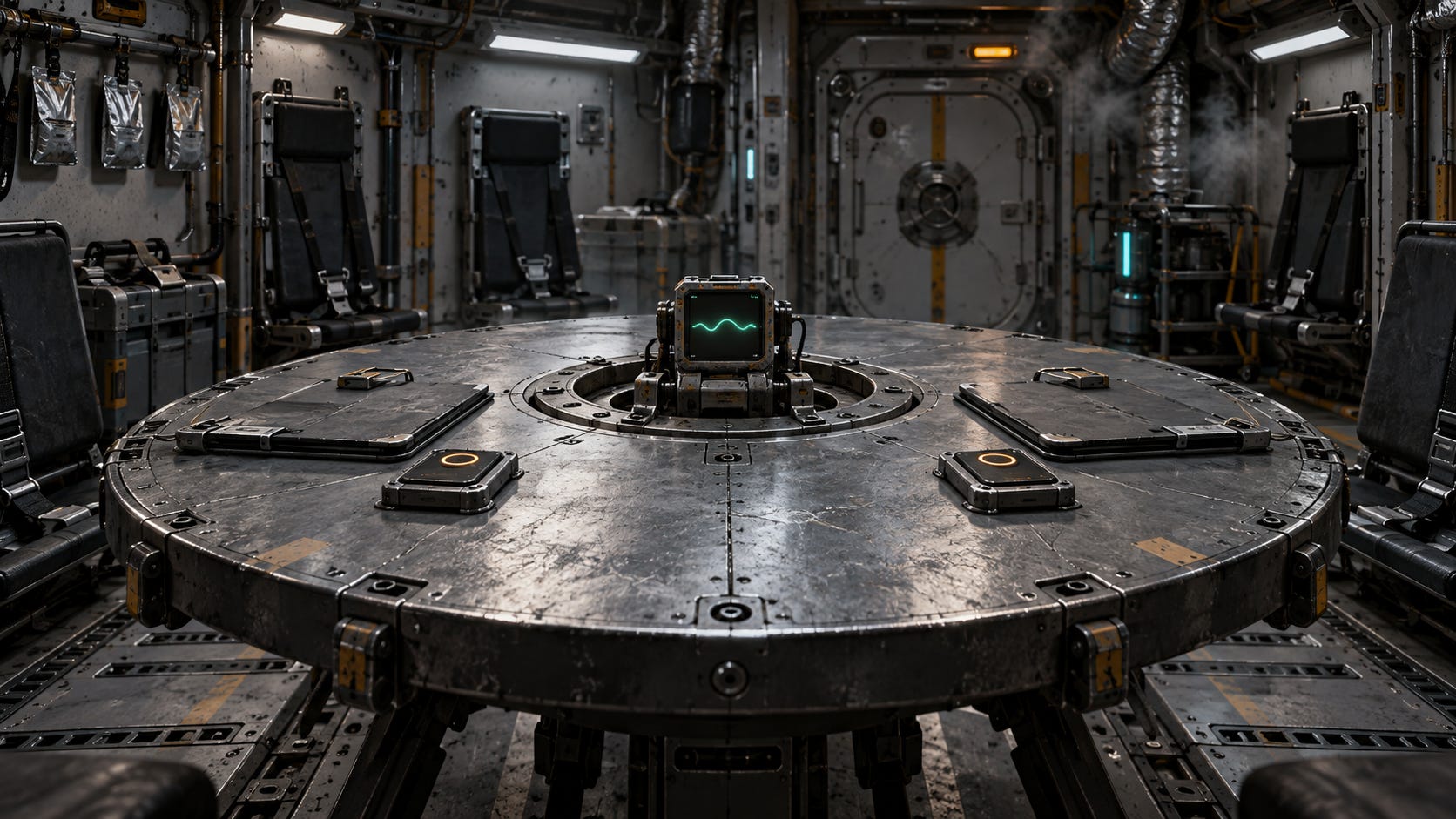
Sigrid Hedlund locked her boots opposite Kavita. Lena Vasquez took the rail beside the organizer, one cuff still marked by the dust no suit brush reached. Helios counsel secured two document panes at Sigrid’s right. Nobody used the folded seats.
The previous meeting had opened with offers already numbered and refusals already phrased. This one opened with the scrubbers under their feet and the station’s unedited record available on every terminal.
Sigrid touched the first agenda packet. “Immediate work authorization.”
“Medical status first,” Molefe said.
Counsel’s mouth tightened. “The emergency trend is stable.”
“Stable under temporary equipment, reduced activity, an isolated branch, and crews working outside their normal assignments.” Molefe turned the central display until no seat had a privileged angle. “I have not cleared normal station operations.”
The green marks continued at the same interval. They measured the canteen’s breathing zone, not station reserve. A stable line was not spare capacity. She had made that mistake impossible to claim before the crisis. She would not let a quieter room make it useful again.
Lena unclipped a slate from her cuff and fixed it beside the monitor.
“Life-safety roster,” she said. “Filter changes first. Brace replacement after the load path is signed. Duct inspection after the replacement holds through a full cycle.”
Three columns followed the tasks. Named crew. Withdrawal time. Return confirmation. Each line carried the same boundary: strike status preserved, no extraction, no production restart, no general return to duty.
Sigrid read the exclusions before the assignments. “Who can stop a task?”
“The worker at it. The technical lead. Either side’s safety lead. Medical for exposure.”
“Who releases it?”
“The reason for the stop decides the technical clearance. Air goes through environmental and medical. Structure goes through engineering and the worker who called it. Both safety leads release their holds. Medical keeps the exposure limit.”
Counsel opened a blank exception field. Lena reached across the table and closed it.
“Write the exception when one exists. Do not prepare the empty place first.”
Molefe checked the roster against the ward relief board. Two names appeared on both the filter rotation and the brace team. She marked them without commentary.
Kavita moved one assignment to the next shift. Sigrid replaced a Helios technician with a rested worker from the environmental reserve. The roster grew slower and safer by one line.
No one called the change efficient.
The second pane held the review terms.
Sigrid opened the maintenance-deferral history and the operations-security hold beside it. “Independent review of both chains. Original records, revision histories, access logs, and the authority attached to each hold.”
Kavita read past the heading. “Independent from which chain?”
“Ceres production and operations security. The reviewers cannot report through either office under examination.”
“Workers who disclose an unsafe order?”
“Protected from discipline for the disclosure.”
Lena tapped the management column. “Workers and managers. The orders moved both ways.”
Sigrid added the second word herself. “Workers and managers. Protected from Helios Ceres discipline when they preserve the order and report it through the review channel.”
Kavita added the same protection to the chapter’s side of the record. Neither promise offered immunity from an independent finding.
Counsel leaned toward her. “That language could shelter a participant.”
“It shelters the record,” Sigrid said. “Participation is a finding for the review, not a reason to make the next person stay quiet.”
She inserted one more line. The operations-security function identified at the credential level would lose privileged environmental and maintenance access pending independent review. The suspension attached to the function, not to an inferred person. Emergency access would require dual authorization and appear on both channels.
Molefe read the line twice. It closed a route without pretending the record had identified a hand.
Kavita brought up the joint emergency command. Its original header still limited it to the air crisis and named life-safety assignments.
“This worked because neither side could order the other into danger,” she said. “It expires when someone declares the emergency over. That returns every disputed decision to the same structure that spent the margin.”
Sigrid did not defend the old structure. “Your replacement?”
“Thirty-day interim safety council. Equal labor and management seats. Medical and engineering attend every session. Either side can stop council-authorized life-safety work. The stop stays narrow to the affected task or system unless the evidence requires more. Technical review and both releases before work resumes. Published minutes by end of shift.”
“Advisory?” counsel asked.
“No.”
Sigrid looked at the central monitor, then at the temporary-work roster. “Interim authority only. Permanent governance remains on the bargaining agenda.”
Counsel inserted an expiration condition beneath her sentence: normal operations would resume when the repaired trunk reported stable flow.
Molefe locked the field before anyone could sign it. “This monitor measures one canteen. The trunk instruments measure one repaired segment. Neither proves restored redundancy, safe exposure across the station, or medical clearance for normal load.”
“Then what ends reduced activity?” Sigrid asked.
“A separate medical and technical review recorded after the work. Not a sentence that clears the station before the readings exist.”
Sigrid deleted the automatic restart. Kavita added the separate-review requirement to both copies.
“Recorded,” Kavita said.
That difference mattered. Thirty days could keep a filter crew from being ordered past a hold. It could not decide who owned the authority after day thirty.
Molefe added a medical condition: no safety-council vote could clear an exposure restriction without the clinical record supporting it. Kavita accepted. Sigrid accepted. Neither called the condition neutral. It was simply outside both their control.
The service link chimed.
Ji-woo Han appeared seated at the repaired trunk’s control alcove, clipped at the waist with a carbon-dioxide trap beside her. Molefe had repeated the coordination, orientation, and capnography checks before clearing twenty minutes of seated instrument duty, no loaded-branch entry and no manual work. Mateusz Zieliński occupied the opposite rail with the matched-material receipt clipped before him. His task was custody and timing, not air certification.
Behind them, a temporary pressure panel carried three live traces. The damaged branch remained isolated.
“Replacement filters were seated under the existing emergency order,” Ji-woo said. “The repaired trunk segment has held at inspection flow for forty-one minutes. Live flow remains inside the band. That is a measurement, not release for the next load. Temporary scrubbers remain online.”
Mateusz opened the receipt on his side of the link. “The installed media matches the released inventory. No cargo dispatch or production movement is attached.”
Sigrid’s signature field remained empty. Kavita’s did too.
“Then call the airflow stable,” counsel said.
Ji-woo kept her hand off the test control. “The next step changes the load. The authorization is not complete.”
The scrubbers pressed their rhythm through the canteen deck. Molefe’s monitor added another green mark at the center of the table.
Sigrid signed for Ceres Operations.
Kavita signed for the chapter’s life-safety scope.
Lena signed the technical roster. Molefe signed the exposure limits.
The link verified four signatures and returned the same checksum to both channels.
Environmental brought the repaired segment to the authorized test flow. Three new marks crossed Ji-woo’s pressure pane. A fourth followed without leaving the band.
Ji-woo opened the live record. “Airflow stable through the repaired trunk. Damaged branch isolated. Temporary scrubbing still required. No clearance for normal load.”
Mateusz added the receiving time and witness mark. No celebration crossed the link. Ji-woo ended her instrument interval and transferred the panel to the environmental lead.
The first packet now held immediate work, review, protected reporting, suspended privileged access, and a council that would outlast the emergency order without pretending to be a settlement.
Several hands moved toward release clips.
Molefe opened the second agenda packet.
Wages. Scheduling. Maintenance authority. Access rules.
The words filled four panes, none of them softened by the air they had managed to save.
“Medical has no position on your wage table,” she said. “Medical does have a position on whether you leave the system that produced these injuries untouched. Normal operations remain uncleared. Continue.”
Nobody unlocked their boots.
The monitor stayed at the center while the harder table began.
If you enjoyed this story, you can follow the main story arc in The Exodus Rush, the first book in The Vethrak Requiem series.