


The alert did not come.
Kira woke at 0400 anyway, eyes open in the dark of her quarters, body braced for a klaxon that fourteen years of war had trained it to expect. The overhead stayed dark. The comm panel stayed silent. Hope lay docked at Prometheus Station with her reactor in standby, and the bunk beneath Kira did not carry the fine vibration that had run under her spine every night for eleven weeks.
A bed that did not hum was a bed that was wrong.
She lay still and catalogued the quiet the way she would catalogue a sensor anomaly. Air circulation on the low setting, a soft push from the vent above the door. The tick of hull plating equalizing against station temperature. Somewhere aft, a maintenance pump cycling on a schedule that had nothing to do with combat. No threats. No tasks. No reason to be awake, and no way to be asleep.
At 0412 she gave up.
The lights came up at ten percent when her feet touched the deck. The quarters were larger than any she had ever held: a captain’s quarters, permanent, the word still unfamiliar in her own head. Tanaka’s old mug sat on the shelf above the desk where she had placed it after the handover. Dark ceramic, chipped at the base, the only thing she had asked for. Beside it lay the letter from Marcus, still sealed. She had carried it from the strike force muster to the depot and back. Eleven weeks. She would open it when she knew what she wanted it to say.
The command pin rested on the nightstand where she set it every night. She picked it up, turned it once in her fingers, and put it back down. Taking it off to sleep was the last habit in her that still treated the rank as removable.
She dressed and walked her ship.
Hope’s corridors at 0430 were empty. Under thrust there was always someone: a watch rotation changing over, a repair detail, a runner with a pad and an apology. Docked and in standby, the ship kept a skeleton duty section, and the passageways belonged to the low warm lighting and the sound of her own boots. The sound was wrong too. Too loud. No engine harmonics underneath to fold it into.
She passed the ready room, the tactical office, the ladder down to the torpedo spaces. Her hand trailed along a bulkhead that was cool where the metal should have carried the working warmth of a ship at stations. A ship in standby was a body in hibernation. Alive. Breathing shallow.
“Good morning, Captain.” CLIO’s voice came from the corridor node at half volume, pitched for the hour. “Would you like a systems report?”
“Go ahead.”
“The reactor is in standby. The fold drive is in cold shutdown pending drydock inspection. Hull integrity is nominal. Life support is on station feed. All departments report secure.” A pause, longer than processing required. “Captain, all systems are nominal. There is nothing to check.”
“I know.”
She kept walking. CLIO did not comment on that. The AI had spent eleven weeks learning when to offer data and when to let her work a problem that had no data in it, and somewhere in those weeks the pauses had become their own kind of tact.
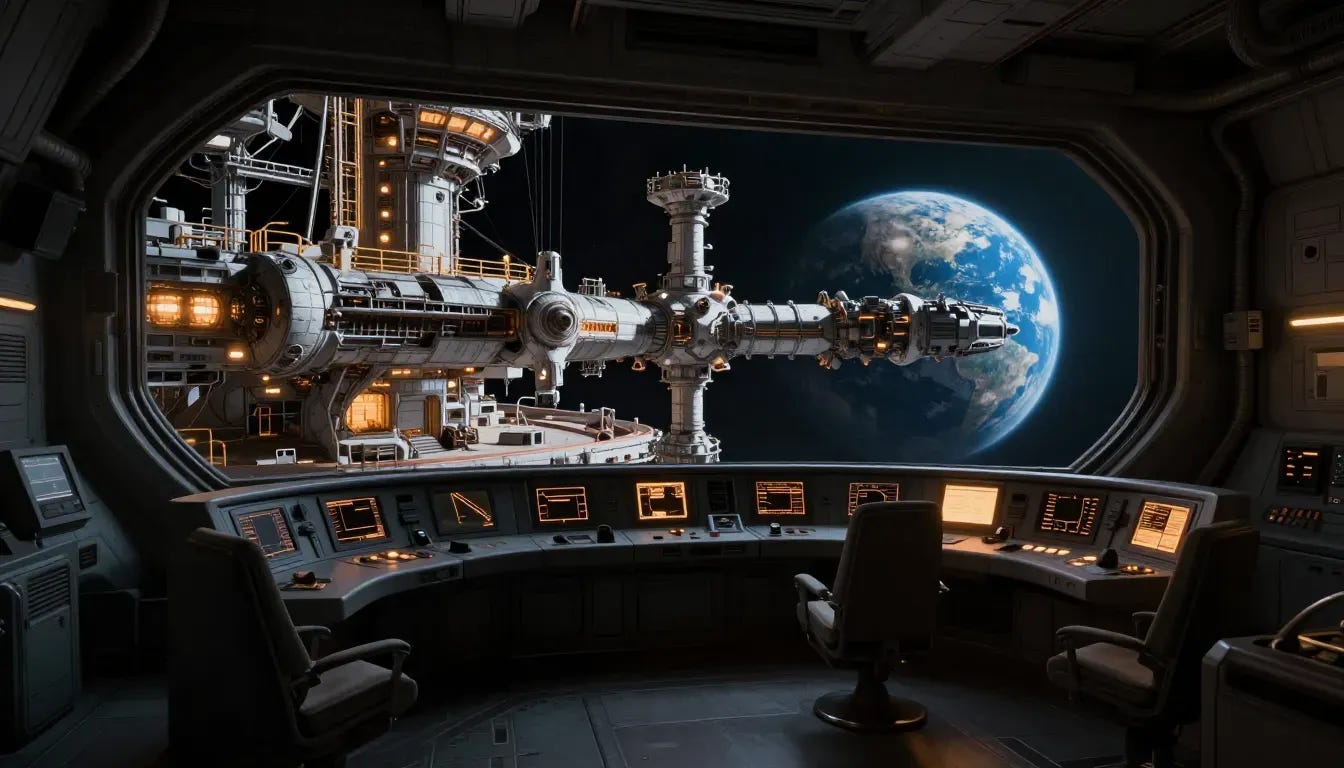
The bridge was dark except for the standby ring glowing faint around the command chair. She did not sit in it. She went forward instead, to the armored viewport, and stood looking at the thing there had been no time to look at on approach.
Prometheus Station filled the near field, a patchwork of salvaged hull segments and construction frameworks, work lights pooling amber against dark metal, the bones of the old fleet holding up the new one. Beyond the station’s third arm, blue and white and turning, was Earth. Home, in the technical sense. She had been gone eleven weeks. The planet did not look like it had counted them.
Fourteen years of war had taught her exactly what to do with every hour of her life. Threat assessment. Firing solutions. Contingency stacks three layers deep. No one had taught her what to do with a morning that asked for nothing. Her hands settled on the viewport rail, and she caught herself testing the rail’s mounting bolts with her thumb, and she stopped, and then she tested them anyway. All four were tight. Of course they were tight.
At 0515 she went to the mess.
The compartment was empty except for the duty lights and the smell of the overnight coffee urn. She drew a cup, black, and had taken one sip when a junior tech came through the hatch with a toolkit in one hand and a ration bar in the other and froze somewhere between a salute and an apology, caught by the sight of the captain standing at the urn at 0515 in a docked ship.
“Don’t,” Kira said.
The tech relaxed by a measurable fraction, managed a nod, and retreated to the far table with the ration bar. Kira turned back to her coffee. That was a skill she would need now, she supposed: releasing people from ceremony faster than they could commit to it. Tanaka had done it with stillness alone. Kira was still finding her own way to do it, the way she was still finding her own way to do most of what the chair required that the manuals never mentioned.
She took her cup to the table by the mess viewport and sat with the ship quiet around her, the station’s work lights sliding slow patterns across the tabletop as Prometheus rotated through its morning. Somewhere above her, on the station, repair schedules were being drafted for her ship. Somewhere below, on the planet, fourteen years of survival were being turned into plans for whatever came next. Both of those would reach her desk soon enough, and when they did, she would know what to do with them. That part had never been the problem.
This morning asked for nothing. She stayed in it as long as she could, coffee cooling in front of her, hands finally still.
The first morning of the rest of the war.
If you enjoyed this story, you can follow the main story arc in The Exodus Rush, the first book in The Vethrak Requiem series.