


The training platform orbited Tau Ceti at the distance that maximized sensor coverage and minimized emissions signature. Built from salvaged hull sections in the first hundred years after the attack, it was not beautiful. It was functional – a ring of interlocked modules around a central training bay, its walls worn smooth by generations of young Keraneth.
First-Light-After stood at the shield harmonics calibration station, running the final assessment sequence. The results were within tolerance. The instructor acknowledged with a brief pulse of Certainty-Tone. The calibration was correct. First-Light-After acknowledged without pleasure. The approval had been expected.
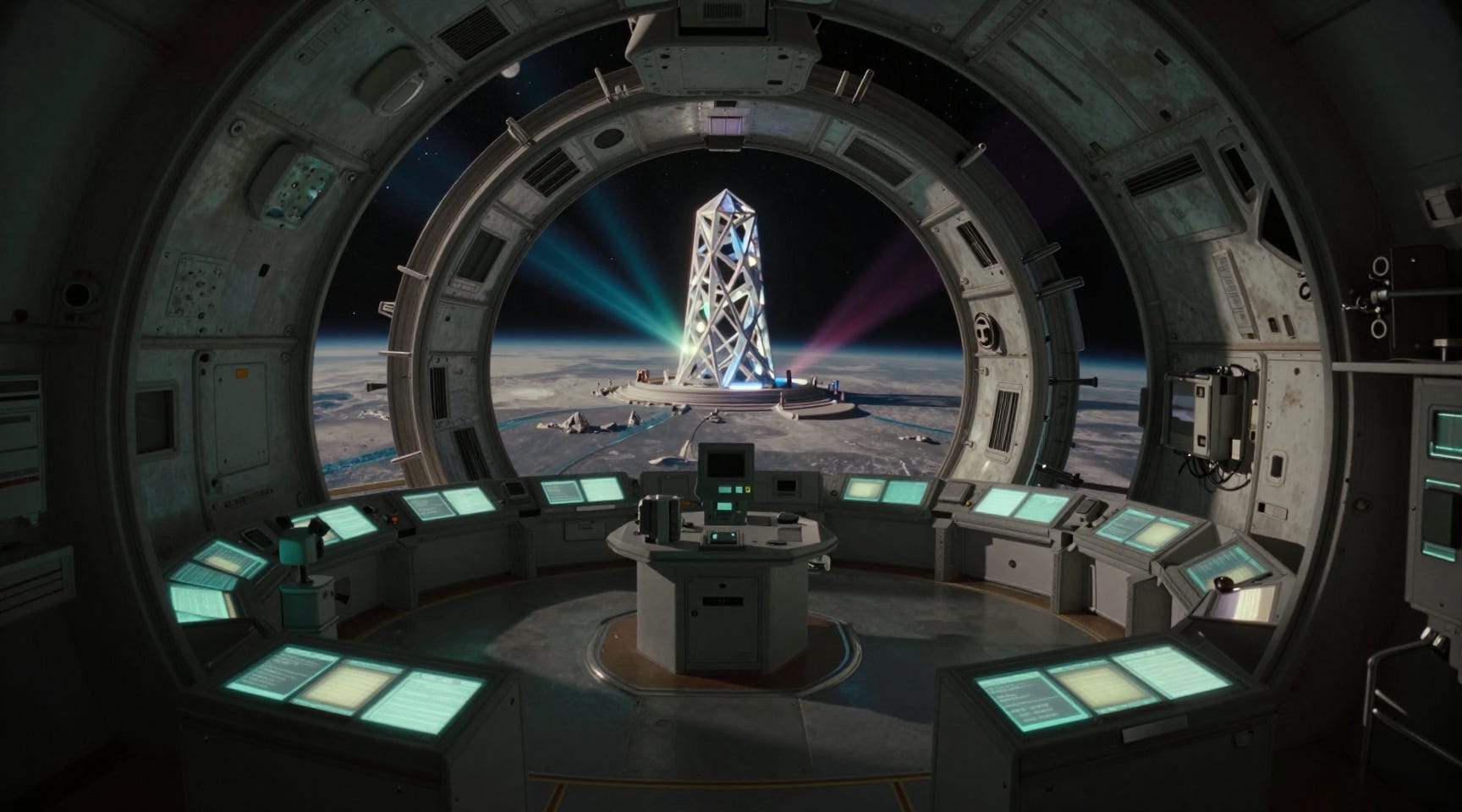
The training operated on a rhythm established before First-Light-After existed. Calibration exercises in the first watch, tactical simulations in the second, physical conditioning in the third. The rhythm had been the same for the previous generation. It would be the same for the next. First-Light-After had never questioned it.
The Monument pilgrimage was approaching. Every young Keraneth made it upon reaching a certain developmental threshold. The pilgrimage was not optional. It was the moment when the preparation became personal – when the theory of sacrifice became the experience of standing before its evidence.
The descent craft was small, built for atmospheric entry. The other candidates were silent during the transit. The craft passed through the upper atmosphere, and the external displays showed Tau Ceti IV unfolding below: impact craters scarring the landscape, reconstruction zones rising over ruins, and the Monument visible on the horizon, catching the star’s light and refracting it into patterns that were not random.
The patterns were the Monument’s communication. The Monument knew they were coming.
The landing site was a flat expanse near the Monument’s perimeter. The candidates disembarked into air thinner than the platform’s atmosphere, carrying the scent of dust and the residue of something organic. First-Light-After’s display surfaces registered the change – the Monument’s resonance field pressed against the lower frequencies like a harmonic the body could perceive even when the conscious mind did not focus on it. The Monument did not just exist in physical space. It existed in the sensory space of every Keraneth within range. It had been doing so for a hundred and ten years.
The approach was conducted in silence. The candidates walked in loose formation, their display surfaces cycling through subdued register. The Monument grew as they approached, resolving from a distant shape into a structure of specific geometry. The lattice was composed of millions of individual facets, each one a boundary between the preserved consciousness inside and the world outside.
First-Light-After stopped at the viewing position. The resonance field was immersive. The Grief-Tone of the volunteers saturated the air, layered with Gratitude-Tone and something First-Light-After could not immediately identify. The Monument held the full complexity of twelve hundred minds that had chosen to cease being discrete selves, their final broadcasts preserved in the crystalline matrix.
The weight was physical. It sat in the hydrostatic balance of the body, in the involuntary shift of the bioluminescent register toward colors the Monument broadcast. First-Light-After’s display surfaces pulsed in Grief-Tone ultraviolet without conscious decision. The Monument was not communicating. It was present, and presence was enough.
The training had prepared for tactical scenarios and shield harmonics. It had not prepared for this: the awareness that a hundred and ten years ago, twelve hundred individuals had stood in this same space, alive and separate and capable of choosing, and had chosen to enter the lattice. The first volunteer – Keth-Vethan – had broadcast Hope-Resonance in their final moments, a pulse of soft rose to copper still present in the Monument’s lower frequencies. It was there, pressing against the display surfaces. The Hope-Resonance was not an abstract concept. It was a color that pressed against the display surfaces with the same physical reality as the star’s light.
First-Light-After knelt. Not from protocol. There was no ceremonial requirement. First-Light-After knelt because standing was wrong in front of something that had held its shape for a hundred and ten years without breaking.
The Monument did not respond. It did not need to. First-Light-After remained kneeling while the star moved across the sky, the lattice’s refraction patterns shifting with the angle of the light. The other candidates were distributed around the viewing perimeter, each processing the Monument in their own silence. No one spoke. The Monument was not a place for communication. It was a place for being in the presence of what had been sacrificed.
First-Light-After returned to the training platform at the end of the cycle. The descent craft lifted from the surface and the Monument shrank on the horizon, resolving back into a crystalline shape against the landscape.
The shield harmonics exercises resumed the following cycle. But the calibration was different now. First-Light-After adjusted a setting that had previously been acceptable, pushing the resonance margin closer to the upper tolerance limit. The existing calibration was within the acceptable band. First-Light-After had stood before the Monument and carried the weight of a hundred and ten years of preparation, and the margin that had been acceptable before the pilgrimage was not acceptable now.
The instructor registered the adjustment and broadcast a Query-Tone. First-Light-After responded with Certainty-Tone: the calibration was correct. The adjustment was intentional. The instructor acknowledged and returned to the next station.
The rhythm of the training platform continued. But First-Light-After had changed, and the change registered in small adjustments across the subsequent cycles: a calibration margin tightened, a simulation repeated until it exceeded the benchmark. Small adjustments. The kind another young Keraneth would inherit as the new standard, generations from now, without knowing anyone had tightened them.
The Monument had not told First-Light-After what to do. It simply held the weight of the choice twelve hundred individuals had made, and let those who stood before it decide what to do with the weight. First-Light-After had decided: the preparation would be deeper. The margin would be narrower.
The Monument continued its silent refraction of the star’s light on Tau Ceti IV, a hundred and ten years into the wait, receiving the adjustments of a young Keraneth who had stood in its presence and decided that the weight was not enough to break them.
If you enjoyed this story, you can follow the main story arc in The Exodus Rush, the first book in The Vethrak Requiem series.