


Samrawit Assefa secured the first coupon in its tray before changing the result to pass.
The little welded strip had returned from the load frame without a permanent bend. Its dimensions matched the baseline. The ultrasonic scan showed no new indication. Both halves came from the same receiving row, with the same upstream certificate behind their local tags.
She clipped the tray into the rack and opened the next record.
The other plate row passed too.
Two clean results. Neither answered the question waiting in Slip Two.
Beyond the lab partition, Article Four hung in its slings. The short barrel would join two pressure hulls at a place Samrawit was not cleared to know. Tuva Hawthorne’s red hold plate still crossed its open mixed transition. The two plate populations met the same receiving limits. Their hardness readings occupied different parts of those limits, and the blind manifest offered no forming or thermal history to explain the separation.
The test operator waited with one hand on the frame’s restraint rail.
“Mixed coupon next?”
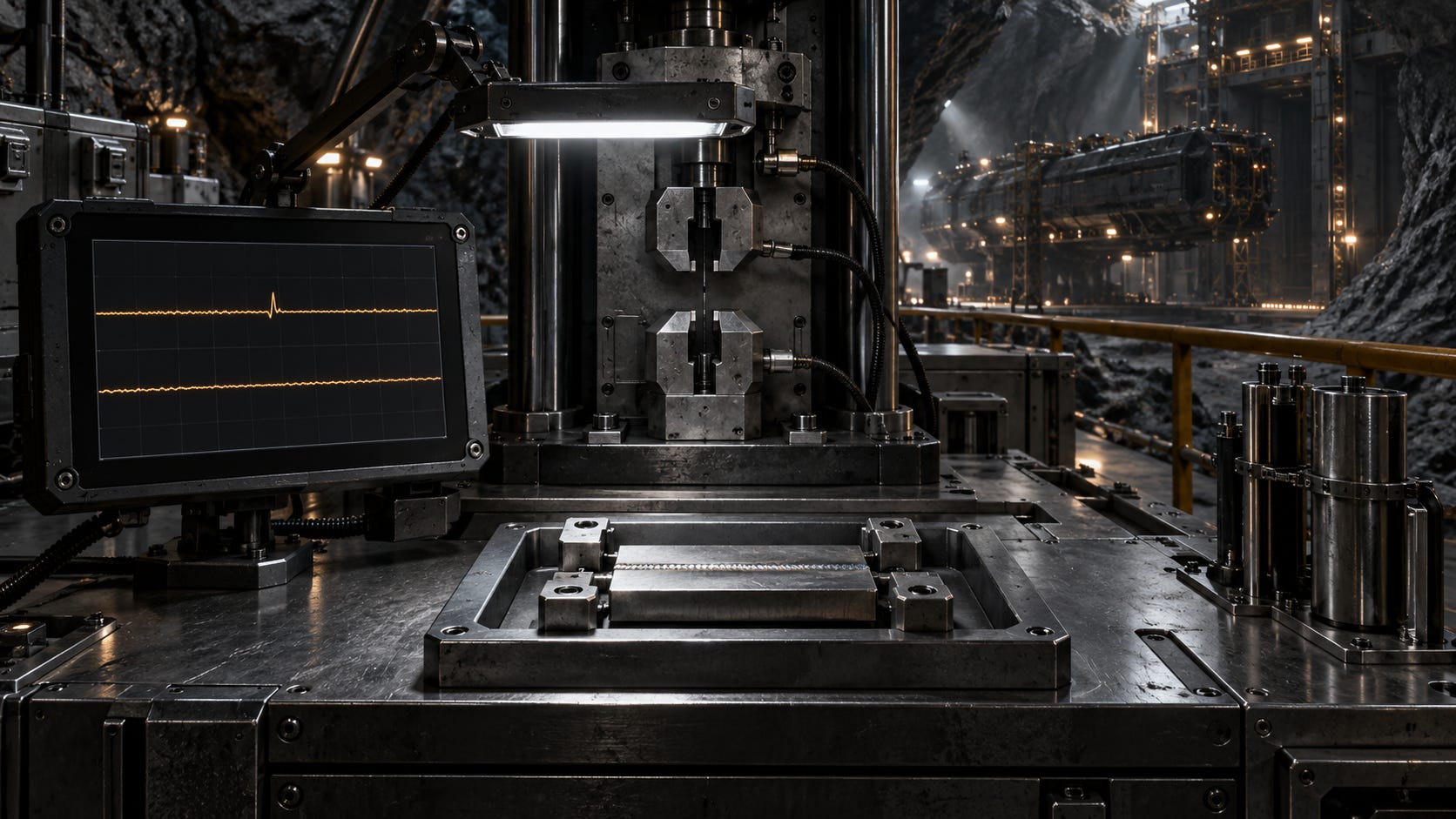
Samrawit checked the power reservation. Foreman Cho had moved another bay’s work to give her this cycle. A second mixed specimen waited in a retained slot beside the first, already prepared through the same joining and thermal procedure. The slot had cost someone an idle shift and someone else a later one.
“Check the baseline with me.”
They compared the first mixed coupon’s dimensions and scan with its preparation record. Tuva’s procedure number matched the approved revision. Heat input and the recorded thermal cycle stayed inside its qualified range. The weld face carried no undercut or visible crack. Its two halves retained separate material links.
Samrawit pulled herself into the console restraint and fastened the waist strap. The operator closed the frame guard and moved behind the marked boundary. Load traveled between the machine’s grips; her body supplied none of it.
The acoustic channels answered their reference check. Each pickup could detect a small elastic disturbance through the steel. They could also detect a grip settling, an attachment shifting, or a cable brushing something it should not touch.
She retained the reference traces beside the specimen baseline.
“First stage.”
The actuator loaded the strip. Its strain curve rose inside the acceptance envelope and held there. They returned to zero, then advanced through the remaining prescribed stages.
At peak load, every line stayed where the procedure allowed it.
The operator eased the force down.
One acoustic channel marked a short spike.
Samrawit lifted her hand from the completion field.
The force continued its controlled return to zero. No second channel joined the first. The strain curve closed inside limits, and the specimen remained straight between its grips.
“That was on the way down,” the operator said.
“Keep the zero-load hold. Save every channel.”
The short spike appeared on the transition pickup’s trace. One arrival on one channel could not locate its source reliably. It had a time, an amplitude, and a place where the machine had listened. Those were different things.
She enlarged it without changing the display threshold.
Too little energy for the rejection criterion. Enough to keep her hand off the next field.
After the hold ended, Samrawit confirmed zero force and actuator isolation before the operator opened the guard.
She clipped to the service rail, released her console strap, and drew herself along it. Her inspection lamp remained tethered to her wrist. Nothing touched the pickup until she had photographed its position and the cable path.
The retaining clamp held firm. The cable had clearance through the grip’s full travel. She checked the coupling material between sensor and steel for a displaced edge, then inspected the contact face after removal. No obvious dry patch. No loose attachment to explain a single pulse.
“Clean that seat,” she said. “Same measured coupling layer. Record the remount.”
While the operator worked, she checked the grip witness marks against the setup photograph. No visible slip. The fixture displacement record showed no step at the event time.
That ruled out a large movement. A small release at a contact could still make sound without leaving either mark.
She repeated the channel check against the reference. Timing and response remained inside calibration limits. She compared the pulse with the empty-fixture record. There was no matching event she could point to and call an answer.
The coupon’s post-test dimensions matched its baseline. A repeat ultrasonic scan found no new indication at the weld or beside it.
Tuva arrived at the lab’s access rail. She checked her clip before bringing her cuff display within reach.
“Is that mine?”
Samrawit turned the specimen record toward her. “Your procedure. First mixed pair.”
Tuva studied the enlarged trace. Her free hand closed around the rail.
“Did the weld open?”
“We have no indication of that.”
“What made the sound?”
“I can’t assign it.”
The lab fan drove a steady draft across Samrawit’s cheek. In the bay, the red plate held its place across the open seam. A failed coupon would give the yard a decision it understood. A clean coupon would let it recover hours. This one offered neither convenience.
“Repeat it,” Tuva said.
“That is what the second specimen is for.”
Samrawit returned the first coupon to its own tray. She retained the original setup and every trace, including the quiet channels. Keeping only the spike would make it look stronger than it was.
The operator mounted the second mixed specimen. Its material pair, procedure revision, geometry, and baseline checks matched the planned comparison. The remounted pickup received a fresh reference check. Samrawit attached that result without replacing the earlier calibration.
They cleared the frame again.
The second strain curve rose, held, and returned through the interval where the first pulse had appeared.
The transition channel stayed quiet.
Samrawit waited through the full zero-load hold. No repeat at the same pickup. No corresponding event elsewhere that established the same source. The second coupon remained inside every release limit, its final dimensions and ultrasonic scan unchanged.
Tuva’s cuff chimed with a shift message. She silenced it without opening the torch queue.
“Does that clear the first one?”
Samrawit placed both unloading traces on the screen.
“It gives us a second result.”
Cho called while she completed the disposition.
“Do we reject the paired stock?”
The rejection field waited beneath her thumb. Beside it sat the acceptance limits, unchanged by the amount of time the yard had paid for these tests.
“The coupons meet the limits,” she said. “I cannot reject both rows on this event.”
“Can the mixed work proceed?”
“Under a witnessed conditional work package. Structural release stays separate.”
She entered the event as an unresolved intermittent indication and linked both complete data sets. The first pulse remained visible beside the second coupon’s quiet trace. Fixture release, coupling behavior, and a material response remained possible explanations. None became the finding.
Her requirements followed: dense acoustic coverage across the full-geometry transitions, retained strain channels, a pre-test ultrasonic baseline, and witnessed staged proof with controlled unloading. The little frame could not reproduce the barrel’s restraint or the way its loads crossed a curved interface.
“Inspection has to accept the coverage and witness plan,” she told Cho. “This disposition does not remove the red plate. The next work authorization has to carry the condition.”
“Send it with the power request.”
She did. The proposed test block entered his queue without a structural-release signature.
Tuva read the condition at the rail. “I can carry that into the work package.”
Samrawit checked the sample retainers once more. Both coupons stayed in numbered trays, each retaining links to both plate rows. Their preparation records showed what the yard had done to them. The missing upstream history remained missing.
She left that question attached.
Under the lab light, the first coupon looked whole. On the screen beside it, the irregular trace still waited for a place in the metal.
Author’s note: This story continues the Site Anvil arc in late Year 3, before Article Four’s mixed transitions are welded. A passing small specimen establishes the result of that test, not the behavior of a complete hull structure.
New to The Vethrak Requiem? Start with The Exodus Rush, Book 1, where humanity fights for survival after an alien invasion using technology it barely understands. These short stories explore the wider universe; the novel begins the main story.