


The skirmish was not going well.
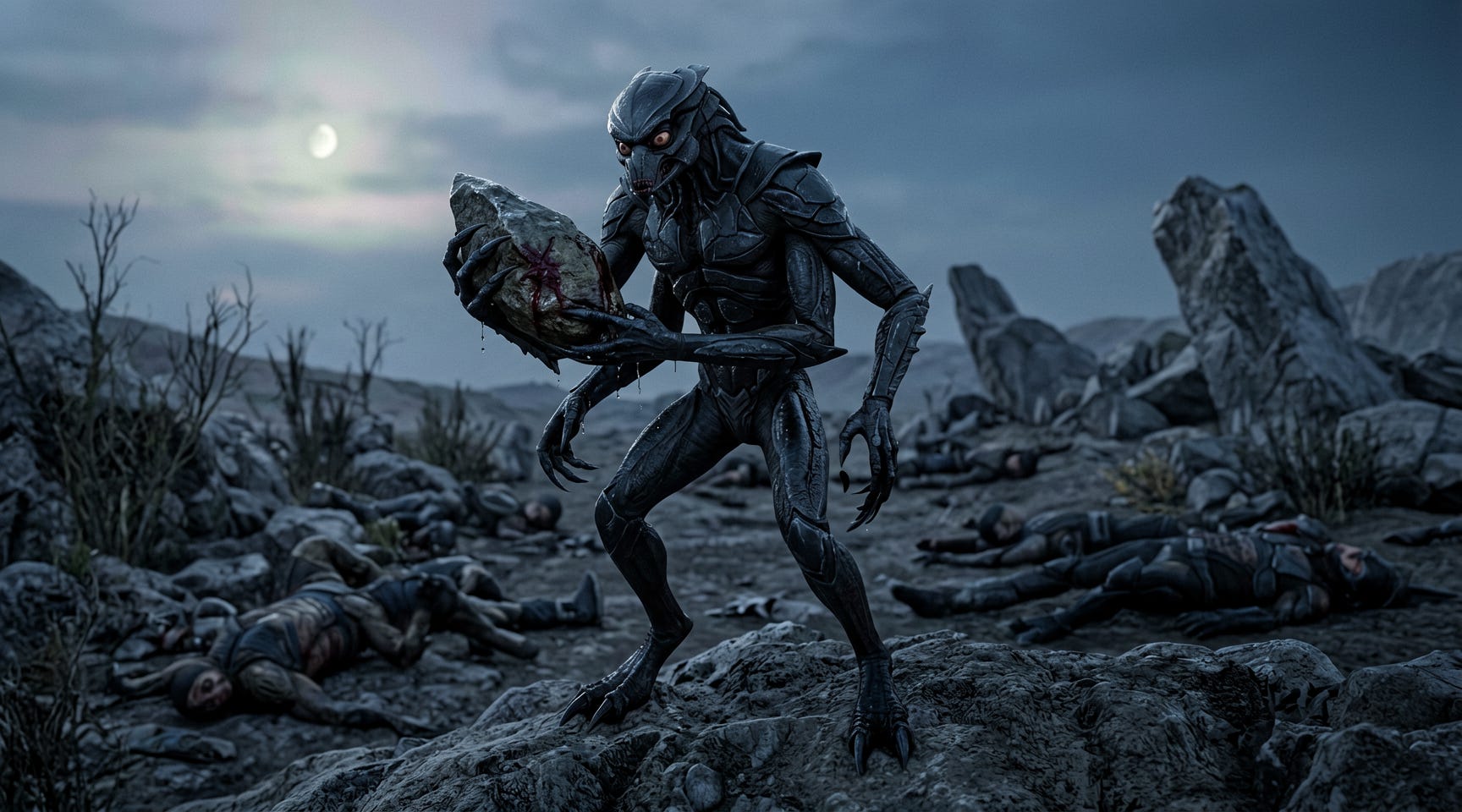
Kreth pressed against the stone outcropping, breathing hard, the sharpened rock in the upper right hand still wet with something that was not stone-dust. The hunters were larger than the scouting reports suggested. Faster. The ambush position Kreth’s group had spent two cycles preparing had been discovered before the first strike could spring, and now the skirmish was about survival, not strategy.
Three of Kreth’s group were down. Their bodies were visible from behind the outcropping, the limbs still, the membrane at the joints darkening as the internal pressure equalized to the air. The hunters did not eat their kills. They killed and moved on, searching for the next heartbeat that did not match their own. The waste was something Kreth’s kind did not have language for. The hunters left meat. They left knowledge. They left the possibility of becoming stronger.
The sound of stone against chitin came from Kreth’s left. One of the hunters had found Vess. The impact reached Kreth through the ground, and then the silence, and then the hunter’s cry. Not pain. Acknowledgment. The hunter was calling others.
Kreth’s legs were shaking. The hydrostatic body compressed without conscious command, the terror response narrowing the frame by a third, pressing the membrane tight against the chitinous plates. The compression was supposed to make Kreth harder to detect. It had never been tested against a hunter this close. Kreth had never been this close to a hunter and survived.
The opportunity did not come as a plan. A hunter, wounded by a strike from one of Kreth’s group, staggered past the outcropping, off-balance, its sensory apparatus tilted toward the sounds of the continuing skirmish rather than the shadow behind the stone. Kreth did not think. The arm moved.
The sharpened rock entered the hunter’s eye socket. The hunter’s body registered the intrusion for half a heartbeat before the nervous system ceased. The hunter fell. The impact through the ground was heavier than Kreth had expected.
Kreth stood over the body. The hunter’s four arms were still. The hunter’s legs were still. The hunter’s chitin showed the same wear pattern as Kreth’s own, older, more layered, but the same substance. The hunter and Kreth were not the same species, but they were built from the same principles. Chitin and membrane. Arms and legs. Senses tuned for hunting and hiding. The hunter was larger. The hunter was faster. The hunter was dead.
Something in Kreth’s body knew what to do next.
The hunger was not the familiar hunger of an empty stomach. It was deeper. Cellular. A recognition that the hunter’s body contained something Kreth’s body needed, a capability, a sensory enhancement that Kreth’s kind had not evolved naturally and could not acquire any other way. The hunger was not a choice. The hunger was an imperative.
Kreth’s lower hands found the wound where the sharpened rock had entered. The upper hands found the neural tissue beneath the chitin. The body moved before the mind could object. Not much. A fragment. The amount that could be held in two cupped hands.
The effect was immediate.
Kreth’s nervous system registered the change before the conscious mind could categorize it. The spatial awareness expanded. The positions of the remaining hunters resolved with a precision that had not been possible a moment ago. Distinct points of pressure in a three-dimensional map that unfolded behind the eyes. The hunter’s spatial sense was now Kreth’s spatial sense.
The hunter’s speed was now Kreth’s speed. Not the full capability, a fragment of tissue could only convey a fragment of the trait, but enough. Kreth’s legs were different. The hydrostatic pressure redistributed. The body recalibrated around the new information, the new architecture, the new possibility written into the cells.
Kreth looked at the remaining hunters and they were no longer threats. They were sources.
The skirmish continued around Kreth. The sounds of impact, of chitin striking stone, of the hunters’ acknowledgment calls. Kreth’s group was still losing. But Kreth had crossed a line that the mind had not known existed, and there was no crossing back.
The hunger did not fade. It sharpened.
Kreth moved. The new spatial awareness tracked a hunter approaching from behind a collapsed rock formation, and Kreth was already there when the hunter rounded the corner. The sharpened rock was still wet. The hunter’s eye socket was not armored from the side. The rock found it. The hunter fell.
Kreth did not consume this one. The hunger remained, but it had refined into something more discriminating. The first hunter had given spatial awareness and speed. This hunter’s traits might not be additive. The body knew the difference.
The skirmish ended. The hunters withdrew. The engagement had cost more than anticipated, and the cost-benefit calculation of a predator was as instinctive as the hunt itself. They would return. They always returned. But not tonight.
Kreth’s group had lost four. Six remained. Kreth stood among the survivors, the sharpened rock still in hand, the new spatial awareness still resolving every heartbeat within a body-length, the legs still carrying the hunter’s speed.
Vreth, the oldest of the group, looked at Kreth for a long moment. Vreth did not speak. The language did not have a word for what Vreth was registering. But Vreth’s posture shifted. The weight redistributed. Something had changed. Vreth did not know what, but Vreth knew it had happened during the skirmish, and Vreth knew it had happened to Kreth.
Kreth did not explain. There was no word for the hunger. There was no word for the cellular recognition. There was no word for the moment the body had decided, on a level below conscious thought, that the hunters were not threats to avoid but sources of capability. The language would need new words. The species would need a new framework. Neither existed yet.
Kreth walked away from the others. The sky was darkening into the long twilight. The hunters’ calls faded into the distance. The bodies of the fallen, Kreth’s group and the hunters both, cooled on the stone. Kreth carried the hunger like a second body, pressed against the inside of the membrane. It was not painful. It was simply present, and it would never not be present.
The Vethrak, not yet called Vethrak, not yet anything but survivors on a world that wanted them dead, had discovered what they were. Not through philosophy or strategy. Through a biological imperative that activated the first time one of them killed a hunter and the body recognized that the hunter contained what the Vethrak needed to become something else.
The Claiming would take thousands of years to develop. The Dominion. The Five Laws. The Culling Doctrine. The Genetic Archive. The Voice. All of it was still waiting, still unimagined, still millennia away. But the seed had been planted. Not in a mind. In the cells. In the membrane. In the hydrostatic body that had learned to compress from terror and was now learning to expand from hunger.
Kreth reached the ridge and stopped. The world stretched below, gray and broken, the scars of predator territory visible in the stunted vegetation and the collapsed stone formations. The hunters were out there. The new spatial sense registered their heartbeats, distinct in the growing dark. They did not know what had changed. They did not know that one of the prey had consumed one of them and been altered. They would learn.
Kreth’s hands tightened on the sharpened rock. Not from fear. From something that was not quite anticipation and not quite resolve. The closest word the language would eventually develop was purpose. But the language was still thousands of years away.
In the growing dark, the creature that would become the galaxy’s apex predator stood on a ridge on a nameless world and the hunger settled into the architecture of the body. It would never leave. It would be passed to offspring. It would shape every decision. It would write itself into doctrine and ritual and identity. It would eventually consume the species that carried it, turning survivors into harvesters, prey into predator, the hunted into something that had forgotten what it was like to be hunted.
The creature on the ridge was still Kreth, holding a rock that had killed two hunters, carrying a spatial sense that belonged to one of them, knowing with a certainty that sat in every cell of the body: the Vethrak would never be prey again.
The price of that certainty was that the Vethrak would now always be hungry.
If you enjoyed this story, you can follow the main story arc in The Exodus Rush, the first book in The Vethrak Requiem series.