


The address was a cargo expediting office on the third commercial ring of Mimas Station, behind a freight-quotation kiosk and two doors down from a hydration vendor. The door read KADE LOGISTICS in stenciled industrial gray. The lettering was clean. The paint was old.
Anya read the door for a half-second longer than she needed to.
The shadow-market reply had given her a time and a name. The name was Davit Kade. The time was the back end of second shift, when the freight-quotation kiosk was closed and the corridor was loud enough with cargo handlers to make a meeting forgettable.
She went in.
The front office was unremarkable. A counter, a quotation terminal, a chair for waiting clients, a filing rack with hard-copy bills of lading because the inner-system carriers still demanded them. A clerk who was not a clerk looked up from a manifest, recognized her without recognizing her, and tilted his head toward a door at the back. Anya walked through.
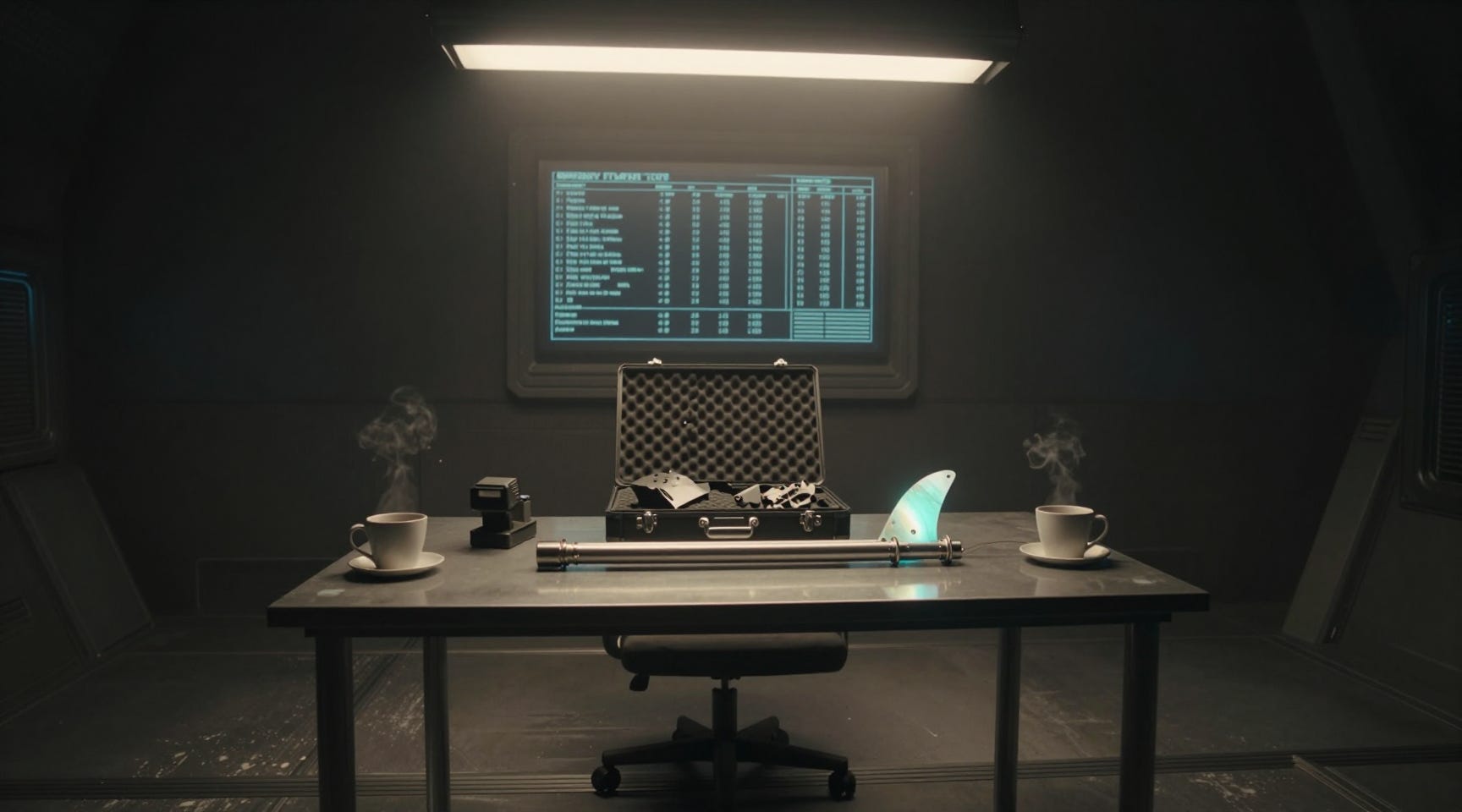
The back room was the same kind of unremarkable. A desk, two chairs, a wall slate showing freight rates between Ceres and the Saturn ring belt, a coffee maker on a side counter that was producing actual coffee from beans Anya had not seen in two years.
The man behind the desk stood up.
“Anya Rask,” he said. “Davit Kade. Sit, please. Coffee?”
He was thirty-four, maybe a year older. Mid-height. The kind of face that had decided early in life to be pleasant. He had the easy posture of someone who had been comfortable in offices since before the invasion and had not lost the habit. His clothes were good. Not new. Cared for.
She sat. She did not answer about the coffee.
He poured two cups anyway. He set one on the desk near her right hand. He sat down opposite her with his own cup, and he waited.
“You said triple Salvage Protocol valuation,” Anya said.
“I said triple in the first message. Triple is the floor. The actual price depends on what you brought.”
“I brought three samples.”
“Show me.”
She set the field case on the desk. She opened it. The three samples lay in their molded foam cradles. A hull-plating fragment with a clean Vethrak metallurgical signature. A section of internal conduit with an intact alloy lining. A stabilizer fin from a fold-cusp lance, smaller than her palm, the rarest piece a freelance salvager would willingly part with.
Davit looked at the samples without picking them up.
He picked up a small handheld scanner from his desk drawer. He passed it over each piece without touching them. He read the screen. He set the scanner down.
“The plating is grade two. Standard market for grade two right now is eleven hundred per kilogram at Salvage Protocol valuation. I’ll pay forty-two hundred.”
“That’s not triple.”
“Triple is on the conduit. Salvage Protocol values intact alloy lining at eight hundred a meter and nobody who buys it can use it. I have a buyer who can use it. Twenty-eight hundred a meter. The fin is what I want most.”
He looked at her for the first time the way a buyer looked at a seller. Direct. Patient.
“Fold-cusp components don’t move through Salvage Protocol at all. They classify as restricted research material. The protocol office will hold it for ninety days, run it through three inspections, and pay you a research stipend that is an insult. I will pay you twelve thousand for the fin. I will pay it tonight.”
The number sat between them.
Anya did the arithmetic. She did it twice because the first time her face had not moved and she wanted to be sure it would not move on the second.
“What’s the catch.”
“There isn’t one on this transaction. There is a question on the next one.”
He let that hang.
He drank his coffee. He waited.
“Ask the question,” she said.
“I would like a standing arrangement,” Davit said. “You bring me what you find. I pay current rate plus a small premium for consistent supplier relationships. The premium is five percent for the first six months. After that we renegotiate on volume. You don’t have to bring me everything. You don’t have to tell me what you don’t bring me. I don’t ask where it comes from. I don’t ask who else you sell to. The only thing I ask is that what you sell me, you sell me clean. No double-dipped Salvage Protocol claims. No counterfeit metallurgical signatures. Clean inventory.”
“And in return.”
“In return you get a buyer who pays on time, in thermal credits, at rates the protocol office cannot match. You get access to a courier chain that reduces your UEN scrutiny on transit. You get someone who can place a fold-cusp fin without holding it for ninety days.”
“Thermal credits.”
“Yes.”
“Not protocol scrip.”
“No. Thermal credits transfer through six different settlement systems and clear in under an hour. They hold value against any commodity backing they touch. The protocol scrip is paper. It buys what the protocol says it buys.”
Anya knew thermal credits. She had not held them in volume. The freelance market was supposed to run on protocol scrip and barter, with thermal credits reserved for the kind of inner-system financial activity she did not participate in. Hearing them named here, in a back room on Mimas Station, was the answer to a question she had not yet thought to ask. She filed it.
“I want to think about it,” she said.
“Take the night.”
He did not push. He did not raise the rate. He did not add a sweetener. He sat with his coffee and waited for her to decide whether she had already decided.
Anya looked at the three samples on the desk. The fold-cusp fin caught the light from the overhead panel and sent a small clean reflection back at the slate on the wall. She thought about the Polaris fragment in her chest pocket. She thought about the cabin paneling she had cataloged as personal effects on a manifest the night before. She thought about the two-word reply she had sent six months after she had first read the message and the way the airlock had cycled while she held one hand to her chest and did not move.
The line had crossed in the field. The paperwork was catching up.
“I don’t need the night,” she said.
The handshake was not ceremonial. He did not hold it longer than was necessary. He did not look at her the way a man looked at a woman he had recruited into something. He shook her hand the way one professional shook another’s at the close of a clean negotiation, and the moment was over so quickly that Anya was halfway out the door before she registered that her hand was changed.
The thermal credit transfer cleared on her wrist comm before she reached the corridor.
The number was good. She had not expected it to be that good. The fin alone covered three months of fuel and consumables, and the conduit and the plating made the rest of her last six weeks of solo work irrelevant.
The number was also not the thing. She knew it was not the thing while she watched it sit on her wrist comm and resolve into a transferable balance.
The relationship was the thing.
She walked back down the third commercial ring with her empty field case in her left hand and a cup of coffee she had not asked for in her right. The coffee was actual. The beans had come from somewhere, through someone, on a chain that was not the protocol office. She drank it slowly.
The Underweight was in bay seventeen. Maren would be sleeping on the bunk. Bero did not exist yet. The crew that would replace the work she was about to do alone was not yet on a station roster anywhere.
Anya finished the coffee at the airlock. She set the empty cup on the recycler shelf. She cycled the door.
She did not look back at the corridor.
Behind her, two doors down from a hydration vendor, on a door with stenciled gray lettering that read KADE LOGISTICS, a man she had now done business with closed a field case and put it in a desk drawer he kept locked.
He poured himself another cup of coffee.
He was already thinking ahead.
Author’s note: Day Seven of the Iron Wake Origins arc. Anya Rask meets Davit Kade for the first time, in the back room of a cargo expediting office on Mimas Station. He pays in thermal credits, on time, in full, at rates the Salvage Protocol office cannot match. He does not ask where the inventory came from. He offers a standing arrangement with a five percent supplier-relationship premium, and he waits. The handshake is the moment the line is officially crossed and unofficially erased. Anya walks back to the Underweight with a thermal credit transfer confirmation on her wrist comm and the certainty that the number is good and the number is irrelevant. Davit was already thinking ahead. He will eventually propose the eighteen percent commission structure, the courier chain through Enceladus relay, and the name “Iron Wake.” Year 1, Month 10. The institutional architect has just been introduced.
If you enjoyed this story, you can follow the main story arc in The Exodus Rush, the first book in The Vethrak Requiem series.