


The fragment had been in Anya’s chest pocket for three days, and she had not looked at it once since pulling it from the cold cache aboard the Underweight.
She set it on the desk in D-17 now and looked at it for the first time under the bay’s overhead strip. The piece was the size of a thumbnail. The cut edge had the wrong color. The lattice on the broken face caught the light in a way station scrap could not.
It would either be seventh-generation Vethrak hull or it would be something her crew had been salt-stung into believing was Vethrak hull. The difference was a margin that would move it through Davit Kade’s chain at a number she had been needing for two months, or sit in the back-bonded subsection of D-17 until she could admit she had spent thermal credits on a piece of scrap.
She had run it through her field analyzer twice on the way back from the ring. The analyzer was a salvage-grade unit, second-hand, calibrated against UEN reference samples four years older than they should have been. The analyzer had said probable. The analyzer said probable about a great many things. Probable was a word she could not afford to take to a buyer.
She had heard about the metallurgist last cycle from a brokerage runner who owed her a favor and would not have given her the name if he had not been three drinks in. The runner had said the metallurgist worked private. The runner had said the metallurgist had been at Tethys Yard before the budget cut and did not advertise. The runner had said the metallurgist was precise.
That was the word that had stayed with her. Precise.
Anya put the fragment back in her pocket. She locked D-17 behind her. She walked down ring corridor four toward the desalination plant, past the grates venting their twice-a-shift vapor, and then deeper into a corridor she had not walked before.
She had to ask directions twice.
The first person she asked was a junior maintenance tech who did not know what she meant. The second was a station administrator who did, and would not say so, and pointed without looking at her.
The corridor narrowed. The overhead strips dimmed to half-power. The deck plates were stamped with a generation-three station designation that had not been the current one for nine years. She passed a hatch sealed in plastic ribbon, a bulkhead patched with foam, an empty office with the door open and the chairs gone.
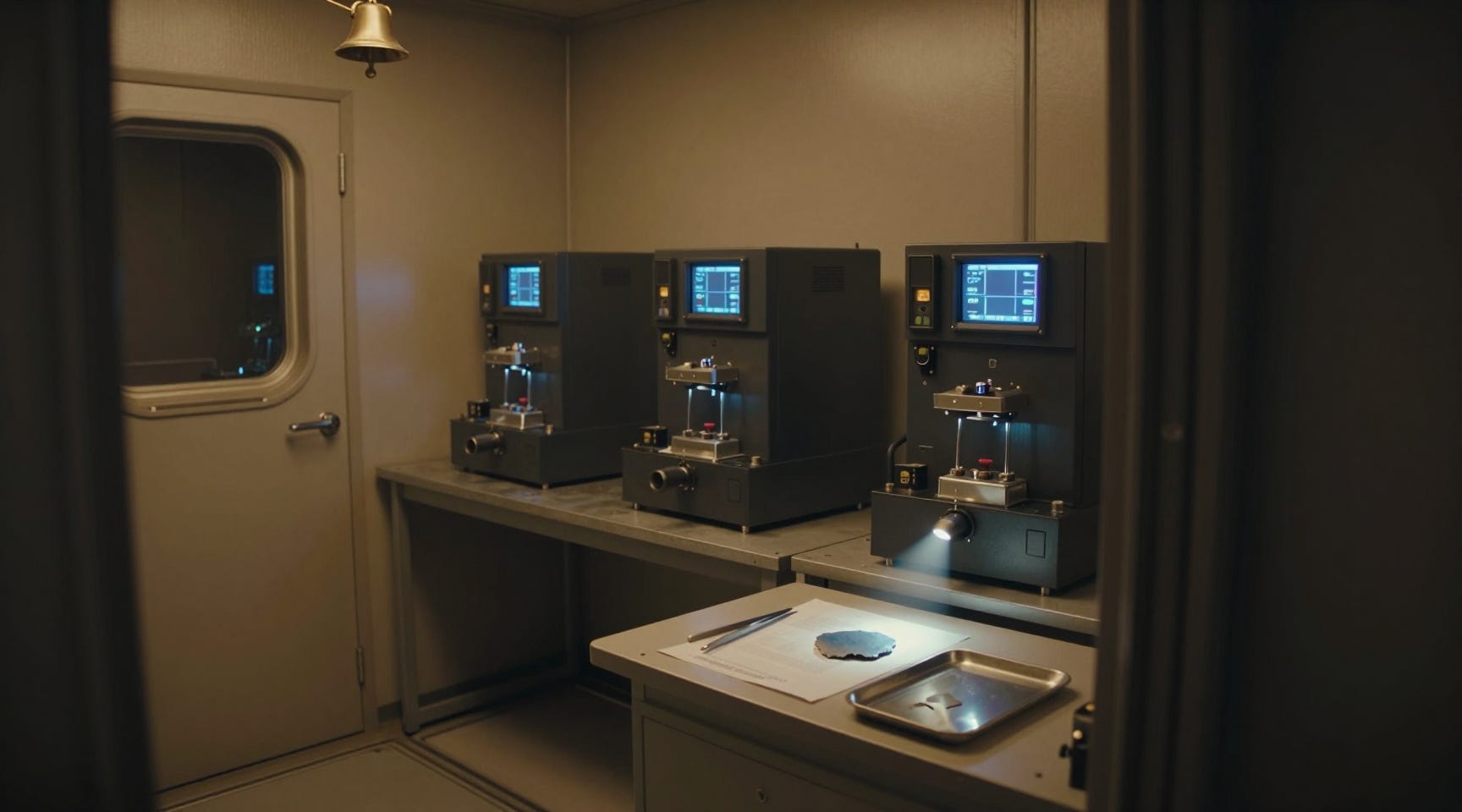
The lab was the third door past the empty office. The door was unmarked. A small brass bell, salvaged from a freighter galley, hung from a wire above the threshold and rang twice when Anya pushed the door open.
The lab was warm.
That was the first thing Anya marked. The corridor had been at station ambient, which was station cold. The lab was warm, and the warmth came from the equipment racked along the back wall, and the equipment along the back wall was newer than anything she had seen on Mimas Station outside the desalination plant control room.
The metallurgist was at a small table near the inner window port. She was perhaps fifty. She wore a station-issue lab coat that fit her precisely. Her hair was cut short and entirely grey. Her hands rested folded on the table in front of her.
She looked up when Anya entered. She did not stand. She did not speak.
Anya waited.
The metallurgist let the silence run. Anya understood, after a moment, that this was the first test. She let the silence run with her. She kept her hands at her sides. She did not look at the equipment along the back wall.
After perhaps thirty seconds, the metallurgist said, “Soo-jin Baek.”
“Anya Rask.”
“Sit.”
Anya sat.
Soo-jin Baek did not ask what Anya wanted. She watched the door close behind Anya and waited.
Anya took the fragment from her chest pocket and set it on the table between them.
Soo-jin looked at it without picking it up. She looked at it for a long time. Then she opened a drawer at her left hand and took out a pair of long-handled tweezers and a small enameled tray. She picked the fragment up with the tweezers and set it on the tray with the cut edge facing her.
“Twenty minutes,” she said.
“All right.”
“I do not ask where it came from.”
“I would not say if you did.”
Soo-jin’s mouth did not move, but something at the edge of her eyes did, briefly, and Anya understood that she had passed the second test.
The authentication took twenty-two minutes. Anya counted.
Soo-jin worked at the equipment along the back wall in a sequence Anya did not understand. She did not narrate. She did not gesture for Anya to come closer. She moved the fragment through three different units, each humming at a different pitch, each producing a readout Soo-jin glanced at, recorded by hand on a paper slate at her elbow, and turned away from.
The paper slate was a deliberate choice. Anya marked it.
When the twenty-two minutes were complete, Soo-jin returned to the table. She set the fragment on the enameled tray between them. She set the paper slate beside it.
“Eighty-six percent probability seventh-generation Vethrak hull lattice,” she said.
Anya kept her face still.
“Eighty-six,” she said.
“The cut edge is consistent. The decay curve at four hundred kelvin is consistent. The crystalline structure on the broken face is consistent. The eighty-six is the upper bound of what I will say without comparison samples I do not have.”
“What samples would you need.”
“Three more seventh-generation fragments from the same find, or one verified Tethys Yard reference. You will not have the second. The first I would charge you the same again to assess.”
“Understood.”
“Your field analyzer told you probable.”
It was not a question. Anya did not answer it.
Soo-jin tilted her head slightly. The gesture was somewhere between acknowledgment and faint dry amusement. “Eighty-six is enough for Davit Kade’s chain,” she said.
The name landed without weight. Anya registered it. Soo-jin had not asked anything about provenance. Soo-jin had not needed to.
“How much,” Anya said.
“Four hundred and twenty thermal credits.”
Anya counted out the credits from the small case in her jacket. She set them on the table. Soo-jin did not count them. She slid them into the drawer the tweezers had come from and closed it.
“A note,” Soo-jin said.
“Yes.”
“Bulk discount. Five fragments at one sitting, three hundred per. Ten at one sitting, two-fifty per. Twenty I will need scheduling for.”
“Noted.”
“One thing more.”
Anya waited.
“You will be back,” Soo-jin said. “I do not say this to flatter the work I do. I say it because what you are bringing me cannot be authenticated by the equipment you can afford. There are three of us on Mimas Station who can do what I have just done. The other two will charge you more and tell you less.”
“Understood.”
“You may want to remember this, when the time comes you can afford your own equipment.”
Anya picked up the fragment. She put it back in her chest pocket where it had been before. The Polaris fragment was there too, and the key chip to D-17, and now the small weighted certainty of eighty-six percent.
“I will,” she said.
She walked back to D-17 the long way.
The corridor heating had not improved. The desalination plant was venting again as she passed it, and she let the warm vapor curl around her ankles for a moment before walking on. The vapor smelled of brine and recycled coolant. The smell had stopped registering as unpleasant some months ago. She did not know when.
In D-17 she sat at her desk for a long time without taking the fragment back out.
Four hundred and twenty thermal credits was a sum she could afford. Two-fifty per fragment at bulk was a sum she could afford. The sum she could not afford was the long compounding curve of what those numbers would look like across a year of operations, across two years, across the volume of finds the cooperative was already beginning to push through D-17 and the other small bays Davit was scouting on other stations.
The fragment was eighty-six percent seventh-generation. Davit’s chain would move it at a number that would more than cover today’s four hundred and twenty.
The math worked today.
The math would not keep working.
She thought of Soo-jin’s paper slate, and the equipment along the back wall, and the precise small sentence: what you are bringing me cannot be authenticated by the equipment you can afford.
There were three metallurgists on Mimas Station who could do what Soo-jin had done. Two of them would charge more and tell less.
The cooperative had eleven captains now. Davit was building chain. Maren was building courier. Anya was building inventory.
We need our own version of this.
She wrote it down in the paper ledger she kept in the desk drawer. She wrote it in the simple two-line form she used for the things she was not yet ready to bring to the cooperative table.
Authentication. Internal.
She closed the ledger.
The fragment was warm in her chest pocket where it had been cold an hour ago. The lab had been warm. The corridor was cold. The bay was cold. She did not turn on the desk heater. She sat in the cold and watched the overhead strip flicker once, and once again, and settle.
The math would not keep working. The math could be made to work. The first time Anya was sure of that, she was sitting alone in a cold bay on the lower ring of Mimas Station, with eighty-six percent of a piece of dead Vethrak hull warming the inside of her jacket, and a number Soo-jin Baek had not asked her to remember already written down twice.
Author’s note: Day Twelve of the Iron Wake Origins arc. Year 2, Month 4. Anya Rask takes a single fragment to a soft-spoken former Tethys Yard analyst named Soo-jin Baek, working private contracts out of an unmarked lab on a back corridor of Mimas Station. The authentication takes twenty-two minutes. The result is given as a precise probability, not a yes-or-no. The price is four hundred and twenty thermal credits, with a bulk discount on offer. Anya walks out with the answer she came for, and a different problem entirely: across the long compounding curve of the cooperative’s volume, outside authentication is a cost that does not stay manageable. By Year 14, when Iron Wake’s reference library catalogs forty-eight Vethrak alloys against its own decay curves, the small two-line note Anya writes tonight, “Authentication. Internal.”, will be the seed of an internal guild the cooperative names the Hollow Seam.
If you enjoyed this story, you can follow the main story arc in The Exodus Rush, the first book in The Vethrak Requiem series.