


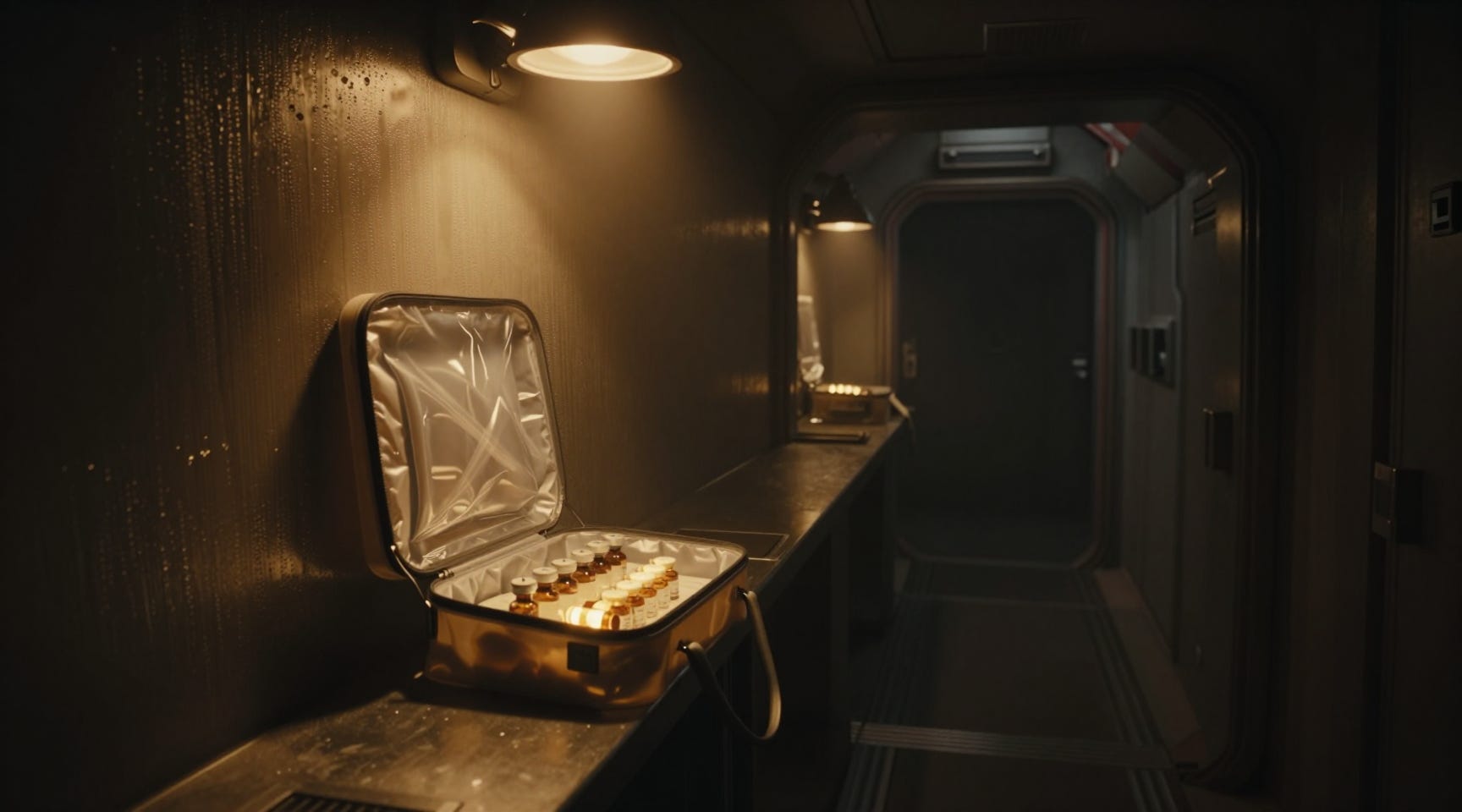
The vial was warm against Achieng Fournier’s palm, body heat leaching through the polymer casing faster than the insulated pouch should have allowed. She checked the seal. Intact. The thermal indicator strip on the side still showed green, which meant the fever suppressant inside remained viable for another six hours. After that, the active compound would begin to degrade, and by hour eight, the vial would hold nothing more useful than saline.
Six hours. She had fourteen stops on tonight’s route.
Achieng moved through Corridor 7-South on Callisto Ring, a narrow throughway that connected the lower residential tier to the maintenance tunnels running beneath the station’s recycling hub. The overhead lights had been dimmed to nightcycle levels, casting everything in a flat amber wash that turned faces into masks and made it impossible to read expressions at more than three meters. Good conditions for carrying product she wasn’t supposed to have.
Her satchel held twenty-two vials of synthesized antipyretic, each one diverted from a UEN medical shipment bound for Callisto Ring’s official clinic three weeks ago. The clinic had received its full allocation on paper. The actual crates had arrived fourteen vials short, the discrepancy buried in a manifest amendment that listed the missing units as damaged in transit. Nobody at the clinic had filed a correction. Nobody would. The clinic’s head pharmacist received two hundred credits a month to accept manifest amendments without question.
The Vein handled the rest.
Achieng had never met whoever ran The Vein’s operations on Callisto Ring. She knew Siamak Ntuli, her handler, a compact man with steady hands who met her every third night at the recycling hub’s intake bay and passed her a sealed pouch. She knew the route he assigned, the addresses, the dosage counts. She knew the names of the families who opened their doors at her knock, and she knew what their children looked like when the fever had gone untreated for too long: glassy eyes, cracked lips, skin that radiated heat like reactor shielding.
The official clinic served Callisto Ring’s registered population of six thousand. Registered residents held medical access cards that entitled them to treatment within the clinic’s formulary. The formulary covered basic wound care, nutritional supplements, and antimicrobials. Antipyretics had been removed from the standard formulary eight months ago, reclassified as a controlled pharmaceutical after a supply chain disruption reduced system-wide inventory by forty percent. Registered residents could still obtain fever suppressants through a priority request process that required a physician’s assessment, administrative approval, and a seventy-two-hour processing window.
Seventy-two hours was a long time for a child with a temperature of 40.2 degrees.
The unregistered population, another three thousand people who had arrived during the migration surges and never received processing numbers, couldn’t access the clinic at all.
Achieng’s first stop was Unit 7-S-414. She knocked twice, paused, knocked once. The door opened to reveal a woman in her fifties holding a sleeping toddler against her shoulder. The child’s forehead glistened with sweat.
“Two vials,” Achieng said. She held them out. “One now, one in four hours if the fever doesn’t break. Dissolve in thirty milliliters of water. Not more.”
The woman took the vials with one hand, the other cradling the child’s head. “How much?”
“Forty credits.”
The woman’s mouth tightened. She reached behind the door and produced a ration chip, the old kind that predated the current allocation system. These traded on the lower decks at roughly twenty credits each, depending on remaining balance.
“Two chips,” the woman said. “It’s all I have until next cycle.”
Achieng took the chips. The Vein accepted ration chips, salvage tokens, labor vouchers, or hard credits. Whatever people had. The pricing was standardized: twenty credits per vial, which covered the cost of the manifest amendments, the pharmacist’s cooperation, the courier network, and a margin that kept the operation sustainable. Forty credits for two vials was correct. The two ration chips might hold forty credits between them. They might hold thirty. Achieng wouldn’t check until she returned to the intake bay. If the balance fell short, she’d cover the difference from her own courier fee and log it as a collection variance.
She did this more often than Siamak would approve of.
Her comm unit vibrated as she left Unit 7-S-414. A text message from an unlisted address, which meant Siamak. She read it in the stairwell between decks.
Route change. Skip stops 8 through 14. Bring remaining inventory to Bay 3, Level 2. Client waiting. Priority.
Achieng stared at the message. Stops 8 through 14 covered Units 7-S-731 through 7-S-890, the deepest section of the lower tier where the unregistered families concentrated. Seven families. Nine children between them. She’d delivered to these addresses every cycle for the past four months.
Bay 3, Level 2 was upper deck. Registered territory. Someone up there wanted antipyretics without the seventy-two-hour processing window, and they were willing to pay enough that The Vein considered seven lower-deck families expendable for a cycle.
She counted her remaining vials. Sixteen. Seven stops at two vials each would use fourteen, leaving two for the upper-deck client. Two vials wouldn’t satisfy a priority redirect. The client wanted the full sixteen, which meant the lower deck got nothing.
The math was simple. The upper-deck client would pay market rate, probably three hundred credits for sixteen vials. The seven lower-deck families would pay a combined total of roughly five hundred and sixty credits in mixed currency, most of it ration chips that might or might not hold face value. On pure revenue, the lower deck was the better return. On collection reliability and client risk, the upper deck was safer. One transaction, one handoff, no exposure across seven separate doorways in the most surveilled section of the lower tier.
Siamak wasn’t wrong about the operational logic.
Achieng closed the message. She descended two more flights to the lower tier and knocked on the door of Unit 7-S-731. A man answered, bleary-eyed, a medical cloth draped over his shoulder. Behind him, a cot held a small shape wrapped in a thin thermal blanket.
“Two vials,” she said. “One now. One in four hours.”
She completed all seven stops in ninety-three minutes. When she reached the last family in Unit 7-S-890, she had two vials remaining. She gave them both to the woman who answered, whose twin daughters shared a single cot and a fever that had been climbing for two days.
Her satchel was empty when she reached Bay 3, Level 2. The upper-deck client wasn’t there. She waited twelve minutes, then left.
The comm unit vibrated on her walk back.
Where’s the product?
She typed her response in the stairwell, the words illuminated by the amber nightcycle glow.
Distributed per original route. Collection complete. Full accounting at next handoff.
The reply came in nine seconds.
That wasn’t the instruction.
Achieng pocketed the comm and kept walking. Tomorrow, Siamak would be angry. He’d calculate the revenue loss, factor in the upper-deck client’s displeasure, and assess whether Achieng’s value as a reliable courier outweighed her insubordination. The calculus would probably break in her favor. Good couriers were scarce. The Vein couldn’t afford to lose one over a single redirected cycle.
If it didn’t break in her favor, someone else would walk the fever route. Someone who would answer redirect orders without hesitation. Someone who wouldn’t cover collection variances from their own fee. Someone who wouldn’t know that the twins in Unit 7-S-890 were named Priti and Meena, or that their mother had sold her water allocation three days ago to afford this cycle’s delivery.
Achieng reached the recycling hub’s intake bay and sorted the ration chips and labor vouchers into the collection pouch. The total came to five hundred and twelve credits. Sixty credits short. She transferred the difference from her personal account and sealed the pouch.
The nightcycle lights hummed overhead. Somewhere in the lower tier, fourteen vials of fever suppressant were dissolving in measured doses of water, bringing temperatures down in small bodies that the station’s official medical system had classified as non-priority.
She’d walk the route again in three days. Siamak would give her the pouch. She would make her stops. The upper-deck client would get their vials next cycle, or the cycle after. The lower deck couldn’t wait.
The math was simple. It always had been.
Author’s Note: Callisto Ring’s pharmaceutical supply chain collapsed in stages, not all at once. First came the system-wide shortage that removed antipyretics from the standard formulary. Then came the seventy-two-hour processing requirement that made official access impractical for acute cases. Then came the quiet acceptance that unregistered residents existed outside the system entirely. The Vein filled the gap the same way every black-market medical network fills gaps: by diverting product from official channels, marking up the price enough to sustain operations, and delivering to doorsteps that the clinic’s intake system would never reach. Achieng’s route isn’t charity. It’s commerce. The distinction matters less than it should when a child’s fever is climbing and the nearest official option requires three days of paperwork and a registration number her family doesn’t have.
If you enjoyed this story, you can follow the main story arc in The Exodus Rush, the first book in The Vethrak Requiem series.