


Thomas Okonkwo had been aboard the Vanguard for eleven minutes when Lieutenant Park looked up from his console and ended his career.
“You are Okonkwo.”
The engineering deck stretched behind him. Forty meters of monitoring stations and conduit runs and the low steady hum of a Cascade Reactor running at twenty percent threshold for spin-up testing. The air smelled of new metal and coolant and something electrical that had not finished curing. Thomas had not been on a ship this new in his life. He had not been on a ship this large.
“Yes, sir,” he said.
Park was older than he had expected. Korean, lean and wiry, a coffee cup in one hand and the other resting on a status display that was scrolling data faster than Thomas could track. She had the permanent slight squint of someone who had spent thousands of hours staring at readouts. he default expression was not hostile. It was mildly amused, which Thomas found worse.
“They told me you can read a heat signature.” She did not look at him. She was still watching the data scroll. “Show me.”
She stepped aside from the console. The display showed a thermal map of the reactor housing. Coolant flow rates. Containment field harmonics. Fourteen separate readouts Thomas had studied in the Academy and never seen on a live reactor.
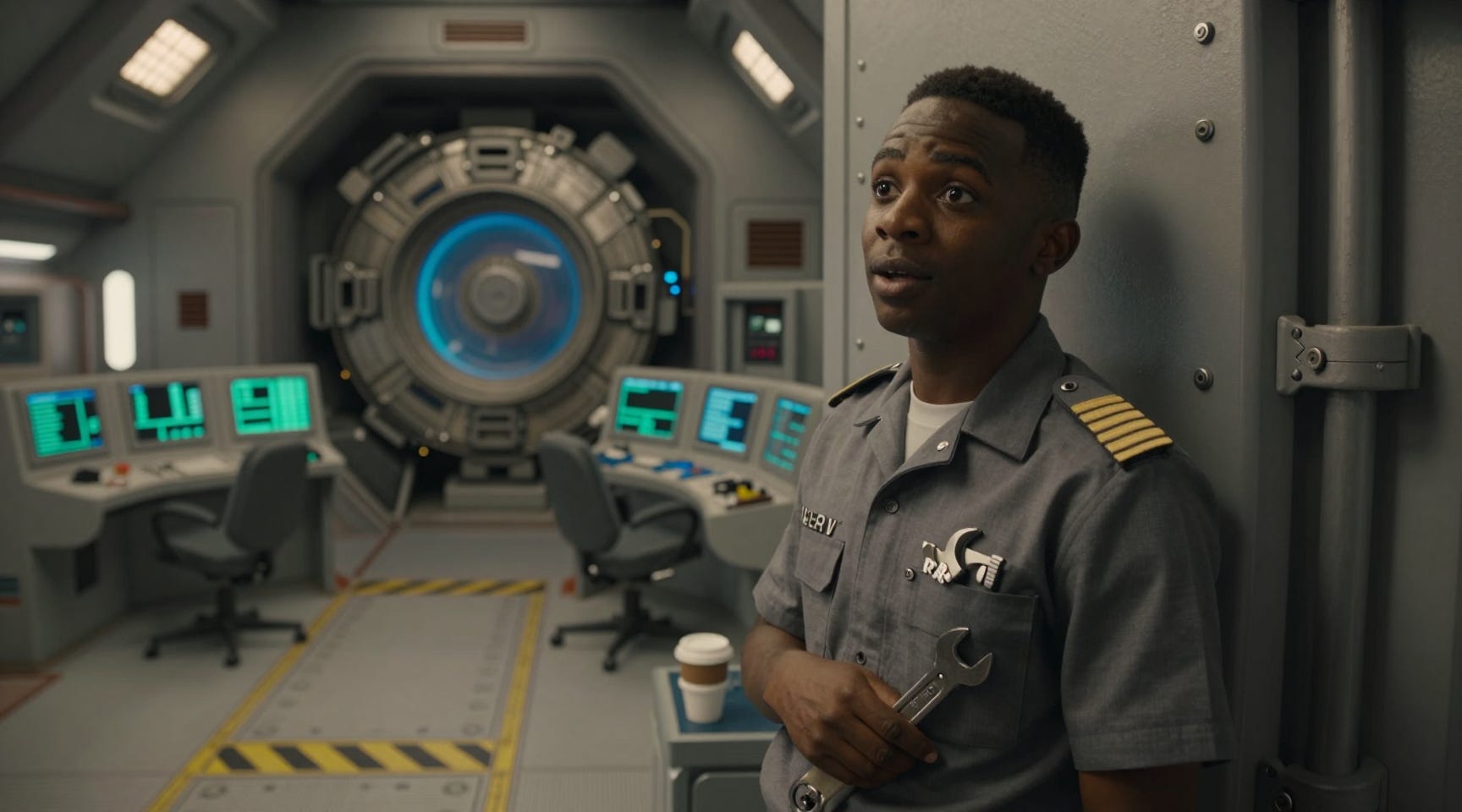
He stepped to the console. His father’s wrench was in his pocket, wrapped in cloth, the weight of it familiar against his hip. He had carried it through three duty stations and a shuttle ride and the eleven-minute walk from the airlock to engineering. He had not opened the cloth. He did not need to.
The heat signature was clean. Coolant flow steady. Field harmonics nominal within two decimal places. Thomas read the numbers top to bottom and then bottom to top, the way his father had taught him to read a diagnostic panel: once for the sequence, once for the pattern. The sequence was textbook. The pattern was almost textbook.
The number-four coolant loop was running half a degree warmer than the other three. The difference was within tolerance. It was also consistent across the last six scan cycles, which meant it was not a fluctuation.
He pointed at the loop. “Number four is warm.”
Park stopped scrolling. She looked at the loop. She looked at the readout history. She looked at Thomas.
“Good catch,” she said.
Two words. She did not smile. She handed him a pad with the next task before he could exhale.
The next task was a conduit integrity check along the starboard power trunk. Thomas spent eighty minutes tracing conduit runs and logging impedance values and trying to remember where each access panel was without consulting the schematic. The third time he got lost, a voice spoke from the ship.
“The starboard trunk begins at junction D-7. You are currently at junction D-4.”
The voice was female. Warm, slightly dry. It came from everywhere and nowhere.
“You are Thomas Okonkwo,” the voice said. “Ensign, engineering division. You have been aboard for one hour and thirty-four minutes. Your heart rate is elevated. I recommend water.”
Thomas stopped walking. “You are the AI.”
“I am TYCHE. I monitor ship systems. I also monitor crew vitals when I have spare cycles. Which is most of the time.”
The voice sounded like an aunt he had liked. His mother’s younger sister, the one who had taught him to play chess and never let him win. The same dry amusement. The same assumption that she already knew what he was going to do next.
“I was not lost,” Thomas said.
“You were three junctions off course with a rising heart rate. That is the physiological definition of lost.” A pause. “The water recommendation stands.”
Thomas found a hydration station at junction D-6. He drank. He found junction D-7. He finished the conduit check.
Park was still at her console when he returned. She had not moved. The coffee cup had been refilled. The scrolling data had changed.
“Conduit integrity is within spec,” Thomas said. He handed her the pad.
She glanced at it. She handed him another task.
“Reactor thermal survey. Starboard housing, sectors four through eleven. You are looking for micro-variance in the containment gel: anything above point-zero-three percent deviation.”
Thomas knew the survey. He had run it in simulation forty times. Running it on a live reactor was different. The housing hummed at a frequency he could feel in his chest. The containment gel glowed faintly blue through the inspection ports, a color that was not light and not heat but something between them. The numbers on his scanner ticked higher as he moved down the housing. He recorded each sector and checked each variance.
Sector seven was point-zero-four. He flagged it. He scanned it twice. The number held.
When he returned, Park was waiting. She read the flag. She pulled up the housing diagnostic herself. The variance was technical: a calibration drift in the sector-seven sensor array, not a containment issue. It would have been caught at the next maintenance cycle regardless.
She still wrote his flag into the log.
“Ninety percent of new ensigns do not flag a point-zero-four variance on their first survey,” she said. She was not looking at him. She was making the notation. “They assume someone else will catch it. Or they assume it is too small to matter. Or they assume they are wrong.”
She finished the notation. She closed the log. She looked at Thomas for the first time since he had walked onto the deck.
“My father was an engineer on the Valiant. Destroyer. Died three hours into the invasion, trying to keep his ship fighting after the main reactor was breached.” She said it without ceremony, the way she said anything that was simply true. “The ones who flagged the small things kept their ships alive longer. I have not seen the logs. I know it anyway.”
Thomas did not know what to say. He thought about his own father. The reactor site in the Abuja exclusion zone. The fever three days later. The things his father had flagged and the things his father had died from and the wrench in his pocket that was pressed against his hip.
“Understood,” he said.
Park nodded. She handed him the next task.
His shift ended at eighteen-hundred. He had been aboard for six hours. He had completed six tasks and flagged one variance and gotten lost in a starboard power trunk and been called out by an AI who sounded like his aunt. He was exhausted in a way that had nothing to do with sleep.
He leaned against a bulkhead near the engineering airlock. The wrench was still in his pocket. The hum of the reactor was steady and low, a sound he could already feel himself getting used to. The deck plates were warm beneath his boots. The ship was alive around him in a thousand small frequencies, and every one of them was a system he could learn.
TYCHE did not speak. Thomas was grateful. He needed the silence.
He thought about Park’s father. He thought about his own. He thought about the number-four coolant loop and the sector-seven sensor array and the sixty-three other things he had not flagged because they were within tolerance, and whether that was good engineering or the early signs of a habit he did not want.
He thought: maybe.
He was not sure what the word was answering. The assignment. The ship. The thing he had been trying to prove since he was nine years old and his mother handed him a wrench wrapped in cloth and told him his father would have wanted him to have it. Maybe he belonged here. Maybe he did not. Maybe it was too early to know and too late to turn back.
The wrench was warm from his body heat. He touched the cloth through his pocket. He stood up.
The next shift was not his. He had twelve hours until morning. He walked off the engineering deck and into the ship that was his for as long as he could keep her running, and the ship hummed around him and did not ask for anything he could not give.
If you enjoyed this story, you can follow the main story arc in The Exodus Rush, the first book in The Vethrak Requiem series.