


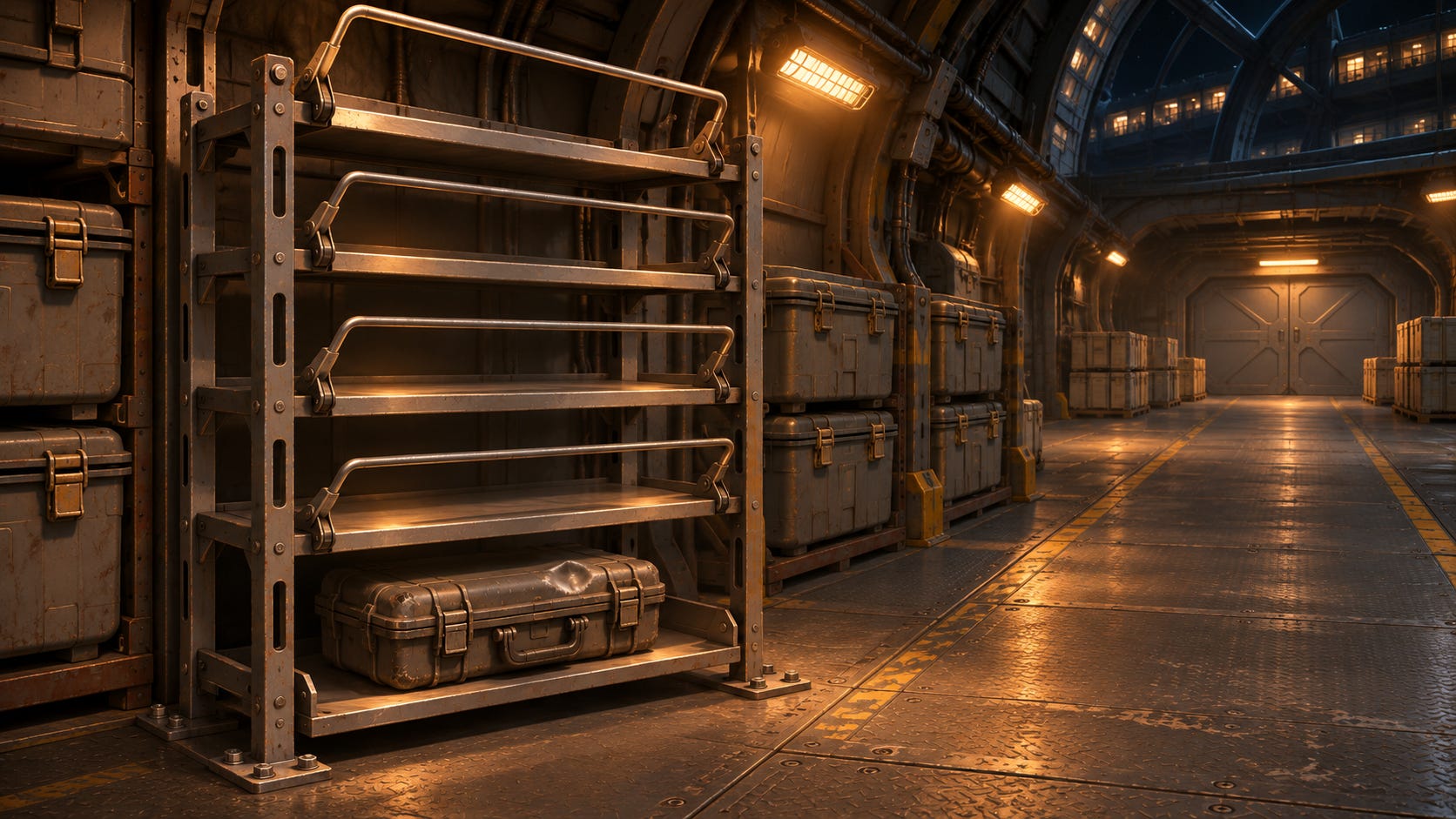
The outbound load reached Gamma stores forty minutes ahead of its window and took the aisle before the clerk had finished clearing her counter.
Six carts came in nose to tail, each stacked three crates high and strapped to its frame. The handlers walked them in leaning back, shoulders canted forward against the mild slope of the ring deck, hips braced against the carts. A loaded cart weighed less than a third of what it would have weighed on Earth and carried every kilogram of its mass. It lifted easily. It stopped reluctantly. The lead cart’s brake chirped on the deck plate, the train compressed behind it, and six sets of straps drummed against the crates.
The clerk set down her reader and watched the lane disappear.
Gamma stores ran in long bays on either side of a central lane, wide enough for the lift-assist and a person walking beside it. That was the design. Now the carts filled the lane from the dock hatch to her counter, and the crates filled the air above it, and the only way through was sideways along the shelving with one hand on the restraint bars. Behind the last cart the dock hatch light turned from amber to green. Somebody on the far side had already queued the next transfer.
“Early,” said the handler at the head of the train. She slapped the lead crate twice, a habit rather than a greeting. “Dispatch moved the window up. You have the paperwork.”
“I have a window in forty minutes,” the clerk said.
“You have it now.”
The clerk took the dock tablet from her. The load was real and the manifest was complete. The revision sat under the dispatch clerk’s signature, stamped eleven minutes ago. Nobody had walked down the lane to tell her.
She read the contents anyway, because reading them was the job. Filter cartridges by the case. Fastener assortments. Gasket sheet in rolls, cable, cutting discs, work gloves, wiping cloths, tape. Nothing dangerous and nothing rare. Ordinary consumables, the things any crew drew down faster than anyone’s estimate, bound for ships that would not be able to buy more of them once they left. Weeks of loads like this had gone through her lane. The yard had been emptying itself a crate at a time, and the clerk had stopped noticing the sound of it the way she had stopped noticing the sealant smell.
At the far end of the counter stood the return rack.
It was a five-shelf open frame bolted to the deck, each shelf fitted with its own restraint bar, the bars all raised. A strip of tape ran along the top rail with one word on it in her predecessor’s block capitals. The predecessor had transferred out long ago. The rack had stayed empty by habit, and the habit had become hers. Other counters along Gamma used theirs for overflow. She had never thought less of them for it.
The dispatch clerk came down the lane sideways between the crates and the shelving, his tablet held over his head like a man wading a channel.
“I know,” he said, before she could speak. “I know. The dock had a gap and I took it. I would have called ahead, but the gap closed while I was calling.”
“The window moved eleven minutes ago.”
“Then I called ten minutes late.”
He had the grace to look at what he had done to her lane. He was good at his work. His manifests balanced, his counts held, and once he had found a seven-unit discrepancy in the middle of a night shift and corrected it before anyone woke to ask. She had never known him to hurry a thing that did not need hurrying. That was what made the next part hard.
“I need these off the lane before handover,” he said. “Staged and signed. The lift-assist has to get through for the second wave, and the dock will not hold the hatch past the change.”
“Where do you want them?”
His eyes went past her shoulder to the end of the counter. She had known they would.
“There.”
“No.”
“It is empty.”
“It is the return rack.”
“It is five shelves of clean frame with nothing on the board.” He turned the tablet toward her. The returns column was a single grey line of nothing. “Nothing is due back. I looked before I came down.”
“Nothing is ever on the board.”
“Which tells me something.”
“It tells you returns do not announce themselves.” She kept her voice level. “They come when somebody finishes. If I cannot rack what they carry in, I cannot close it. If I cannot close it, the record stays open against whoever walked it to my counter. They stand there while I look for a shelf.”
“You could use the counter.”
“The counter holds three things.”
“Then they wait on the counter for the next shift.” He rubbed his eyes with the heel of his hand. “Over a screwdriver.”
“Over whatever they carry in.”
“Against eighteen crates that need to be somewhere in the next hour.” He lowered the tablet. His voice had not risen, and the quiet made it worse. “If this load misses the hatch, it does not wait forty minutes. It waits for the next window, and the next window has its own queue. You know what is in these crates. Somebody is going to count on them being on a ship.”
She did know. That was the difficulty. He was not pushing for convenience. He was right about the clock, right about the dock, right about the crews, and every argument she owned was about a visitor who might not exist.
Both of them looked at the rack.
It would take twelve minutes. She had done it once in her first month, when an overflow had filled the lane the way this one had, and she remembered the sound the crates made settling onto the shelves as relief so clean it embarrassed her. Crates down, lane open, signature given. By the change nobody would remember the rack had ever been anything but storage.
She also remembered the other side of the counter. Years back, before she worked Gamma, she had stood there holding a case of borrowed gauges while a clerk hunted for a shelf. The clerk had been kind. The hunt had taken fifty minutes, and the shuttle she had been walking toward had left without her. Nothing had come of it except a record closed late and the memory of her own arms going numb around the case.
She took the first crate off the nearest cart herself.
The weight came up easily into her arms and the mass stayed behind it, a slow insistence against her turn. She carried it five steps toward the rack. The restraint bar on the lowest shelf stood open, waiting. She stopped with the crate against her chest and the bar a pace away.
“What are you doing?” the dispatch clerk asked.
“Looking at it.”
“It is a shelf.”
“I know what it is.”
She turned around and set the crate back on the cart, and drew its strap down again.
“Give me until the change,” she said.
“To do what?”
“Make you room somewhere else.”
“Gamma is full.”
“Gamma is full of half-empty bins.” She nodded down the bays. “Cable ties in three places. Gloves in four. Fastener assortments split across two bays because somebody ran out of label space. Merge them and I free the floor positions in C seven and C eight. They are nearest the hatch. The carts go there.”
“Two bays in two hours.”
“The lane clears in stages. The first carts go in as soon as C seven opens. The lift can pass after that.”
He looked at his tablet, then at the line of carts, then at the handler, who had been listening with the unconcern of someone whose part was already done. “If the lane is not clear at change, they go on the rack.”
“If the lane is not clear at change,” the clerk said, “they go on the rack, and I carry the first one myself.”
It was not agreement. It was a deadline with both their names on it.
C seven held a single cart-sized pallet position, and three bins sat on top of it, and none of the three was full.
The clerk pulled the first with the lift-assist and let it settle on the lane’s edge beside her reader. She opened the lid. Cable ties, a loose handful, perhaps four hundred in a bag that had split and been taped. She counted them by weight and checked the count against the record. The record said six hundred. The other two bins held the rest of the six hundred, plus another hundred and eighty the record knew nothing about.
She fed it all into one clean bin, sealed it, wrote a fresh label, and carried it to D two.
The work had its own rhythm once she found it. Pull, open, count, merge, latch, relabel, carry. At three-tenths gravity a full bin of hardware looked like something a person could carry for an hour. It was not. The weight was small and the mass was not, easy to lift and difficult to turn, and by the fifth bin her forearms ached from stopping things she had set in motion. She learned to start her turns early. She learned to let the latch bars do their work instead of her wrists.
Gloves were next, because gloves were everywhere. Four boxes lay open on four shelves, each a third full and each, when she tipped them out, a slightly different size from the label. She sorted them by hand under the lane lights, small to large, and sealed them into two full boxes and a remainder she placed on a shelf where the next clerk would see it first.
The handler returned while she worked.
“Hatch cycle has started,” the woman said. She stood at the end of the lane with her arms folded and her carts behind her like a line of patient animals. “If the window is not clear in fifteen, I take the load back out and you can explain it to the dock.”
“The first bay opens in ten.”
“Ten is not fifteen with a margin.”
“Ten is ten.” The clerk set a bin on the deck and straightened. Her back complained. “Bring the first two carts as soon as I call. Park the crates in C seven, not the lane. I will tell you where each one sits.”
The handler considered her. “You are making this harder than it was going to be.”
“It was going to be a rack.”
The handler’s face did not change, but she unfolded her arms.
C seven opened with five minutes of the handler’s margin to spare, the pallet position bare and swept, the deck plate showing the dull scoring of years of other people’s work. The clerk called. Two carts rolled in on the handler’s hand, and the clerk walked beside them, steering each crate to its place and checking its dock code against the manifest while the handler braked. Straps off. Crates down, one by one. The restraint rails clicked closed across the stack. The lane showed bare deck for the first time in an hour, and the clerk’s shoulders loosened by a centimeter.
C eight was the fastener bay, and its assortments gave her the discrepancy.
She had merged two bins into one and run the count against the record twice, and the second time the number was still wrong. Twelve short. A full unit of twelve, which meant a sealed packet or a mislabeled box, not loose pieces lost in a bag. She stood with the reader in her hand and the dispatch clerk’s deadline pressing from behind her. Twelve was not enough to matter to any ship. It was enough to matter to the record, and to the next person who drew from it and found the shelf wrong.
She could have corrected the record down. That was permitted. A short count with a note was an honest entry.
She went and opened the neighboring bin instead.
It was mislabeled. The assortment lay in a flat case under a lid that said something else entirely, and the twelve were there, packed in their own foam, a sealed unit waiting for anyone patient enough to check. She carried them across, merged the count, and closed the line. It cost her nine minutes. The record agreed with the shelves for the first time in longer than she wanted to guess.
She was turning to carry the last box of gloves when the split bin of washers slipped from her hands.
It did not drop. In full weight the bin would have hit the deck and burst. Here it turned over once as it fell, slow enough for her to see the lid come loose, and a bright fan of washers spilled out into the air. They hung. They hesitated. Then they came down in long, lazy arcs, ticking on the deck plate and rolling toward the drain channel in the lane, a hundred small metal rings chasing each other across the deck.
“No,” said the clerk, and went after them.
She did not catch them all. She knelt at the channel with the magnet sweep from under the counter and drew it across the plating, and washers leaped up to meet it with a sound like rain on a tin roof. Nine had rolled under the lowest shelf. Three had gone all the way to the cart wheels, where the handler caught them and returned them to her palm without a word.
“You could have put the load on the rack,” the handler said, crouching beside her. It was not unkind. “Nobody would have said anything.”
“He would have signed it and thanked me.”
“That is what I mean.”
“I know.”
The clerk poured the washers into a clean bin and sealed it. Her knees ached. C eight stood bare at last, nineteen minutes later than she had promised herself, and she called the second pair of carts in. The crates settled into their rails beside the first stack. The count on the manifest board still lacked six crates, and two carts still stood in the lane.
She needed one more bay.
D three held the last obstacle: a pallet of cutting discs and abrasive pads that nobody had drawn from in months, sprawled across a shelf that took up more room than its contents deserved. She had passed it a hundred times. It was not wrong, only inefficient, a pallet position occupied by half a pallet’s worth of product because no one had made the decision to shrink it.
She made the decision. She pulled the discs down in sections, bagged and boxed them, and moved them to an upper shelf already holding the other half of the same stock. The lift-assist took the shelving rails. The deck plate cleared. Where there had been waste there was floor.
The dispatch clerk found her there.
He had come down the lane with his tablet under his arm and an expression she could not read. She expected him to tell her the time. Instead he looked at the empty pallet position and the sealed boxes and the line of carts and the bays beyond.
“Where do you want these?” he asked, and picked up a box of cutting discs.
“Upper shelf, D three. Latch the bar.”
“I know how to latch a bar.”
“Then latch it.”
He carried the box. The bar clicked. He came back for another.
They worked without talking for a while. He did not carry as well as she did. He had the manifest man’s habit of watching the weight and neglecting the mass, and twice a box swung wider than he meant and she caught it with a hand. He said nothing about it. She said nothing either. A third box tipped against his hip and he swore under his breath, quietly and with real feeling, and she turned to the shelf to hide a smile.
“I still think the rack was fine,” he said, setting the last box down.
“It would have been fine.”
“Until.”
“Until someone carried something in.”
“Nobody will.”
“Not yet.”
He wiped his hands on his coveralls. “You know I did not do this to make your shift worse.”
“I know.”
“The load had to go somewhere.”
“It did.”
“I still have to sign it staged by the change, and it is not all staged.”
“Then we have twenty minutes,” the clerk said, and they carried.
By the time the last two carts rolled into D three and the handler eased them to a stop, the lane stood open from hatch to counter for the first time in nearly two hours. The crates sat in their bays, strapped and railed and clear of the walking space. The dispatch clerk checked every dock code against his tablet. She checked each location against hers. The two lists agreed. He signed.
The handler let the hatch cycle. Nobody thanked anybody. The next wave came in from the dock side, and the lift-assist hummed through the lane with room to spare on either side.
The clerk returned to her counter and found her hands trembling slightly with the work. She pressed them flat against the steel until it stopped.
The return arrived with eleven minutes left before the change.
It came in the hands of a fabricator in a grease-stained work jacket, who walked into the lane with the stiff, careful gait of someone who had spent the whole shift hunched at a bench. He carried a hard case with both arms. The case was dented at one corner and scratched along its length, and its latch had failed long ago. A loop of grey cord held the lid shut.
“Is the counter clear?” he asked.
The question was careful, as if he expected a negative.
“The rack is,” the clerk said.
He looked at the frame, bare and level. He did not ask why. Something in his shoulders let go.
“I thought I would be waiting,” he said. “I have a transfer at the change. If this is not closed, my name stays on it.”
“What is it?”
“A driver set. Eleven pieces. I drew it out three weeks ago for a fitting job and kept it longer than I meant.” He set the case on the counter and his hands came off it with visible reluctance. “I would have brought it earlier. Everything ran over.”
“Everything is running over.”
She opened the case. The cord came away without argument. Inside lay a set of hand drivers in cut foam, each in its own slot, worn handles and bright tips. She counted them against the record. Eleven. She turned each one over, checked its tip, and ran a thumb along its shank for burrs or cracks. One handle had been wrapped with tape and the tape had gone grey with use. She noted it. The rest were sound.
The fabricator stood still while she worked. He looked at the lane and the crates and the stacked bays, then at the dispatch clerk, who had come to the counter to wait for his manifest receipt.
“Is something happening?” the fabricator asked.
“Everything is happening,” the dispatch clerk said.
The clerk tagged the case, shut the lid, and carried it the five steps to the rack. She set it on the lowest shelf and drew the restraint bar down across it. The latch clicked once, solid and quiet. She returned to the counter, closed the record, and watched the status turn from open to received.
“It is done,” she said. “Your name is off it.”
The fabricator breathed out through his nose. “Last time, at another counter, I stood half an hour.”
“There was no rack?”
“There was a rack. It had a crate on it.” He tried a smile and found it came easily. “Thank you.”
“It is what it is for.”
He went out through the lane without hurrying, and his stiff gait loosened as he walked, the deck taking him back. The clerk watched him until the lane curved.
The dispatch clerk had not moved. He stood with his tablet against his chest and his eyes on the case.
“That is one,” he said.
“That is one.”
“I would have signed it onto the rack and been done by the quarter hour.”
“Yes.”
“I would not have known he was coming.”
“No.”
He did not say anything else. She did not need him to. He lifted the tablet, checked the lane one last time against the last of the crates, and went back toward the dock side with the sound of his shoes carrying down the clear deck.
The incoming clerk arrived at the change with a flask in one hand and a stylus tucked behind her ear. She stopped at the head of the lane and took in the carts gone, the crates sealed, the lane open to the hatch. Her eyes came to rest on the clerk last.
“You look like you wrestled something.”
“Washers,” the clerk said.
She handed over the sheet. It ran to a full page, which was longer than any handover she had written in a month. C seven and C eight: outbound staging, signed and stacked, dock codes on the manifest. D three: staging overflow, same. Cable ties consolidated to a single bin in D two, count verified. Gloves in two full boxes and one remainder, upper shelf, bay B. Fastener assortment reconciled, twelve found in the neighboring case, record now agrees. Washers in a clean bin, count approximate, a note to recount.
The incoming clerk read it twice and turned the page over for more.
“This is a lot of shelves.”
“It is a lot of shelves.”
“All of it for the load?”
“The lane needed it,” the clerk said. “The load needed somewhere and the lane needed to be clear.”
The incoming clerk looked past her, down the counter, at the end of the frame. A scratched hard case sat on the bottom shelf with a loop of grey cord tied around its lid. The shelves above it were bare.
“Why is the rack empty?”
“It is the return rack.”
“Nothing was due.”
“A driver set came in eleven minutes before the change.” The clerk took her coat from the hook. “Closed. Tagged. Racked. You will want to check the tip on the taped one.”
“What about the rest?”
“The rest is yours.”
The incoming clerk looked at the shelves. She did not say she would keep them clear, and the clerk did not ask her to. It was not a tradition and it was not an instruction. It was a rack in a stores counter on a ring that held a great many racks, and it would be whatever the next person decided it was.
“I will check the taped one,” the incoming clerk said.
“Thank you.”
The clerk shouldered her coat and walked the length of the lane. Her legs ached, her forearms ached, and her back counted every step. The lane lay empty ahead of her, level and bright under the task lights, and she passed the bays of staged crates and the sealed bins of ordinary things. Somewhere beyond the hatch, wherever those crates were going, someone would draw on them without thinking about the hands that had set them down.
She turned at the lane’s end and looked back.
The counter stood tidy. The incoming clerk had already opened her first record. At the far end the return rack held one worn case on its lowest shelf and four clean shelves above it, bars raised, waiting at a height that suited a person’s arms.
She did not know what would come back to it, or when. A shelf did not need to know. It needed to be level and clear and open when somebody carried something in.
She went off shift with her count right and the lane open behind her.
Author’s note: This story takes place on Prometheus in Year 14, before the campaign in The Reclaimed Stars. Prometheus keeps working while the fleet prepares to leave. That practical work is part of the world behind The Reclaimed Stars.
The Reclaimed Stars, Book 5 of The Vethrak Requiem, releases on Kindle December 1. Preorder here.
Audio narration generated with AI using Qwen3-TTS.
For more stories from The Vethrak Requiem, visit us on Ream: https://reamstories.com/vethrak