


The ore cars were clean.
Sigrid Hedlund locked both boots to the catwalk strip and kept a glove on the rail. Six cars hung in their transfer cradles below her, returns from the last dispatch series, clamps closed, doors open on empty beds. Nickel fines coated every surface in this gallery inside a shift. The sills carried old paint and the worn edge of a stencil.
No crew had scrubbed them. The automated wash cycle had run on schedule the night the faces went quiet, and the load of fines that should have buried the metal again never came down the line. Clean sills lasted about an hour on a working line.
Sixty-one hours, then. Three days into the Spacers Union safety stoppage: vital access continued, pressure crews, habitat, rescue standby, and extraction did not.
Five days earlier, Tunnel 3-Bravo collapsed, killing miners on the last authorized cycle. The report called it an unforecast localized shear event. Sigrid had signed that cycle and defended the report. Both belonged to her.
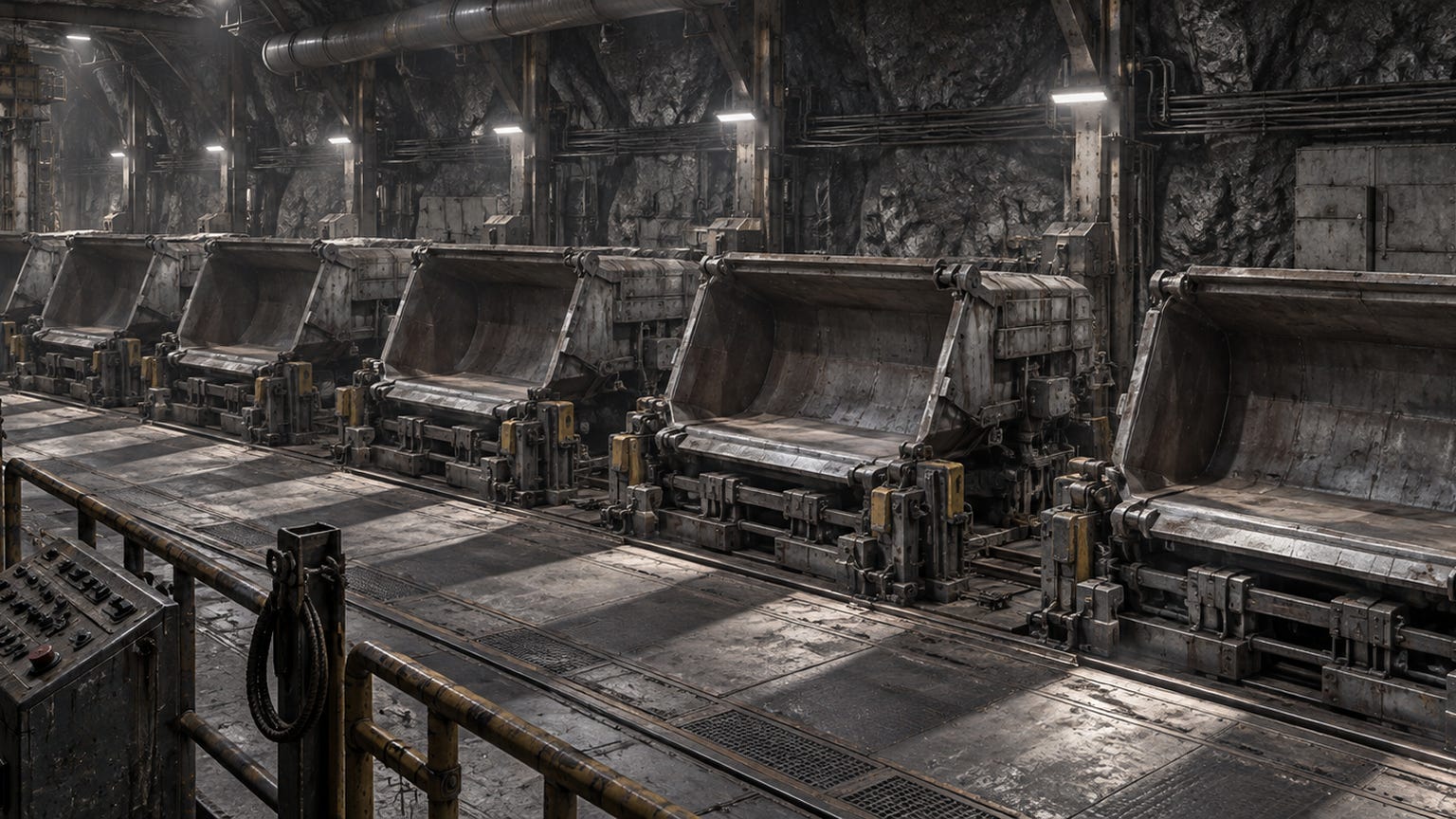
Hard white work strips threw the cradled cars twice, once across the floor plate and once up the carved stone. The production clock over the dispatch arch held its count. Tons extracted, current shift: zero.
The plant control supervisor came along the upper rail hand over hand, boots swinging clear of the posts, and locked in beside her.
“Director.”
“Show me what still runs.”
They took the ladder down two levels, both hands on the rungs, drifting slow in the low gravity, boots finding the station plate at the bottom. The control station smelled of hot dust and machine oil.
“Mills, screens, magnetic separation, grading, loading arms,” the supervisor said. “Feed is in the surge bins. Everything between a bin and the dispatch stack runs without a person at a face.”
“The faces.”
“Dark. Extraction interlocks are open. Nothing cuts rock without a crew on it, and I am not proposing otherwise.”
The supervisor pulled Bin 4’s last run onto the center pane. Level probe, sixty-two percent. Draw rate under it, sagging. Its feed gate was now closed.
“That number is wrong.”
Sigrid leaned into the rail. “Explain it.”
“The fines bridged. Material arched over a void near the outlet. The probe is measuring distance to a surface, correctly, and the surface has nothing under it.” The supervisor tapped the draw line. “The mill knows something is off. The mill cannot say what.”
“How does a floor tech find it?”
“Mallet. Six strikes down the shell. The empty section rings different. Thirty seconds. My day tech has been doing that since before the probe existed. Sensors cannot tell me about what they are not pointed at.”
“Are you asking for hands on the bins?”
“No. Production maintenance stays stopped. The remaining bins run inside the authorized limits and trip on alarm. The grade analyzer uses a calibration built on a blend the shift leads trimmed by eye. Nobody is trimming. Let the blend drift and the analyzer can certify bad material. We stop before that margin closes.”
The previous shift’s log sat on her slate. Pressure crew in on an emergency pass, west collar microfracture, logged and published on two channels. The conveyor alignment pages had come back stamped nonessential. Nothing in the cradles moved today.
The administrative spin ring gave her a chair and a cup that stayed level. The logistics staffer had the allocation board up before she sat.
“Usable dispatch stock, nine thousand six hundred tons,” the staffer said. “Eligible feedstock, excluding Bin 4, converts to two thousand four hundred more. Six hundred a day, four days of milling. Twelve thousand total.”
“With my plant supervisor’s asterisk on the milling,” Sigrid said. “That yield holds while the blend stays inside the inspection limits. Demand.”
“Two thousand tons a day under contract. Twelve hundred is public construction, habitat shells, the station frame program, the freighter yards with names on them. Eight hundred is the coded reserve line.”
Sigrid had the arithmetic before the staffer reached it, and let it be said anyway.
“Six days at full contract. Both lines fed, nothing held back, and at the end of the sixth day the total is zero. Exactly zero, with nothing behind it.”
“The other way.”
“Public allocations only, twelve hundred a day, ten days.” The staffer kept a flat voice. “Those four extra days are not extra production. Across six full days the coded line takes four thousand eight hundred tons, and protecting the public shipments moves that same tonnage to public frames, ton for ton out of the reserve. There is no third pile.”
Sigrid was not cleared to name one yard behind the hashed blocks on the coded line. She was expected to feed all of them, and the traffic language had carried the word committed since June.
Corporate counsel spoke from the far end of the table, quiet, prepared.
“There is an option that changes the supply side rather than the allocation side. We serve a formal lockout notice and bring in contract crews from the offworld pool. Emergency medical, habitat, rescue and stabilization access stays protected under the notice, which is not negotiable. A notice puts a different set of facts on the table before anyone sits down at it.”
“How long before a contract crew is worth a shift on the good faces?”
“The pool advertises a ramp.”
“The pool advertises.” Sigrid set the cup down. “A crew that has never read Ceres rock does not arrive knowing which brace is tired. That knowledge is local, and I cannot buy it on a roster. Import a crew now and I am putting people who cannot read a tired frame into the conditions that took the last one.”
“Understood,” counsel said. “The designation carries weight separate from deployment.”
“Draft it,” Sigrid said. “Draft only. Nothing served, no crews booked, no transit requested, no contractor contacted. It does not leave this office without my signature, and I want the cost of executing it written into the same document, in plain tons and days.”
“Copy.”
She left the authorization on the screen. A threat to the people she needed back at the faces. It would carry her name whether or not she served it.
She came back down to the gallery hand over hand off the spin transfer, boots locking at the station plate.
The production map hung on the left pane, tiles amber under standby hatching. Tunnel 3-Bravo sat gray and boxed at the bottom of the column, isolated from the production network. The emergency monitors on the sealed branch stayed live.
“I want the raw sensor file from 3-Bravo,” Sigrid said. “The traces, the shift before the event and the shift of it. Unfiltered. Not the report extract, not the summary pane.”
The staffer at the console took a beat too long. “Everything in the package went through the report team, Director.”
“The package is a document. I am asking for the measurements.”
“I will route the request.” The staffer keyed a note. “There is a legal hold on the collection, so it goes up the chain instead of straight off the array. A day or two.”
“Tomorrow, end of shift, or tell me who is holding it.”
“I will find out.”
The traces had been one tap from her cursor on the morning she signed the exception, and she had not spent the tap.
Below the catwalk the six cars hung clamped and clean, doors open on nothing, their shadows repeating down the floor plate, one pair to each lighting strip, all the way to the dispatch arch. Past the arch the loading arms worked stored stock onto a hull, permitted and steady and no help here. The production clock rolled into the next hour, and the number under it held.
If you enjoyed this story, you can follow the main story arc in The Exodus Rush, the first book in The Vethrak Requiem series.