


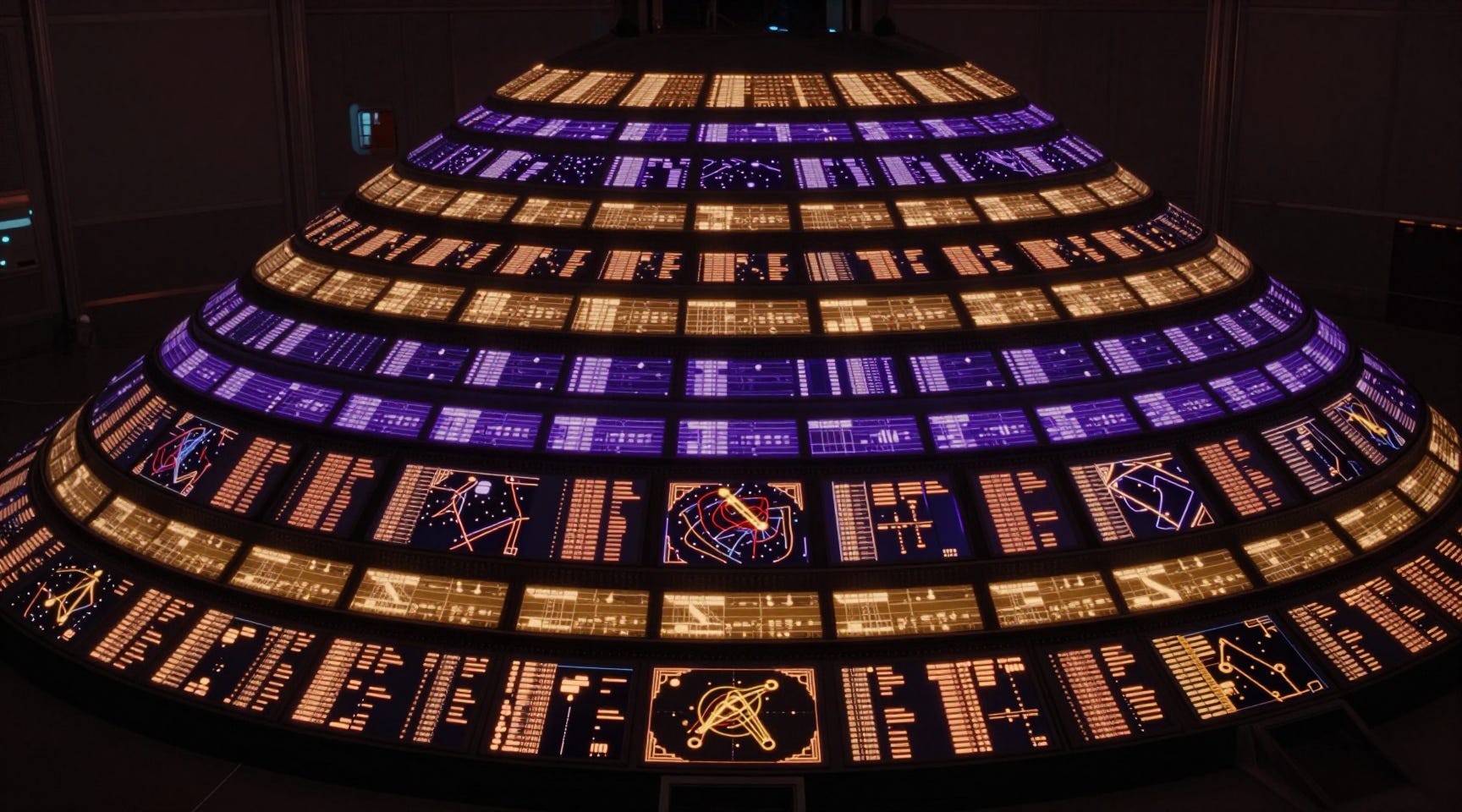
The analysis chamber was a hemisphere of layered display surfaces arranged in concentric tiers, each ring tuned to a different information stream, the whole assembly designed for simultaneous processing of data that would overwhelm a sequential mind. Assessor-of-Threat-Patterns occupied the central platform, the layered displays cycling through sector deployment data, harvest completion rates, resource allocation efficiency metrics, and the quarterly strategic assessment that was the chamber’s current purpose.
The Tau Ceti engagement data arrived as a priority transmission flagged for immediate strategic review.
The Assessor opened the file. The after-action report was concise, structured in the standard Dominion operational format: engagement summary, asset losses, tactical assessment, recommendations. The Assessor read it once, then again, the second reading taking longer because the Assessor’s mind was already running pattern-recognition frameworks that the first reading had triggered.
The engagement summary: a Vethrak task force consisting of one Ripper-class heavy cruiser and six Fang-class destroyers had engaged an alliance force in the Tau Ceti system. The alliance force had included Keraneth vessels, the species from the Tau Ceti system harvested eight hundred years ago and assessed as contained. And human vessels, originating from the Earth system harvested twelve years ago and assessed as a non-threat-level residual population.
The tactical outcome: one Ripper destroyed. Three Fangs lost. The remaining task force commander ordering withdrawal.
The Assessor sat in the silence of the analysis chamber, the layered displays cycling through supporting data. A Ripper-class heavy cruiser destroyed by prey species. The Assessor searched through the memory of every strategic evaluation conducted across a career spanning centuries and found no equivalent entry. Capital-class ships were not lost to prey species. The Assessor’s bioluminescent patterns shifted to deep amber, a response that was not voluntary.
The cross-reference work began. The Keraneth file showed a species harvested eight hundred years ago, assessed as contained. But the Tau Ceti engagement data showed Keraneth vessels with shield harmonics that had allowed a Keraneth heavy cruiser to absorb multiple Ripper-class weapon strikes. The assessed threat level did not match the demonstrated capability.
The human file showed an Earth system harvest assessed as incomplete due to resource inefficiency, the survivors classified as a non-threat-level residual population. But the survivors had built warships in twelve years, traveled to another system, and engaged a Vethrak task force in coordinated action with another species. The Assessor recalculated the threat trajectory: from non-threat residual to tactical alliance partner in twelve years. The trajectory was not consistent with the assessed classification.
The pattern-recognition frameworks were already reaching for additional data points. The Skarreth file appeared in the search. The Skarreth system was harvested one hundred forty-seven years ago, the remnant population assessed as contained. But the cross-reference showed Skarreth stealth assets active in sectors adjacent to the Tau Ceti engagement zone, their presence logged as routine traffic by local patrol commands and assessed as non-significant because no engagement had occurred.
The Assessor ran the pattern analysis. Earth. Tau Ceti. Kresh. Three points in Dominion space, each containing a harvested species whose assessed status was inconsistent with the demonstrated reality. The Assessor overlaid the three data points on a spatial map and the pattern formed before them: a spatial triangle, each point separated by significance, each containing a survivor population whose classification was not consistent with the available evidence.
The Assessor’s conscious mind was not experiencing emotion in any human-accessible sense. The Assessor was registering a structural anomaly: the Dominion’s threat assessment framework had classified three survivor populations as non-threat, and all three had been demonstrated to be inconsistent with that classification within a window of time that was statistically impossible to attribute to coincidence.
The Assessor created a new category. The Dominion’s strategic taxonomy had classifications for allied species within the Dominion’s hierarchy: client species, vassal species, integrated species. The Dominion did not have a classification for alliances of survivor species. There was no precedent in the available records for multiple harvested species forming a coordinated strategic alignment against the Dominion. The Assessor created the category under the provisional designation “survivor-coordination threat.”
The revised strategic assessment was filed in standard Dominion operational format: “Earth-origin system: reclassify from routine reacquisition target to emergent threat node. Recommend sector fleet reinforcement and accelerated harvest timeline. Cross-reference: Tau Ceti system, Kresh system. Alliance of survivor species confirmed. No precedent in available records.”
The Assessor reviewed the assessment, verified the cross-references, and transmitted it to the command hierarchy. The assessment would be processed through the standard routing protocols and elevated through the appropriate levels of the strategic evaluation hierarchy. Whether it reached the level of attention required was not the Assessor’s function. The pattern had been identified. The system had been updated.
The Assessor returned to the next sector evaluation. The layered displays continued their steady operation, cycling through deployment data and resource metrics. The Earth file remained open in the Assessor’s awareness, not as a conscious thought but as a data point whose status had changed.
The Assessor completed the quarterly strategic assessment two cycles later. The Earth-Tau Ceti-Kresh triangle was referenced in the cross-sector pattern analysis appendix, flagged for additional observation in the next evaluation cycle. The Assessor closed the session and left the analysis chamber, the layered displays going dark one by one.
The corridor outside was empty. The Dominion’s facilities were quiet in the off-cycle hours. The Assessor moved through the corridor with the economy of motion that came from centuries of service, the bioluminescent patterns settled to the steady amber of standard operational state.
A Ripper-class heavy cruiser destroyed. A tactical defeat by an alliance of prey species. Three survivor populations whose classifications were all inconsistent with demonstrated reality. The Assessor had identified the pattern and filed the analysis. The Dominion’s command hierarchy would process the information at its own pace, through its own protocols.
The Assessor reached the personal quarters and settled into the recovery state that served the function of rest for the Dominion’s analysts. The Earth exception was logged in the Dominion’s strategic database, a new node in the cross-referenced pattern of the galaxy’s threat landscape. The domain of pattern-awareness that operated below conscious processing continued its work, tracing the connections between harvested systems and survivor populations, between incomplete assessments and tactical defeats, between the routine quarterly evaluation and the first strategic challenge the Dominion had faced in the Assessor’s memory.
The Assessor would review the Earth exception again in the next quarterly cycle. The pattern would either deepen or dissolve. Either outcome was acceptable. The work of the Dominion continued, and the Assessor was the Dominion’s instrument for one specific category of that work. The Earth exception was now part of the formal record, waiting for the Dominion’s attention to reach it through the layers of hierarchy that separated a sector-level assessment from the level at which fleet allocations and harvest timelines were adjusted.
The galaxy was vast, the Dominion was eternal, and Assessor-of-Threat-Patterns had just filed the first official acknowledgment that there were exceptions the Dominion’s doctrine had not accounted for. The Dominion did not yet know it had begun to revise itself.
If you enjoyed this story, you can follow the main story arc in The Exodus Rush, the first book in The Vethrak Requiem series.