


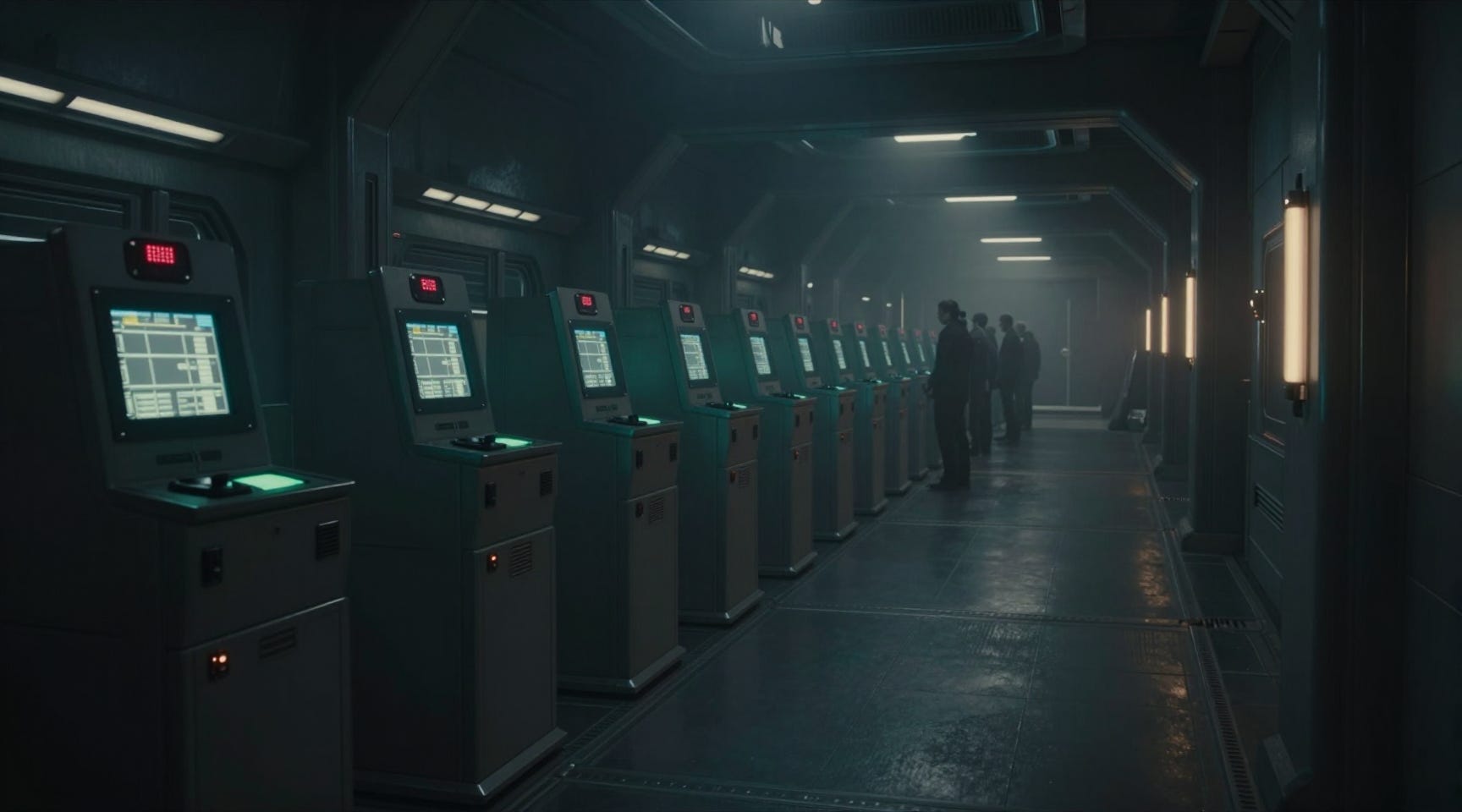
The biometric reader pulsed green. Greta Stratton confirmed the scan, assigned the ration tier, allocated Hab Block 7-C. Refugee four thousand eight hundred and forty-seven, processed through Pallas Station’s intake corridor during the second year after the invasion.
The man on the other side of the partition took his chit without speaking. Thin. Trembling. His pressure suit patched in three places with cargo tape already curling at the edges. He shuffled toward the hab assignment queue, one more body in a line that stretched from the processing hall to the docking ring.
Greta pulled up the next record.
The screen froze.
BIOMETRIC MATCH: DUPLICATE ENTRY DETECTED. REFERENCE ID 2917-P. CROSS-REFERENCE ID 4211-K.
Error codes were nothing new. Sensor fouling from dust or humidity. Partial reads from damaged fingertips. Calibration drift after a power fluctuation. The system flagged anomalies six or seven times per shift, and she cleared each one with a manual override and a visual confirmation.
This was different. A duplicate biometric match meant two entries in the registration database shared identical fingerprint, retinal, and vascular patterns. The probability of a natural match across all three modalities was one in forty-seven trillion. The system did not produce false duplicates.
Someone had copied a person’s biometric profile and registered it twice.
She opened both records. ID 2917-P: Hana Lowgren, age thirty-one, registered nine weeks ago, Hab Block 12-F, drawing standard ration allotment. ID 4211-K: Petra Sundqvist, age twenty-eight, registered three weeks ago, Hab Block 19-D, drawing standard ration allotment.
Different names. Different ages. Different hab blocks. Identical biometrics.
One of them was a ghost.
She pulled the hab assignment logs. Block 12-F existed, occupied at eighty-seven percent capacity. Block 19-D existed too, technically. The section had been sealed four months ago after a micrometeorite puncture caused partial decompression on the outer ring. Nobody lived in 19-D. Nobody could.
Petra Sundqvist was drawing rations from a sealed hab block. Someone had cloned Hana Lowgren’s biometric profile, attached it to a fabricated identity, and registered that identity to a location no compliance officer would physically visit. The ghost drew rations every seventy-two hours through an automated dispenser. The rations went somewhere.
Greta should have flagged the duplicate, filed a fraud alert, and locked both accounts pending investigation. Protocol existed for a reason. Every ghost identity that drew rations took food, water, and medical supplies from someone real.
She ran a broader query instead.
The results came back in eleven seconds. Fourteen duplicate biometric profiles in the active database. Fourteen ghost identities, each registered to a sealed or decommissioned hab section, each drawing standard rations on a seventy-two-hour cycle. Fourteen phantom mouths consuming resources meant for the nineteen thousand actual refugees packed into Pallas Station’s functioning compartments.
Fourteen ghosts did not create themselves.
She checked the registration timestamps. All fourteen had been processed through Intake Station Three during second shift. Greta worked first shift on Intake Station One. Second shift on Station Three belonged to Gerardo Cabrera.
Everyone in intake processing knew Gerardo. He had been on Pallas since before the invasion, part of the original mining support crew, one of the few permanent residents who stayed when the station converted from ore processing to refugee housing. He knew every corridor, every maintenance access, every sealed section. He brought coffee to the intake clerks on double shifts and fixed the biometric readers when the maintenance queue backed up.
The fourteen ghosts carried his authentication codes.
Greta closed the query results. The processing hall hummed around her, ventilation cycling through its familiar rattle of filters that needed replacement. The constant low vibration of a station built for four thousand now holding nearly twenty thousand pressed against her from every direction. The line of refugees stretched past her partition, faces blank with exhaustion, each one waiting for the green pulse that meant survival for another cycle.
She could file the alert. Compliance would lock the database within the hour. A full audit would follow: every registration reviewed, every biometric reverified, every ration allotment frozen until the investigation cleared the system. Standard protocol estimated fourteen days for a station-wide audit. Fourteen days during which automated dispensers would not release rations to anyone whose identity was under review.
Nineteen thousand people. Fourteen days.
Her terminal chimed. The next refugee placed a hand on the biometric reader. The scanner hummed, sampling fingerprint ridges, retinal patterns, vascular geometry. Green pulse. Clean read. No duplicate.
Greta confirmed the scan. Assigned the ration tier. Allocated the hab block.
At 1847, after her shift ended, she walked to Intake Station Three. Gerardo sat behind his partition, posture unhurried, running scans with the measured rhythm of someone who had done this work every day for five months. He looked up when she stopped at his desk.
“You’re off shift,” he said.
“I found fourteen.”
His hands did not stop moving. He confirmed a scan, handed a chit through the partition, turned back to her. “Fourteen what?”
“Ghosts. Sealed hab blocks. Your codes.”
Gerardo looked at her for three seconds. He reached under his desk and produced a small insulated case, the kind used for transporting temperature-sensitive medical supplies. He set it on the desk between them.
“Open it.”
She lifted the lid. Inside, packed in thermal gel, twelve vials of broad-spectrum antibiotics. The labels read UEN Medical Supply. The lot numbers were handwritten. Black market stock.
“Hab Block 22 has thirty-eight children with respiratory infections,” Gerardo said. “Medical requisitions take nine weeks. Those children have three days.” He nodded at the vials. “Fourteen ghosts feed the Latchkey Crew. The Latchkey Crew gets medicine to Block 22 before the requisition forms clear processing.”
“Three percent.” He leaned forward. “The ghosts skim three percent of total ration allocation. Compliance audits haven’t caught it in five months because no one checks sealed blocks. Nineteen thousand people get ninety-seven percent of their rations. The three percent keeps the Crew operational. The Crew fills gaps the UEN cannot.”
“It is still theft.”
“Yes.” He did not argue. He confirmed a scan, handed a chit to the next refugee, and waited.
Greta looked at the case. Twelve doses. Thirty-eight children. The shortage was obvious even in the solution.
She closed the lid, picked up the case, and walked toward Hab Block 22.
The line at Intake Station Three kept moving behind her.
Author’s Note: In the post-invasion solar system, every repurposed mining station runs on the same insufficient math: too many people, not enough supplies, and a bureaucracy that was never designed to move fast enough. Pallas Station is one of hundreds struggling with that equation. The Latchkey Crew operates in the gap between what people need and what the system delivers, part of a growing network of small syndicates reshaping survival across Sol.
If you enjoyed this story, you can follow the main story arc in The Exodus Rush, the first book in The Vethrak Requiem series.