


The drydock smelled of welding compound and coolant. Thomas Okonkwo stood at the edge of Vanguard’s open engineering section, his datapad scrolling through the damage assessment, and the ship spread out beneath him like a patient on a surgical table.
The hull plates from frame forty-seven through sixty-two had been removed. The crysteel beneath showed the stress fractures. Micro-fissures radiating outward from the impact point, each one mapped and color-coded on his display. The ramming near-miss during the depot raid had come closer than the after-action report acknowledged. Six meters closer and the Vethrak destroyer would have cored Vanguard through the reactor housing. Six meters the other direction and Thomas would not be standing here cataloguing damage. He would be dead. Park would still be dead either way.
Thomas scrolled to the next section. Shield generator number three: stress fractures in the emitter housing, ninety-four percent of rated output under combat load. The generator had held during the extraction. Marginally. He noted the replacement priority and moved on.
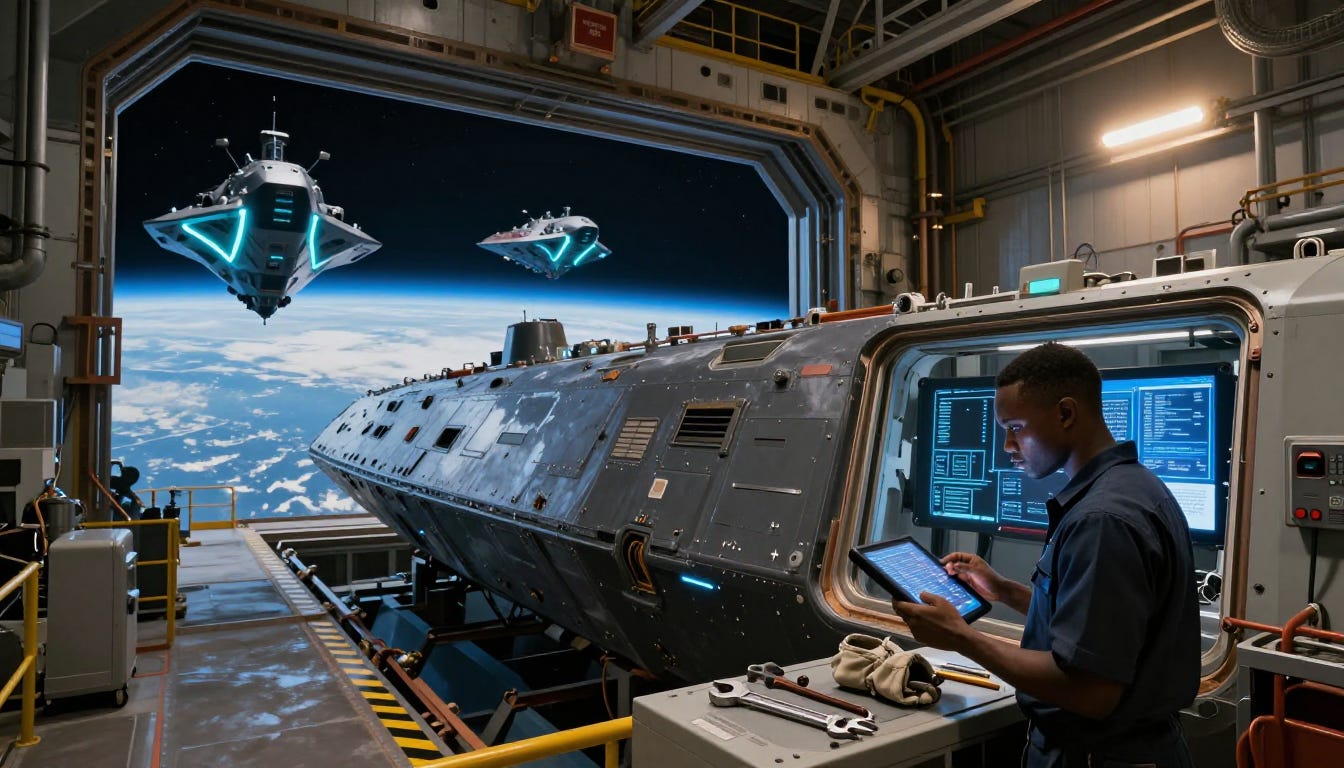
The work was methodical. Exhaustive. The kind of work Park had taught him to do before he learned to do anything else. The ship tells you where it hurts. Your job is to listen before it screams.
Park had been dead for forty-one days. Thomas had stopped counting the hours sometime after the depot raid. The wound was no longer fresh. It was something denser. A weight that had settled into the architecture of his chest and learned to live there.
He finished the shield generator section and moved to the fold drive housing. The secondary calibration array had drifted by point-three percent. Within tolerance. He marked it for review anyway.
“Lieutenant Okonkwo?”
Thomas looked up. A junior engineer stood at the edge of the bay, her uniform still stiff with the newness of someone who had not yet learned which stains were permanent and which would wash out. Her insignia marked her as Resolute’s engineering section.
“Sir. I have a fold drive problem. My section chief said you might be able to help.”
Thomas put down his datapad. “Show me.”
The walk to Resolute’s berth took them through three docking corridors and a maintenance access way that smelled of burnt insulation. The junior engineer, her name patch read something that was not Okonkwo, something longer, talked while they walked. The tertiary harmonic dampener. Calibration drift. They had been chasing it for two days and every fix made it worse.
Thomas listened. He had learned to listen to people the way he listened to machines. The junior was not incompetent. She was frustrated. The frustration was making her skip steps, and the skipped steps were compounding the problem. Park would have spotted it thirty seconds in. Park would have asked one question that made the junior realize she already knew the answer.
They reached Resolute’s engineering section. The ship was docked two berths down from Vanguard. Smaller. Older. One of the pre-invasion hulls that had survived the fleet action at Earth and been retrofitted instead of scrapped. Her fold drive housing was original equipment. Forty-year-old Vethrak salvage, maintained by four generations of engineers who had learned on the job because there was no manual.
The diagnostic screen showed the problem immediately. The dampener’s phase variance was oscillating inside a feedback loop. Every correction the junior had applied had tightened the loop instead of breaking it.
“Here,” Thomas said. He pointed at the tertiary node. “You are calibrating to the primary output. The tertiary dampener does not reference the primary. It references the secondary. That is why each correction makes it worse. You are feeding the wrong signal into the loop.”
The junior stared at the screen. Her jaw tightened. The look of someone who had spent two days chasing a ghost and just found out the ghost was a misread diagnostic label.
“I ran the same calibration on the secondary dampener last week,” she said. “It worked.”
“The secondary dampener references the primary. Different input path. Your procedure was correct for the system you thought you were working on.” Thomas tapped the screen. “Reset the tertiary to its default calibration. Run the secondary’s baseline. Use that as your reference. The dampener will stabilize.”
She did not move. She was processing. The self-recrimination was visible on her face, the particular shame of a mistake that looked obvious in retrospect.
He recognized the feeling. He had worn it for most of his first year aboard Vanguard.
“You found the problem,” Thomas said. “It took two days. That is not a failure. That is engineering.”
She looked at him. “I should have seen it.”
“Park used to tell me the ship tells you where it hurts. Your job is to listen before it screams. You listened. You caught something wrong. You asked for help.” Thomas paused. “That last part took me longer to learn than I want to admit.”
Something shifted in her expression. Not relief. Not quite. The beginning of a reframe. The mistake becoming experience.
“Thank you, sir.”
Thomas walked back toward Vanguard through the maintenance corridor. The smell of burnt insulation was stronger in this section. Something in the environmental system needed attention. He made a mental note to check the filtration logs.
Halfway back, a Keraneth engineer intercepted him. The Keraneth was tall and angular in the way of all Keraneth, their bioluminescent patterns shifting through what the translator collar rendered as polite inquiry but what Thomas had learned to read as professional impatience. A Keraneth who was waiting and did not like waiting.
“Lieutenant Thomas Okonkwo.” The translator flattened the Keraneth’s dual-channel communication into synthetic English. “The coupling interface. Your Skarreth colleague Kresh-Vol evaluates the compatibility matrix. The assessment requires human power distribution specifications that are not yet standardized. Your input is requested.”
Thomas stopped walking. “Which coupling?”
“The primary power transfer linkage. Swift Talon’s energy distribution architecture references a standard that is not present in the shared database. The Skarreth standard approximates it. The human standard does not. Reconciliation requires a third point.” The Keraneth paused. A brief flare of amber crossed their bioluminescent field. “You are that point.”
Thomas pulled a grease pencil from his pocket. A bulkhead panel beside him was clean. He sketched.
The Keraneth leaned forward. Their bioluminescence shifted to attention-blue.
“Human power distribution uses a decentralized architecture.” Thomas drew a node. Drew three lines. “The distribution manifold accepts input from any source capable of matching the frequency standard. The Skarreth architecture is centralized. The Keraneth architecture is redundant. Every node can serve as primary.”
The Keraneth’s translator rendered a click pattern as acknowledgment.
“The problem is not the standard. The problem is the handoff.” Thomas drew another node. Another set of lines. “When power flows from a decentralized source to a centralized receiver, the receiving system interprets the multiple inputs as noise. It is expecting one signal. It gets three.”
The Keraneth was silent for a long moment. The attention-blue deepened. Then: “The solution is not in the coupling. It is in the distribution architecture.”
Thomas capped the grease pencil. “You buffer the input. One-half-second delay. Enough for the receiving system to reconcile the sources before the power flows.”
“A translation layer.” The Keraneth’s patterns shifted through something that was not quite the word the translator rendered as “impressed” but was close enough. “The coupling interface is not a mechanical problem. It is a language problem.”
“Most engineering problems are language problems,” Thomas said. “The systems want to talk to each other. You just have to give them the right grammar.”
The Keraneth studied the grease-pencil sketch on the bulkhead. Thomas kept his eyes on them as they read it. The way their bioluminescence shifted as each line resolved into understanding. The same way Thomas read a diagnostic screen. Different medium, same process. Three engineering traditions, one problem. The Skarreth efficiency. The Keraneth durability. The human flexibility. None of them sufficient alone. All of them necessary together.
“I will convey this to Kresh-Vol,” the Keraneth said. “The buffered input. The translation layer. The grammar.” A pause. “You should write this down. Somewhere less temporary than a bulkhead.”
Thomas looked at the grease-pencil sketch. The lines already beginning to smudge. “I will,” he said. “Eventually.”
The Keraneth departed. The corridor was quiet again. Thomas stood in front of the bulkhead for a moment, the sketch fading in the recycled air, and thought about Park. About the reactor pulse. About the fold extraction. About all the things he had done because he was the person in the room when they needed doing and nobody else knew how.
He was not supposed to be the person. He was supposed to be the assistant chief engineer of one ship. Vanguard. Shaw’s ship. Park’s ship before that. The wrench in his pocket was supposed to be a memento, not a credential.
The Resolute engineer had come to him. The Keraneth engineer had waited for him. Kresh-Vol was waiting for him, somewhere in the engineering workspace, with a compatibility matrix that needed a third point.
Thomas walked back to Vanguard’s engineering bay. The damage assessment was still open on his console. The shield generator stress fractures. The fold drive calibration drift. The hundred small things a ship needed after combat, each one methodical, each one necessary. Park’s voice in his head, a diagnostic running in the background of every repair. The ship tells you where it hurts.
He sat at his console. The wrench went on the table beside him, wrapped in cloth. He did not pick it up. He did not need to.
The diagnostic screen showed green across the board. Everything was functioning. Everything was fine. Thomas sat in the quiet bay and understood, for the first time, that the work was no longer one ship’s damage assessment.
Shaw found him there at the end of the shift. She entered the engineering bay the way she entered every space, exactly present, taking the measure of the room in the time it took to cross the threshold. Her right hand rested at her side. The tremor was barely visible tonight.
“I understand you fixed Resolute’s fold drive today,” she said.
Thomas did not look up from the diagnostic screen. “It was a calibration issue.”
“It was not your ship.”
He looked at her then. Shaw’s expression was unreadable in the way of a captain who had learned to keep her assessments where her crew could not find them. But something was there. A quality he had seen before, months ago, when Park had observed him execute the reactor pulse and said nothing at all.
“That Keraneth engineer stopped me in the corridor,” Shaw said. “Keth-Miren. They wanted to know if you were available for a joint working session tomorrow. They used the phrase ‘point of translation.’”
Thomas did not know what to say to that. The Keraneth had given him a title. He had not asked for one.
“The captain of Resolute sent a commendation,” Shaw continued. “Her chief engineer wants to know if you can consult on their fold drive maintenance schedule. The junior you helped this morning apparently told her section chief that you treated her like a colleague instead of a problem.” Shaw paused. “You are not just Vanguard’s engineer anymore, Thomas.”
The words landed in the quiet bay. The ship hummed around them, docked and dormant, the reactor in standby. The green diagnostic lights cast Shaw’s face in pale relief. Thomas sat at the console with his father’s wrench on the table and his ship’s damage assessment open on the screen, and the thing Shaw was telling him was something he had already known for hours without having the words for it.
“I do not know when that happened,” he said.
“It has been happening for months.” Shaw did not sit. A captain did not sit in her own engineering bay when she was delivering a truth that changed someone’s shape. “It happened when you pushed the reactor past safety margins at the Kuiper Gap. It happened when you worked with Vasquez to integrate Revenant’s systems. It happened when you sat in a workshop with a Skarreth engineer and a Keraneth engineer and convinced them to build something none of you could build alone. You have been becoming this person for a year. You just recognized it today.”
The silence stretched. The ship hummed. Thomas’s hand found the wrench. The cloth was worn soft from months of carrying, the shape of the metal familiar beneath the fabric. His father’s wrench. Park’s mentorship. His own hands, learning to listen.
“I do not know how to do this,” he said.
“You do,” Shaw said. “You have been doing it. The only thing that changed today is that someone else recognized it.” She turned toward the bay door. Paused at the threshold. “Write down the bulkhead sketch, Lieutenant. Before it smudges.”
She left. The engineering bay was quiet again. Thomas sat at his console for a long time. The green diagnostic lights held steady. The damage assessment waited. The Keraneth’s translation layer waited. The Skarreth compatibility matrix waited. Three ships that were not his. Three engineering traditions that needed a grammar.
He picked up the wrench. Unwrapped it. The metal was cool in his palm, the weight of it exactly the same as it had been since he was nine years old. The weight had not changed. He had.
Thomas set the wrench down on the console. Opened a new file on his datapad. Typed the first line: Buffered Input Protocol, Tri-Species Power Coupling Standard.
The ship hummed around him. The work was waiting.
If you enjoyed this story, you can follow the main story arc in The Exodus Rush, the first book in The Vethrak Requiem series.