


The chapel was a converted maintenance bay. It held nineteen folding chairs, a salvaged altar table that had once been a coolant manifold housing, and a single observation port patched twice with thermal sealant. Through the port, Saturn turned slow and pale across the black, and the ring debris caught light in long slow drifts that Tomasi had learned to read the way other men read a clock.
He stood behind the manifold table in his work coveralls. The collar of his salvage rig was unfastened. He had not bothered with vestments since the first month. The congregation would not have known what to do with vestments.
Twelve people sat in the chairs tonight. Six were crews of two. Three came alone. Tomasi knew each of them by the wear on their pressure suits, by the small uneven scars at the cheekbone or the jaw where helmet seals had bitten in too long, by the cadence of their breath.
He opened the small book he had assembled himself. The liturgy inside was his own, adapted from psalms he had memorized as a boy on Tongatapu and rewritten for people who lived where there was no horizon.
“The drift,” he said. “The drift teaches us our weight.”
The congregation answered without prompting. “We are not the heaviest thing.”
“The drift teaches us our breath.”
“We do not own the air.”
“The drift teaches us our reach.”
“We cannot reach alone.”
Tomasi closed the book.
He spoke for ten minutes. He spoke of the woman in the second row whose tether had failed last cycle, and of the man in the third row who had clipped onto her line and held her while two skiffs argued for forty seconds about who would burn the fuel to retrieve them. He did not name either of them. He did not have to. The chapel was small enough that everyone knew which line had snapped and which line had held.
He closed with the benediction he had written himself.
“Go in the drift. Carry each other home.”
The congregation said amen and did not stand.
This was the part Tomasi had been preparing for, and the part the congregation had come for, and the part he had not yet learned how to do without his hands trembling under the table.
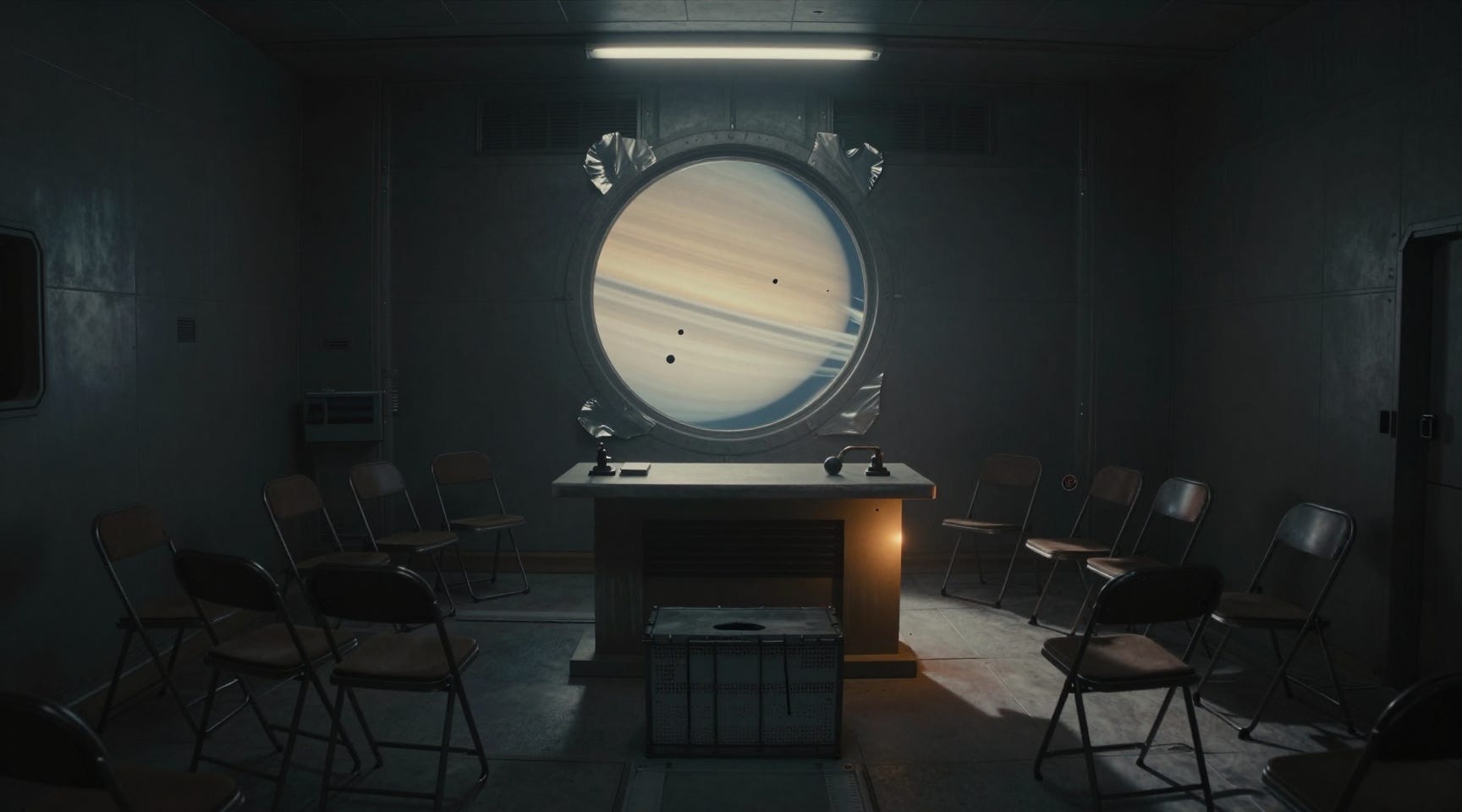
Folding the chairs took two minutes. Setting them in a rough circle took another two. The manifold-housing table stayed where it was. Tomasi sat on a salvaged crate at the open end of the circle. The pulpit position had not survived the transition into the second part of the evening.
Mereoni Vunipola came in late, the way she always did, and took the empty chair across from him. She was the closest thing the chapel had to a deacon, and the closest thing the salvager crews working this ring section had to a treasurer. She set a battered slate on her knee.
“Twelve attending,” she said. “Eight have paid into the pool this cycle. Three have not. One could not.”
“Which one could not.”
“Sailosi. His skiff threw a coolant line. The repair took the credit he would have brought.”
“Pay him out from reserve.”
“He would not ask.”
“That is why we do not make him ask.”
Mereoni made a mark on the slate. She did not look up.
Tomasi turned to the circle. “Tonight,” he said. “Three items. First, the rota for the next medical retainer payment. Second, the question of the buyer at Mimas who has been undercutting our prices on first-grade hull alloy. Third, the question of arbitration when a dispute exceeds what two captains can settle between themselves.”
The conversation was practical. The conversation was slow. The conversation moved with the deliberation of people who knew that any system they built would have to hold them up when the rings turned cold.
They settled the medical rota first. They settled the Mimas buyer second. They argued the third item for twenty minutes and arrived at a workable proposal: a panel of three, drawn by rotation, with a final appeal to Tomasi as a tiebreaker. He had not asked for the tiebreaker role. The circle had given it to him. He had not refused it.
As the circle loosened, Apisai Fonua, who was the oldest salvager in the chapel and the only one who remembered Earth as a green place, raised his hand.
“Pastor,” he said. “What do we call this thing.”
The room went quiet in the way it did when someone said something everyone had been thinking and had not yet said.
Tomasi answered slowly. He had practiced this answer in private. The practice was not helping him now.
“A covenant,” he said. “The drift teaches us we owe each other our lives. A covenant is what we make of that.”
“The drift covenant,” Apisai said. He said it the way a salvager tested a fitting before committing it to a hull.
“The Drift Covenant,” Mereoni said. She wrote it on the slate. She wrote it with capitals, the way she wrote things meant to last.
The room sat with the name for a moment.
Then the meeting ended, and the congregation filed out into the corridor, and Tomasi stood at the open door watching them go, and the name stood in the air behind him in a way that settled against the back of his neck.
He cleaned the chapel alone.
He folded the chairs. He carried them to the wall. He wiped the manifold table with a rag that smelled of the desalination lubricant the station ran on. He set the small book back into the drawer he had welded into the underside of the table.
He stood at the observation port.
Saturn turned. The rings carried their slow long drift across the glass. A piece of debris caught a flash of light and moved on.
Tomasi knelt at the manifold table.
He had not knelt at the start of his ministry on this station. He had stood, because standing had felt more honest, because the people in this chapel did not need a man on his knees in front of them. He knelt now because the room was empty and the prayer he had to say was not a prayer he could say standing.
“Lord,” he said. “Forgive me, in advance, for what I think this will become.”
He stayed kneeling for a long while.
When he stood, the prayer was still in the room. The name was still in the room. The two of them sat together in the small space between the altar and the observation port, and Tomasi knew already that one of them was going to outlast the other.
He turned off the chapel light.
He cycled the door behind him.
The corridor was cold. The ring turned. The drift kept its slow patient count.
Pastor Tomasi Havili walked back to his quarters, and behind him, in the room he had just locked, the Drift Covenant was already a thing with a name that had not been there an hour before.
Author’s note: Day Eleven of the Iron Wake Origins arc. Year 2, Month 3. This is the first of the parallel-syndicate POV breaks: Anya Rask is nowhere on the page. The rings are full of people making the same hard choices in different shapes, and on a small ring-belt station chapel some sections out from Mimas, a Tongan preacher named Tomasi Havili is organizing what will outlast him. The Drift Covenant frames itself as mutual aid: pooled medical funds, shared EVA emergency response, collective bargaining with buyers. It is Iron Wake’s gentler cousin. It is also, inescapably, a syndicate, and Tomasi knows it before anyone else does, and kneels alone to ask forgiveness in advance for the thing he has just helped name. By Year 14, when the Drift Covenant is one of Iron Wake’s peer organizations across Sol, the small chapel on a ring-belt station will still be the place its members trace the origin to.
If you enjoyed this story, you can follow the main story arc in The Exodus Rush, the first book in The Vethrak Requiem series.