


The first seedlings had broken through the soil that morning.
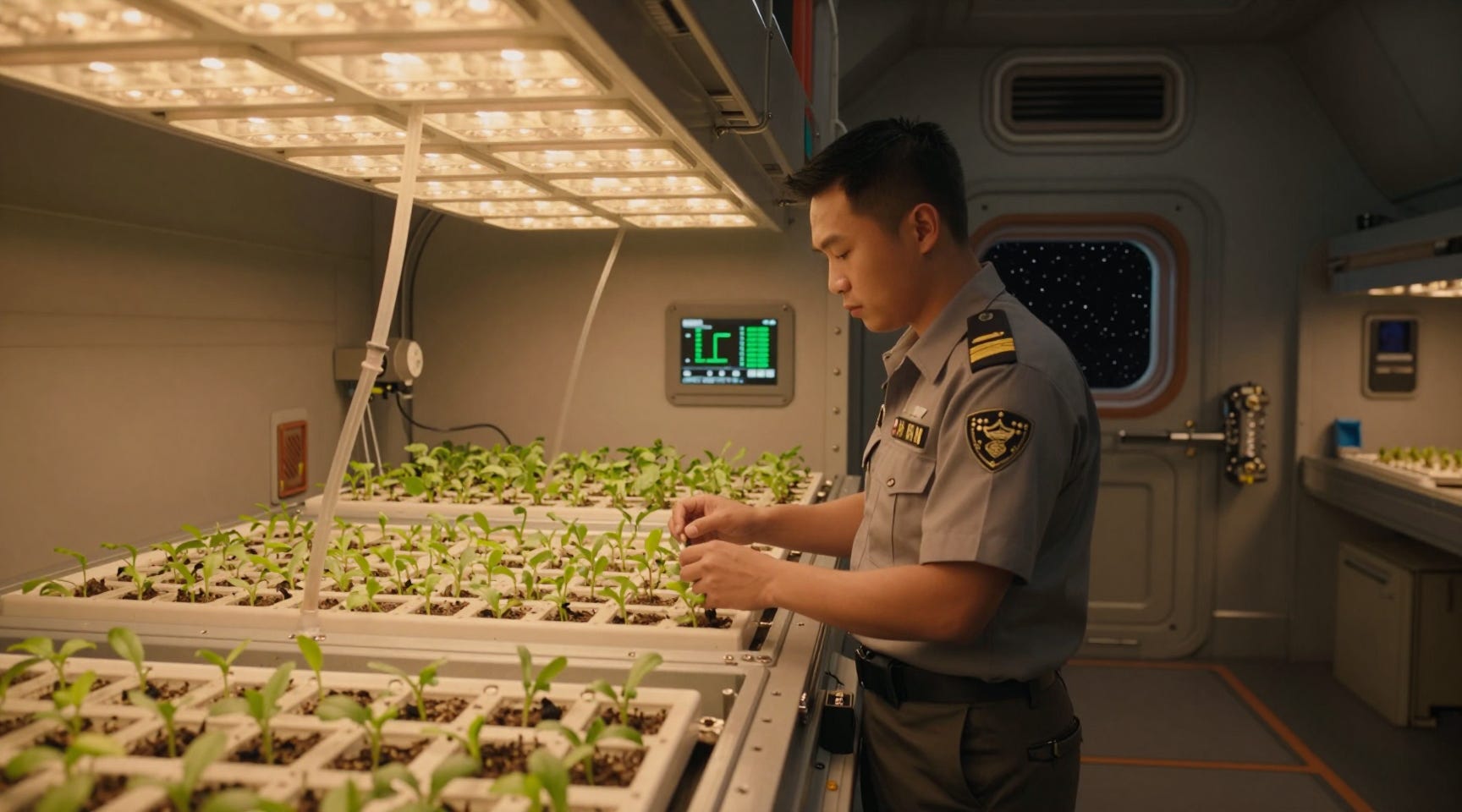
Tuan Le stood at the edge of the hydroponics bay and let himself feel it for a moment. Twenty-two trays of Brassica rapa, the quick-growing cabbage cultivar the Fleet nutritionists had selected for the first patrol crop. Seven days since the seeds went in. Seven days of monitoring the nutrient drip, adjusting the light spectrum, checking the root aeration. The first pale green shoots were barely a centimeter tall. They looked impossibly fragile against the black synthetic soil.
Tuan had spent his first twelve years in the orbital farm towers above Melbourne, watching his grandfather coax vegetables out of hydroponic trays that were older than the invasion. His grandfather had been a cane farmer in the Mekong Delta before the seas rose, before the family moved south to Australia, before the towers went up and the old man learned to grow rice in tubes of nutrient solution twelve stories above the ground. He had died three years before the Vethrak came. Tuan had always thought that was a mercy.
“Bay three to Maintenance,” he said into his comm.
The door to the maintenance closet was not seating. The pressure seal had hissed and stuttered on his second day aboard, refusing to close cleanly, and it had not improved since. He had logged the work order. He had logged it again the next day, and the day after that, and once more this morning. Four work orders in five days. The door still jammed at the lower right corner every time.
“Maintenance here.” The voice on the other end belonged to a chief petty officer named Brennan who had been asleep or possibly dead when Tuan filed the first three reports. “What’s the problem, Le?”
“The hydroponics maintenance closet. Door Bravo-Four. It will not seat. The lower right seal refuses to engage.”
A long sigh. The kind of sigh that contained information.
“Le, I have a coolant pump on deck four that is vibrating so hard the crew quarters two sections over are getting a massage they did not ask for. I have a waste recycler on deck two that is making a sound normally associated with dying animals. I have a list of forty-seven other work orders and three people on duty. Your door is on the list. It will stay on the list until I have people to clear it. Understand?”
“I know,” Tuan said. He did know. He had worked maintenance himself before the Academy. Before the Fleet decided he was worth more with a soil-analysis kit than a wrench. “I am only asking you to tell me when you might have someone to look at it.”
“I will look at it when the coolant pump is not about to vent superheated steam into someone’s bunkroom. Brennan out.”
Tuan stood in the quiet of the bay. The seedlings did not care about the door. The seedlings were busy being alive.
He went to his cabin.
The cabin was small. Every cabin on a Vanguard-class cruiser was small. His grandfather’s hand-tool kit was under the bunk, in the footlocker where he kept the things the Fleet did not issue. The kit was old. The wrenches had wooden handles worn smooth by decades of use in the tower farms, the screwdrivers had his grandfather’s initials scratched into the metal, and the adjustable spanner had a slight bend in the handle from the time his grandfather had used it to pry open a seized irrigation valve and the valve had fought back. The kit was not Fleet-approved. Tuan did not care.
He carried it back to the hydroponics bay.
The door was a standard pressure-seal hatch, waist-high, designed to hold extra nutrient packs and soil trays and the small toolkit Fleet had issued for the bay. Fleet had designed it to close. Fleet had not designed it to close after six days of patrol-vibration had settled the frame by half a millimeter. Tuan knelt and opened his grandfather’s kit.
The lower-right hinge plate was the problem. The mount had shifted. Not much. Half a millimeter at most, the width of a root hair, the kind of misalignment that was invisible to the naked eye and catastrophic to a pressure seal. Tuan loosened the four bolts with his grandfather’s adjustable spanner. The metal was cold. The vibration from the ship’s engines ran up through the deck plates and into his knees. He realigned the plate by feel, the way his grandfather had taught him to feel a stuck bolt rather than force it, the way he had learned that machines tell you what is wrong if you are patient enough to listen.
He tightened the bolts.
He stood. He tested the door. It swung closed. The seal engaged with a soft pneumatic hiss and held. The indicator on the frame shifted from amber to green.
He did not file a follow-up work order. The door was closed. Maintenance had bigger problems. The door would stay closed until it did not, and then Tuan would fix it again.
He put his grandfather’s toolkit away. He walked back to the seedlings.
The grow lights hummed at seven hundred lumens, mimicking the mid-morning sun that none of the crew had seen in six days. The shoots were a little taller than they had been an hour ago. Tuan checked the nutrient readings on the wall display. The calcium-magnesium ratio was drifting slightly high. He adjusted the drip by one point two percent and logged the change.
His grandfather had taught him that too. The plants do not care about the door. The plants care about the light and the water and the nutrients. You keep them alive and they will keep everyone else alive. That is the contract.
Tuan stood in the quiet of the bay with the first crop of the first patrol of humanity’s first warship growing around him, and he thought about the door behind him, sealing properly for the first time in six days, and the coolant pump on deck four, and the waste recycler on deck two, and the forty-seven other work orders that Chief Brennan was going to get to when he could, and the thousands of small failures that made a new warship feel like a new organism learning to breathe.
We are going to make this work, he thought. One door at a time.