


David set two ceramic plates on the fold-down table and squared them until the edges agreed.
The plates had come from the commissary that morning, requested under a supply code that assumed an officer’s dinner guest and did not ask who. White. Slightly thick. The kind of ware that survived being stacked. Not trays. He set forks to the left and knives to the right because that was how their mother had set a table in a Mars hab that had never had room for ceremony and had insisted on it anyway.
The quarters smelled like rice and garlic and black beans that had been on the heat for two hours. Station greens wilted in the pan. The recycler pulled the steam toward the vent and failed to take all of it. David stirred with a wooden spoon that had been in the drawer when he moved in. Low heat. Lid cracked. The way she had done it.
Fourteen years. The recipe had survived. The woman who taught it had not.
A knock. Two raps, then a pause, then a third. Marcus’s knock. It had been their father’s first.
David opened the door.
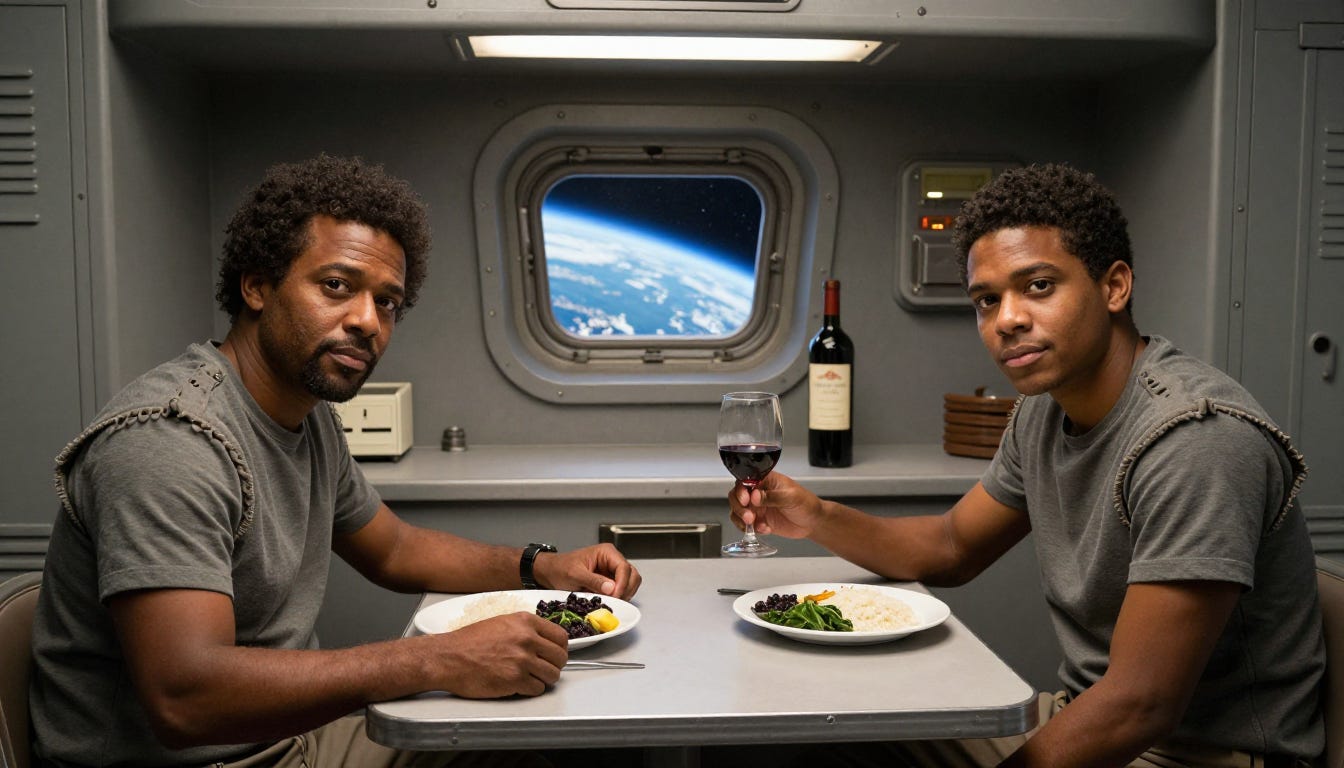
Marcus Rivera stood in the corridor in off-duty gray, a bottle in his right hand, his left hanging at his side with the controlled stillness David had learned to stop measuring. He looked older than the last time they had shared a room that was not medical and not a simulation bay. He also looked like himself.
“You cooked,” Marcus said.
“You brought a bottle.”
Marcus held it up. Dark glass. A paper label gone pale at the edges, the year printed in a typeface nobody used anymore. “Thirty-three years. I have been moving it from posting to posting since the first yard assignment. I told myself I was saving it.”
“What occasion?”
“I never named it.” Marcus stepped inside. The door sealed. He set the bottle on the counter with his right hand. “This will do.”
David found two glasses in the same commissary issue as the plates. He poured. The wine came out dark and slow, older than the war, older than either of them had been the summer they argued over a protein bar in a hab that smelled like wet grow-medium and their mother’s hands.
They sat.
Rice. Beans. Greens that had never seen a sky. Marcus ate the way he did everything now: with attention, without hurry, the left hand a fraction behind the right and then catching up. David did not comment. That conversation had already been used up in a medical room ten days ago.
“These are her beans,” Marcus said.
“Close. The station cumin is a lie. I used twice as much.”
Marcus’s mouth moved. Not quite a smile. “She would have told you it was still wrong and eaten two bowls.”
“She would have told me to stop wasting heat on the second hour.”
“She was wrong about the second hour.” Marcus took another bite. “The second hour is the point.”
They ate. The quarters were small. A bunk recessed in the wall. A locker. A viewport no larger than a hand, Earth a blue-white sliver beyond the station’s dark metal. The fold-down table put their knees close. David had eaten a thousand meals across a table from this man. Most of them had been trays and silence. Tonight the silence had a different shape.
“You remember the last summer,” David said.
“The protein bar.”
“You said you had already eaten.”
“I had not.”
“I know.” David tore a piece of station bread. “You were leaving for the Academy in six weeks. You wanted me to stop talking about it.”
“You did not stop.”
“You ate half and handed me the rest and told me not to make it a thing.”
Marcus set his fork down. “It was a thing.”
“It was a protein bar.”
“It was the last summer we were only brothers.” Marcus picked up the glass. He did not drink yet. “After that I was a cadet and you were the one who stayed. Then the sky burned and none of the categories worked.”
Their mother had run the hydroponics bay on the civilian ring. Twelve trays. Recycled water. A stubborn tomato cultivar she refused to replace. Their father had worked the ore processors on the night shift and come home with dust in the seams of his hands and a word he used the way other men used prayer.
Defiant.
Not the ship. The stance. Sit back down. Finish the row. Do not yield the tray to a man who wants it because he is louder.
David had been sixteen. Marcus had been twenty and already gone in his head, already living in a future that had a uniform in it. They had argued about the last bar because arguing was the language they had for the thing neither of them could say.
“The tomatoes never ripened that year,” David said.
“They ripened. You were too angry to admit the color.”
“They were green.”
“They were ripening. There is a difference.” Marcus drank. A small amount. He set the glass down with his right hand and left it more full than empty.
The conversation circled the way it always had. The ore processors. The way their father washed his hands twice before he touched the table. The summer heat in a dome that never quite vented. Easy shorthand. The kind of talk that only worked if you had grown up in the same cramped dark.
David refilled his own glass. He did not refill Marcus’s. Marcus did not ask.
“I didn’t think I could do this,” David said. “Command.”
Marcus was still. Not the medical-room stillness. The stillness of a man who had been waiting for a particular sentence and had decided not to reach for it.
“I knew you could,” Marcus said. “I was afraid of what it would cost you.”
The recycler clicked. The beans pot ticked as it cooled. Earth slid a fraction in the hand-width viewport.
“What did it cost you?”
Marcus did not answer immediately. His left hand rested on the table, fingers quiet. The latency was there if you knew where to look. David knew. He kept his eyes on his brother’s face.
“Everything,” Marcus said. “I would pay it again.”
They sat in it. Two people who had almost lost each other and had not. Some debts could not be repaid. They could only be carried forward, the way a ship carried a scar in the plating and still made fold.
David’s throat was tight. He let it be tight. He did not fill the space. The chair on Defiant was his. The admission had not made it less his. It had made it honest.
He tipped the last of the bottle into their glasses. Two thin dark lines. He set the empty bottle on the counter.
Marcus lifted his glass.
“To Defiant,” he said.
The word landed in the small room and became two things at once. The ship in her construction framework three rings out, hull patched, reactor in standby, waiting for the first cruise David would run without his brother’s shadow on the board. The other thing their father had put in their hands before he had taught them anything else. Sit back down. Finish the row. Do not yield.
David lifted his glass.
“To Defiant.”
They drank. Marcus finished what was left and set the glass down empty. David did the same. The label still named a place that did not exist.
Marcus stood. He carried his plate to the sink without being asked, the way he had done in the hab when the meal was over and the argument was not. He rinsed. He set the plate in the rack. He touched the empty bottle once, a two-finger contact, and left it where it was.
“Keep it,” he said.
“I was going to.”
Marcus nodded once. He stopped at the door. Off-duty gray. The left hand at his side. A man who had spent fourteen years trying to be the person who survived the invasion and had spent these last weeks teaching other people how to do the next part.
The door sealed behind him.
David washed the dishes. He washed the glasses. He wiped the fold-down table until the metal showed the old scars and none of the meal. He left the bottle on the counter where Marcus had left it. Dark glass. Pale label. Empty.
He would keep it.
If you enjoyed this story, you can follow the main story arc in The Exodus Rush, the first book in The Vethrak Requiem series.