


The corridor was the longest he had ever walked.
It ran the length of the maternity ward at St. Nicholas, fluorescent and cold for Lagos in April. The cold was the kind Chinaza would have called Western, the kind she would have called too much air conditioning for a country that did not need it. Ayodeji counted floor tiles between the door of Suite Three and the small alcove by the linen cart. Sixty-four. He had counted them seven times in the past hour. The number did not change. Counting them did.
His phone buzzed against his thigh. His mother again. He stepped into the alcove.
“Yetunde.”
“You are still at the hospital.”
“Still. Twenty-two hours.”
A pause. The pause was not the kind his mother usually gave him.
“Are you near a television?”
“Mama, the women in the waiting room have it on. I have been seeing pieces.”
“Pieces are not enough. Listen to me. They are saying it is real.”
He pressed his forehead against the cool tile of the alcove wall. His mother had a way of saying real that no other Yoruba woman of his acquaintance could match. The word came out small and final, the way she said amen at the end of grace.
“Mama.”
“Adaeze is asleep beside me. I have the radio low. They are saying the ships are at Mars now.”
“Mama.”
“I want you to know I am not afraid.”
He closed his eyes. The alcove smelled of bleach and starched linen. Inside Suite Three, Chinaza was making the long low animal sound of a woman in the latest part of the work, and a midwife’s voice held steady underneath, encouraging.
“I love you,” he said.
“Tell my granddaughter when she comes that her grandmother has been waiting.”
The line clicked.
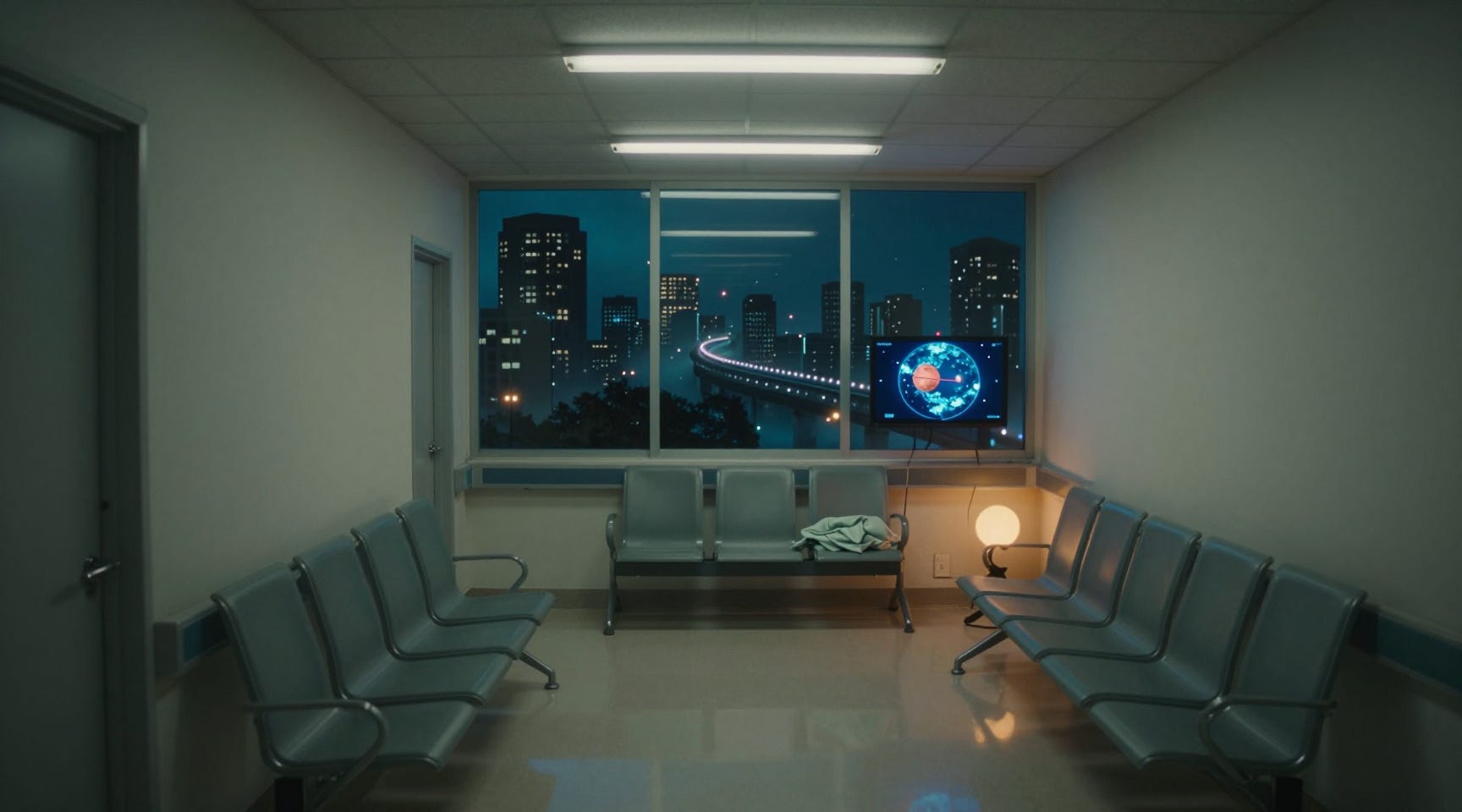
He stood in the alcove for the count of ten. The waiting-room television at the far end of the corridor played at the volume an old woman in a wheelchair had requested, low. The screen was visible from here if he tilted his head. A map of the inner solar system. A red ring around the fourth planet. The anchor’s mouth moved without sound.
He pushed off from the wall and walked back to Suite Three.
Chinaza was a small body in the bed, made smaller by the white sheet drawn up to her ribs and by the focus in her face. Her braids were damp at the temples. The midwife stood at the foot of the bed. The second nurse beside her. The thin curtain at the window had been pulled to keep the city light out of his wife’s eyes.
“Ayo.”
He took her hand. Her grip was the grip of a woman who had been gripping things for a long time.
“How long was the call,” she asked.
“Three minutes.”
“What did your mother say.”
He looked at her face. The color of her, the heat of her. The way her eyes held his with the absolute attention of a woman who had narrowed the world to the next contraction and the next and the one she could feel building.
“She says Adaeze is asleep. She says she loves you.”
Chinaza nodded once. The contraction took her. He watched her go into it the way he had watched her go into every hard thing in their seven years together: head down, breath forward, no theatrics. The midwife counted under her breath. The second nurse adjusted the sheet.
The contraction passed. Chinaza opened her eyes.
“You are lying about something.”
“I am not lying.”
“You are not telling me something.”
A silence. He kissed her forehead, which was salt.
“Have the baby first,” he said. “Have the baby. Then I will tell you anything you want.”
She held his gaze. The trust in her face was not the trust of a woman fooled. It was the trust of a woman who had decided which work to do first.
“Stay where I can see you,” she said.
Folake came at three-fourteen in the morning.
He did not see the moment of it. The midwife asked him to step to the head of the bed. The nurse held his wife’s leg. Chinaza made the long sound he had been hearing all night. Near the end, the sound rose into something different. A sound of effort cresting into a sound of relief. Under it, then over it, the small wet outraged cry of a person who had not been a person five seconds ago.
The midwife laughed. He had not expected the laughing.
“Welcome, omo mi,” she said in Yoruba, soft, to his daughter. “Welcome. You took your time.”
Chinaza was crying. Ayodeji was crying. He tasted it before he understood it. The midwife wiped the baby with a cloth, weighed her on the small scale, swaddled her in pale green, and laid her against Chinaza’s chest. His wife’s hand cupped the small dark head, and his wife did not speak at all. She closed her eyes. She breathed.
He stood at the bedside watching them. Folake’s mouth moved against Chinaza’s collarbone, pursed and unpursed, learning the shape of being.
“Stay with her,” Chinaza whispered. “I want to sleep ten minutes. Stay with her in the corridor while they finish. Do not let anyone else hold her until I wake.”
He took his daughter carefully from the place she had earned on her mother’s chest.
The corridor.
He sat in the molded plastic chair beside the alcove with his daughter against his shoulder. She weighed less than the bag of rice he carried home from the market on Saturdays. Her head fit in the cup of his palm.
Across from him, three chairs down, a man was weeping into his hands. The man’s shoulders moved with a regularity that had nothing to do with the news and everything to do with the news. A nurse passed and rested her fingers on the man’s forearm and continued on without speaking. The man did not look up.
The waiting-room television, around the corner but loud enough to carry, played the emergency broadcast on its loop. The same anchor. The same map. The same words, unidentified vessels in confirmed orbit around Mars, the same controlled voice saying them as if controlled was a thing the voice could be.
His daughter opened her eyes.
She did not see him. He understood that. The new ones did not see the way the older ones saw. She was the size of a question he did not know yet how to ask. Her eyes were the color of the deep middle of the night before the moon.
He had not yet said anything to her.
He thought of the things a father was supposed to say. He thought of the things his own father had said to him, the carpenter’s son’s wisdom, all of it earned in a Lagos of decades ago that did not have ships at Mars. Work hard. Be honest. Keep your hands clean. His father had never had to say I do not know what world you will live in, because his father had known. His father had built the world he gave Ayodeji out of the same wood he used for everything else.
Ayodeji could not tell his daughter the world she would live in. He did not know it. The map on the television did not know it either. Whatever the next forty-seven days would do to the planet she had been born on, no one in this corridor, in this city, in the trembling continents above and below them, knew yet.
His hands trembled against her swaddle. His breath caught.
He bent his head until his lips were a finger’s breadth from his daughter’s small dark ear.
“Folake.”
She did not stir.
“My name is Ayodeji. I am your father.”
Across the corridor the man was still weeping. The television was still telling the same news. His mother was a continent away holding his older daughter while the world learned what the world had not known yesterday.
“I do not know what is going to happen,” he said. “I will not lie to you about that. Not today. Not ever.”
His thumb brushed the bridge of her nose. So small. The smallness of her was the only argument against the largeness of everything else.
“I am here,” he whispered. “I am here, omo mi. I am here.”
She slept against his shoulder.
The corridor was the longest he had ever walked, and he was, for now, at the end of it, sitting still.
Author’s note: This story is the closing entry in the Day Zero Anthology, a sequence of vignettes set in the strange twenty-four hours when humanity first detected the Vethrak fleet at the edge of the solar system. Ayodeji Adeyemi’s daughter Folake is born in a Lagos hospital corridor at 03:14 WAT on what most of the world is already calling Day 2 of the invasion. Her first hour of life is the last quiet hour before the planet she was born on began to brace.
If you enjoyed this story, you can follow the main story arc in The Exodus Rush, the first book in The Vethrak Requiem series.