


Dr. Elena Vasquez had been at her station for three hours and her coffee had been cold for two of them.
The depot database sorted itself under her hands into categories she had invented on the flight back from Kaath-Seven. Power distribution curves. Fuel consumption rates. Maintenance intervals. Fold drive calibration drift. The poetry of logistics, she called it, though she would never have said the word aloud. Poetry implied sentiment. What she did was taxonomy. The Vethrak ran the largest supply chain humanity had ever cataloged, and a supply chain, unlike a warship, did not lie about what it valued. Every kilogram moved, every schedule kept, every priority flag. They were all admissions.
Sarah Vance was at the adjacent station, working the operational patterns. Patrol schedules. Communication timestamps. The rhythm of the Vethrak’s comings and goings. They had not spoken in over an hour, which was normal. The two of them worked the way two instruments in an orchestra worked: each reading their own page, both producing something that only made sense together.
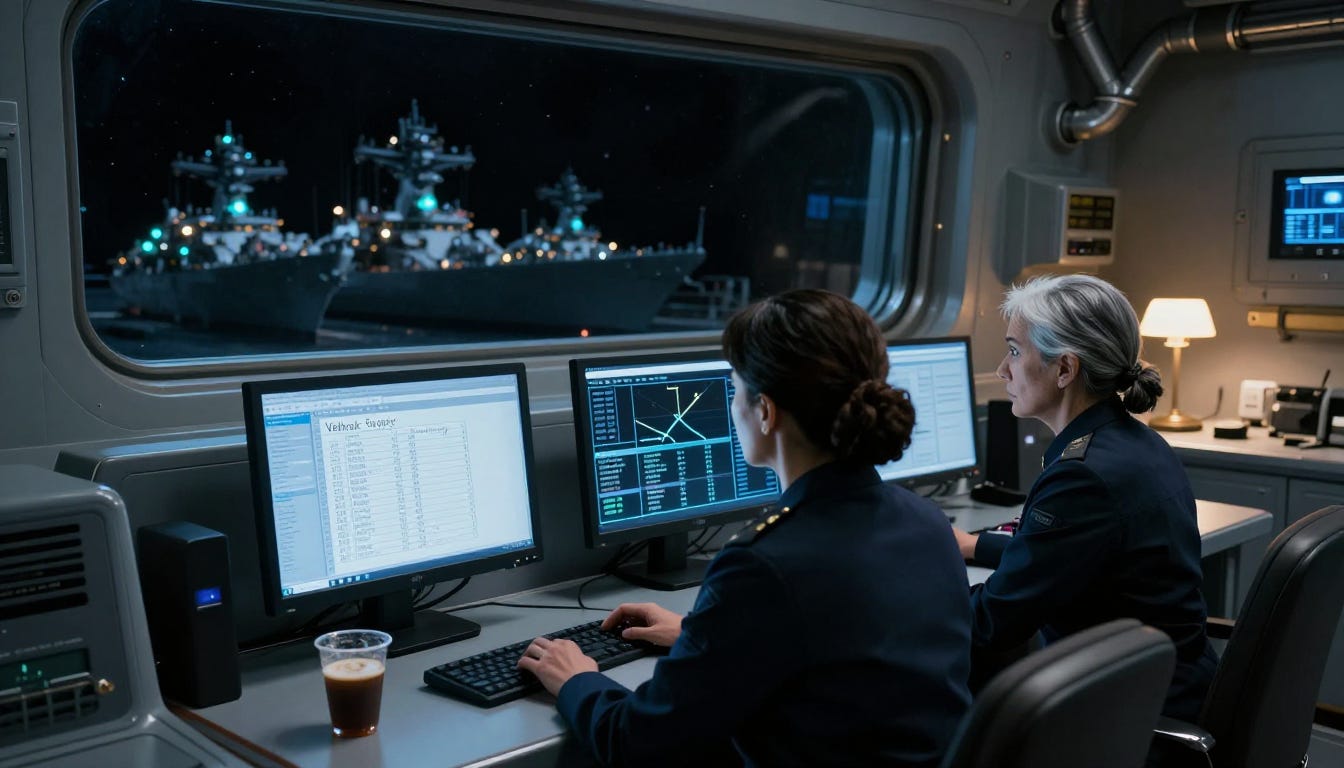
Vasquez pulled up the shipment manifest again. Seven hundred thousand records, give or take, spanning the depot’s last full operating cycle. She had been through it twice already. The third pass was where the patterns hid.
She started with the priority designations. Every shipment carried one. The Vethrak flagged everything, and she had assumed, the first two passes, that the flags meant something. Front-line weapons components. Highest priority. Fold drive fuel. Highest priority. Food stores. Highest priority. Medical supplies. Highest priority. Replacement hull plating for a maintenance bay that serviced nothing but cargo tugs. Highest priority.
The pattern appeared slowly, the way the good ones always did. Not in the content. In her own flat assumption that the flags meant something.
She cross-referenced the priority flags against military value. The food stores shipped with the same urgency as the weapon components. The medical supplies moved through the same secured channels as the fold drive fuel. The cargo-tug hull plating that should have been dead last in any rational triage hierarchy shared a routing corridor, an encryption tier, and a delivery window with the front-line combat spares.
There was no triage. Everything was priority. Everything was critical.
Which meant nothing was.
Vasquez sat back. The realization was not the cold kind that came with a discovery about the enemy. It was the colder kind that came with a discovery about her own assumptions. She had spent three passes looking for what the Vethrak valued most and had missed the more important fact. The Vethrak did not rank their logistics at all. Biological supply. Mechanical supply. Food and fuel, bodies and bullets. One undifferentiated network with no chokepoints and no weak links, because it had never been designed to absorb a disruption. It had never needed to.
The Vethrak had never been attacked.
A supply chain that did not triage was a supply chain that could be starved from any point of entry. The cold-storage drawing Sarah had found, the disproportionate power allocation, the vault beneath the cover. All of it pointed the same direction. The enemy’s strength was its completeness. Its weakness was the same completeness in the negative. A thing with no gaps could be made to have gaps. A thing with everything at priority could be made to choke on nothing at all.
Vasquez marked the finding. She flagged it for Sarah, added her own annotation in the Salvage Protocol shorthand that had become the division’s de facto language. Then she kept going, because a finding was not a conclusion. A finding was the first shovelful.
At 2200 Sarah pushed her chair back. Vasquez did not look up.
The darkness changed in the room. That was how she registered Sarah’s movement, peripherally, by the shift of shadow at the edge of her screen. The night cycle lights had come on at some point, and she had lost the thread of when.
“You found something,” Sarah said.
“I found a pattern. I am not sure it is a vulnerability yet.” Vasquez highlighted the section and sent it across. “The Vethrak do not triage their supply chain. Everything carries a priority designation. Everything is routed through secured channels. There is no ranking. No hierarchy of criticality. Food moves like fuel. Medicine moves like ammunition.”
Sarah studied the forwarded section. Vasquez tracked her progress the way she tracked a resonance test: waiting for the point where the structure either held or cracked.
“A network with no triage is a network that can be starved anywhere,” Sarah said. It was not a question.
“That is what I have been trying to decide.”
“What did you find on your side,” Vasquez asked.
Sarah pulled up her own work. Patrol intervals that shifted on a five-day cycle. A supply convoy that always took the same route through a system with three viable alternates. A route chosen, Sarah suspected, because it was the closest, not because it was the safest. The Vethrak were routine-bound. Their conservatism kept them consistent. Their consistency kept them predictable.
The two findings locked into place beside each other. Vasquez’s logistics: no triage, no hierarchy, one undifferentiated network. Sarah’s operations: fixed cycles, invariant routes, ritual consistency. Together they described an enemy that had spent so long without opposition that it had stopped optimizing for resistance. The Vethrak were not sloppy. They were unpracticed at being hunted.
“It is the same shape,” Vasquez said. “Yours and mine. The Vethrak built a flawless machine and then stopped checking it for weaknesses because nothing had ever tested it.”
Sarah nodded. “Fourteen years of harvesting, and no one fired back until now. Why would they triage? Why would they vary their routes? You do not armor a door no one has ever kicked in.”
“We are about to,” Vasquez said.
The chronometer read 2230. Sarah did not tell her to go home. She had learned, in the weeks since the depot data arrived, that Vasquez did not go home. She left when the work reached a natural stopping point or when her body gave out, whichever came first. Sarah did not argue with it anymore. Instead she pulled her chair over to Vasquez’s station and sat down.
“Then I’ll wait,” she said.
Vasquez looked at her. The gesture was foreign, this simple refusal to leave a colleague alone with the work, and it took her a moment to recognize it for what it was. Sarah was not waiting for her to finish so they could debrief. Sarah was keeping her company.
“You have your own section,” Vasquez said.
“It will keep.”
Vasquez turned back to her screens. The manifest scrolled. The priority flags marched past, one undifferentiated line after another, every one of them an admission the enemy had no longer known it was making.
Outside the viewport the First Three still held their positions in the shipyard, cyan running lights steady against the void. Somewhere beyond them, in a network with no chokepoints and no weak links, the Vethrak were moving food like fuel and medicine like ammunition, and they did not know that a woman in a cold room on Prometheus Station had learned how to make them hungry.
Vasquez reached for her coffee. It was still cold. She drank it anyway.
One more pass.
If you enjoyed this story, you can follow the main story arc in The Exodus Rush, the first book in The Vethrak Requiem series.