


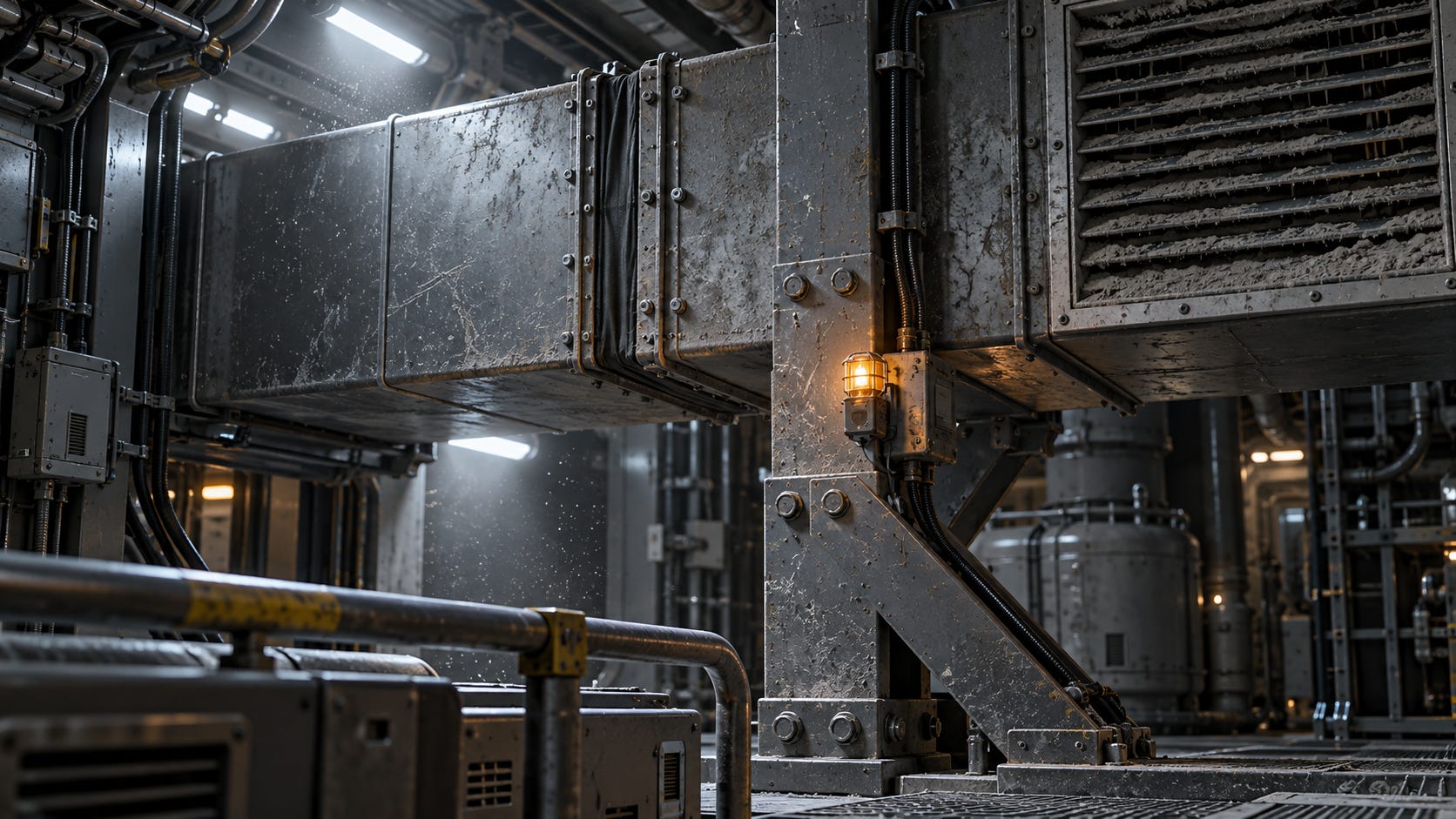
Ji-woo Han hooked her boots under the console rail as the fan surged. Dust lifted from the ventilation grille. Two loose maintenance tags sailed across the environmental control room, turning edge over edge until one caught against her wrist.
The fan note dropped, recovered, dropped again.
“Holding minimum speed,” the environmental lead said.
Ji-woo closed a hand around the tag. Its punched hole had torn through. She trapped it under a cable clip and opened the vibration trace beside the restart controls.
The clock read twelve minutes past midnight. Strike Day Fifteen. Down here, outside Ceres Station’s rotating habitats, her knees floated against the underside of the console whenever she loosened her grip.
Bank C had returned to standby after the earlier isolation. Standby had become their reserve on every subsequent report. Now the environmental lead was trying to bring one of its trains into service, and each pressure pulse traveled through the rail into Ji-woo’s shins.
Bank D’s labor-ring branch remained short of two trains. Yesterday’s remote shutdown receipt still occupied a corner of her screen: eighteen sixteen and four seconds, command signature RC-7316. An accepted command. No identified hand.
Since then, portable traps and movement out of the worst compartments had bought hours. The fresh media Lena’s crew had carried through the service hatch was only part of the repair. It could not clean the inaccessible passages behind the housings.
“Joint pickup?” the lead asked.
“Below the limit. Oscillating.”
He held the speed there. She widened the pressure plot. The fan was pushing against a restriction, losing flow, recovering, then meeting the restriction again. The peaks grew closer together.
The approved recovery curve lay beneath it, smooth and pale.
Ji-woo opened its assumptions.
Clean bypass vanes. Reserve filter service completed six weeks earlier. Rated airflow available on demand.
She selected the service entry. A scheduled date filled the field the model had used. The completion signature was empty. Beneath it sat a deferral, six weeks old, still open.
“Stop the ramp,” she said.
“Already held. What have you got?”
She sent the entry across. On the maintenance camera, the idle bank’s bypass vanes stood partly open under ridges of compacted gray dust. The position indicator said open. The passage between the vanes said otherwise.
“The model uses a filter change nobody completed. Look at the bypass.”
The lead leaned into his restraint to read the image. His thumb stayed beside the shutdown key.
Medical cut across the channel.
“Molefe. Headaches in the labor ring. Two patients having difficulty with ordinary hand movements. I’m moving them to monitored air. Keep the transfer route clear.”
Another voice asked whether oxygen cylinders should go to the assembly point. People were asking for something they could hold.
“Medical oxygen stays with the treatment teams,” Ayanda said. “Patients by clinical need. No distribution queue. A cylinder in the hall does not remove carbon dioxide from the hall.”
Ji-woo pulled the labor-ring trace forward. The curve had steepened again despite the reduced occupancy. A sleeping compartment sat above the ring average. She marked its location for medical, then returned to the joint pickup.
The vibration crossed the limit.
“Abort.”
She pressed the stop before the lead’s hand reached his key.
The fan’s drive indicator went dark. Its pitch fell through a rough band that rattled the trapped maintenance tag against the console. Ji-woo held her boots beneath the rail and counted the peaks until they diminished.
The duct pressure steadied. No pressure-loss alarm followed.
Beside it, the capacity forecast lost the reserve train. The remaining carbon-dioxide estimate shortened. She had kept a joint intact and removed the machine the relocation plan expected to have by now.
Her fingers stayed flat on the console. At 3-Bravo she had signed a hold and left it for other people to act on. This stop carried her login, the measured crossing, and the capacity it had cost.
“No repeat attempt,” the lead said. “Mechanical clearance first.”
She saved the trace without smoothing it.
Sigrid Hedlund joined the channel while the fan coasted to rest. Kavita Nair came onto the same circuit from the labor-ring assembly point.
“We can move the remaining households to administrative spin,” Sigrid said. “Medical gets first transfer.”
“I need a destination that stays breathable,” Kavita said. “We have already moved some of these families once.”
Ji-woo opened the return-air schematic. Every habitation ring touched the main trunk somewhere. Separate doors, separate employers, separate allocation columns. Shared ductwork.
“Moving them lowers exposure now,” she said. “It doesn’t replace the missing capacity. Administrative spin returns through this section too.”
She traced the route with her cursor. The environmental lead confirmed each junction on the common display.
“Seal the receiving compartments?” Sigrid asked.
“For a time. Refuge stores and local traps have limits. We still have to clear the trunk and restore scrubbing.”
Kavita asked for the reserve status. Ji-woo brought up the missed filter change, then the camera image. The other available trains showed overdue work of their own. No clean reserve train waited behind the next command.
The channel went quiet long enough for a relay to click inside the console.
“What can a crew reach without another start?” Kavita asked.
Ji-woo highlighted the intake screens on isolated branches. “These. Environmental verifies each isolation before anyone opens a housing. Manual cleaning, captured dust. No blowing it downstream.”
The lead confirmed the first work boundary. Lena Vasquez answered from the gallery.
“I have two workers with filter tools. Give me the screen locations and the safe anchors.”
Ji-woo enlarged the route. The brace beside the lower hinge remained marked out of bounds, its shifted washer preserved in yesterday’s photograph. She directed the crew to anchors on the sound frame before the junction. Lena read them back.
“Maintenance inventory,” Ji-woo said. “We need the actual stores list. Replacement media, sealed collection bags, inspection status. My access stops at requisitions.”
“Release the inventory to the strike team,” Sigrid said. “Stores and deferred work. Include what has not been completed. Record my authorization.”
The access field changed. Ji-woo checked the first available pack against the housing number and sent the match to Lena. Then she sent the next.
Lena assigned the workers by task. Screen one, collection bag, tether check. The environmental lead logged the isolation. Kavita entered the work under the emergency roster, air only. Nobody asked Ji-woo to shorten the warning attached to the second screen.
She took her fingers off the stop key.
A small increment appeared on the structural panel.
The gauge belonged to the brace beside the main return trunk, the one above the shifted washer. Ji-woo pulled its history across the fan trace. Vibration was falling. Brace strain was not.
Another increment. A short plateau. Another.
She checked the timestamp against the live acquisition clock. Current readings, not a held fault. Load was still moving through the frame after the fan had stopped.
“Lena. Keep everyone this side of the marked junction.”
“Holding.”
Ji-woo opened the outage plan again. Its recovery curve ended in restored airflow. There was no structural allowance beneath it, no line for a brace transferring load into the duct it supported.
The next increment crossed the alarm threshold.
A new alarm tone entered the room. Ji-woo kept the unsmoothed trace on both channels.
If you enjoyed this story, you can follow the main story arc in The Exodus Rush, the first book in The Vethrak Requiem series.