


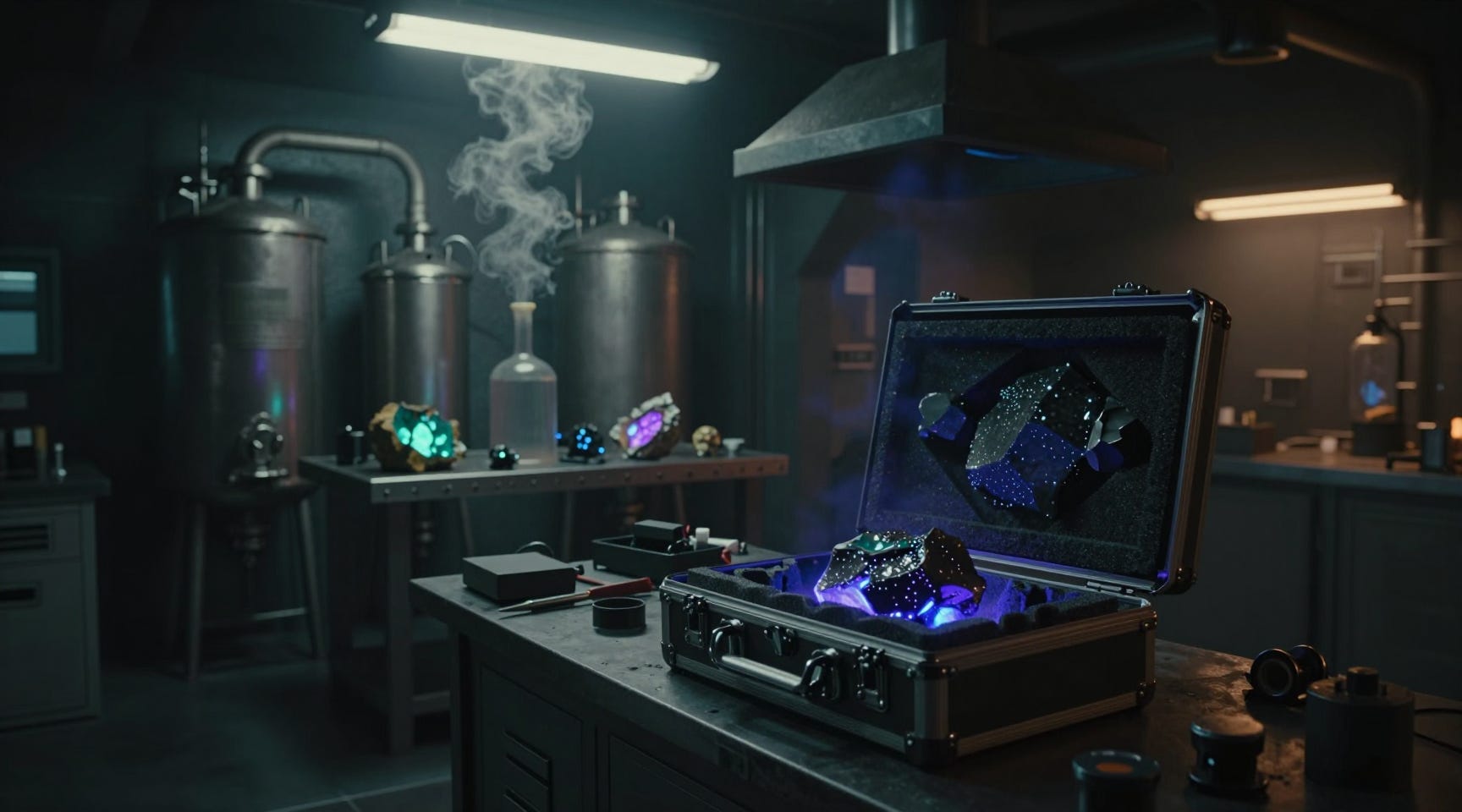
The fragment was the size of a dinner plate, charcoal-black with veins of something iridescent running through it like frozen lightning.
Viviane Merrick set it on the curing rack under the extraction hood and pulled on her nitrile gloves. The gloves were a formality. Vethrak hull composite didn’t burn skin on contact the way the early salvage crews had feared. It did something worse. It shed particulate that settled in lung tissue and stayed there, accumulating over months until the coughing started. Three salvage workers on Titan had died from it in Year 2 before anyone connected the symptoms.
She sealed the extraction hood and activated the ventilation system. The fans hummed, pulling air through three layers of filtration rated for particles down to 0.1 microns. Overkill for a fragment this size. She did it anyway. The dead workers had been careful too.
The workshop occupied a repurposed storage bay on the lower levels of Meridian Station, a Titan orbital platform that had grown like coral since the invasion, accreting modules and docking arms as refugee ships arrived with nowhere else to go. Down here, below the residential decks and the official commerce zones, the station’s oversight thinned to nothing. Maintenance crawled through on quarterly rounds. Security never came at all.
Viviane had rented the bay from a man who managed surplus inventory for the station’s logistics office. The rent was paid in processed alloy, not credits. Credits left trails. Alloy moved hand to hand and disappeared.
She examined the fragment under the magnification lens, tracing the iridescent veins with a stylus probe. Standard Vethrak hull composite consisted of a ceramic-metallic matrix infused with trace elements that human metallurgy couldn’t replicate. The rare metals were the prize: hafnium, rhenium, osmium, all present in concentrations that made natural ore deposits look barren. A single fragment this size, properly stripped, yielded enough rhenium to trade for three months of water credits and supplemental rations for a family of four.
The curing process took twelve hours. Chemical bath to dissolve the ceramic bonding layer. Thermal cycling to separate the metallic components. Acid wash to isolate the target elements. Each step required precise timing and materials that were themselves difficult to source. The hydrofluoric acid alone cost her two fragments’ worth of processed alloy per liter.
She had been running the operation for fourteen months. Twenty-three fragments cured, stripped, and sold through intermediaries who asked no questions and provided no names. The Iron Wake network handled distribution, moving the refined metals from Titan to buyers across the inner system. Viviane had never met anyone from Iron Wake above the level of courier. She preferred it that way.
The door buzzer sounded.
She checked the security feed: a single figure in the corridor, collar turned up, hands in jacket pockets. Enrico Côté. He ran salvage acquisition for a crew that worked the debris fields between Saturn’s rings, pulling Vethrak wreckage from orbital trajectories that would eventually send it spiraling into the planet’s atmosphere. Every fragment he brought her came with a story she didn’t ask to hear and a price she negotiated down by fifteen percent on principle.
She unsealed the door.
“Got something different this time,” Enrico said. He stepped inside and set a sealed transport case on the workbench. Compact, military-grade containment with biohazard markings that someone had scraped off with a knife. “Pulled it from a debris cluster near the B-ring. The readings were strange enough that my crew didn’t want to touch it.”
“Strange how?”
He popped the latches. Inside, cushioned in reactive foam, sat a fragment roughly the size of her fist. Darker than the one on the curing rack. The iridescent veins pulsed with faint luminescence, a rhythmic glow that brightened and dimmed on a cycle of approximately three seconds.
Viviane’s hands stopped moving.
Active Vethrak material was a different category entirely. Hull composite was dead, inert remnants of destroyed ships. Active material meant functional technology. Power cells, sensor arrays, communication nodes. The UEN had standing orders to report any active material to the Salvage Protocol Authority for immediate collection and study. The orders came with a reward: six months of priority ration status and housing upgrade authorization.
The orders also came with scrutiny. Investigators. Questions about where the material was found, who handled it, how it reached its current location. Questions that would unravel fourteen months of careful work in a single afternoon.
“You brought active material to my workshop.” She kept her voice level.
“I brought a payday to your workshop.” Enrico leaned against the workbench. He was a lean man with weathered features and a quiet intensity that could read as patience or calculation depending on the angle. “Inner-system buyers will pay ten times the going rate for active components. Twenty times if the power signature is stable.”
“Inner-system buyers.” She closed the transport case. “You mean weapons developers.”
“I mean people with resources who want Vethrak technology. What they do with it isn’t our concern.”
“It becomes our concern when UEN intelligence traces active material to a black market pipeline that runs through this station.”
“Nobody’s tracing anything. The debris field coordinates are wiped. The transport case is clean. The only people who know this exists are you, me, and my two crew members, who are already compensated for their silence.”
Viviane looked at the case. Three seconds on, three seconds dim, visible through the seams of the lid. A heartbeat in alien metal. She had seen active Vethrak material once before, in a classified briefing she had attended in her previous life. Before the invasion, she had been a materials scientist at a UEN research facility on Mars. After the invasion, the facility had been evacuated, the research scattered, the scientists dispersed to wherever survival took them. She had ended up on Titan with skills that were worth more in a workshop than in any lab that still functioned.
She knew what the pulsing meant. The veins carried an energy medium that human instruments couldn’t fully characterize. The leading theory held that it was a form of structured plasma contained within a crystalline lattice, self-sustaining, self-regulating, drawing power from a source that no one had identified. Every active fragment recovered in four years of salvage operations had added another data point to humanity’s fragmentary understanding of Vethrak technology. Every fragment that disappeared into the black market was a data point lost.
“What’s the offer?” she asked.
“Eight months of water credits. Full allotment, not the reduced civilian rate. Plus medical access. Real medical, not the station clinic. The buyer has connections to a private facility on Enceladus.”
Eight months of water. Medical access. Her mother lived on Deck 14 with a respiratory condition that the station clinic had classified as “manageable with available resources,” which meant they gave her an inhaler and told her to avoid exertion. A private facility could do imaging. Treatment. Things that “available resources” never covered.
“One condition,” Enrico said. “Delivery within seventy-two hours. The buyer’s window closes after that.”
Seventy-two hours. Not enough time to cure and strip the fragment. Active material required different handling, specialized containment that she didn’t have. Which meant the buyer wanted it intact. Functional. A working piece of Vethrak technology delivered whole into private hands.
She opened the case again. The glow pulsed against her gloved fingers, three seconds bright, three seconds dim. A rhythm that might be a power cycle or a signal or something else entirely. The scientists studying this technology were working with a handful of fragments scattered across six research facilities. Each one had advanced humanity’s understanding by increments. This fragment, with its stable power signature, might be worth more to the species than anything she had processed in fourteen months.
The species wasn’t offering her mother medical care.
“I need forty-eight hours to prepare containment,” she said. “Proper shielding, not that scraped-clean case. If this thing emits a detectable signature during transport, we’re both done.”
Enrico smiled. The expression didn’t reach his eyes. “Forty-eight hours. I’ll be back.”
He left. The door sealed behind him.
Viviane stood alone in her workshop with a dead fragment on the curing rack and a living one in the transport case. The ventilation fans hummed. The extraction hood cycled filtered air. The station groaned around her, fourteen thousand people and counting, all of them surviving by margins and arrangements and the particular mathematics of not enough.
She pulled up her contacts list and stared at two entries. The first was a courier code for the Iron Wake network. The second was a UEN Salvage Protocol reporting address she had saved four years ago and never used.
The fragment pulsed. Bright, dim. Bright, dim.
She closed the list without selecting either one and began preparing the shielding materials. Forty-eight hours was a long time. Long enough to build containment. Long enough to make a decision. Long enough to figure out whether the line she kept drawing still held anything on either side.
The curing rack hissed as the chemical bath reached temperature. Dead metal dissolved in acid. Living metal glowed in the dark.
Both were worth something. The question was to whom.
Author’s Note: By Year 4, the salvage economy had become one of humanity’s most complex unofficial systems. Vethrak wreckage drifted through the solar system in quantities that overwhelmed official recovery efforts, and the rare metals embedded in alien hull composite were too valuable for desperate communities to leave floating. Entire networks grew around the collection, processing, and sale of salvaged material, operating in the gaps between UEN authority and civilian need. The discovery of active fragments, still-functioning pieces of Vethrak technology, raised the stakes enormously. For the scientists trying to understand the enemy, each fragment was irreplaceable data. For the people trying to survive, it was leverage in a system that offered them nothing else.
If you enjoyed this story, you can follow the main story arc in The Exodus Rush, the first book in The Vethrak Requiem series.