


Tamar Bekele had stopped sleeping. Not couldn’t. Stopped.
Three weeks since the Vethrak withdrew. Three weeks since the sky stopped burning. The refugee center in Addis Ababa held eight thousand survivors in a complex designed for two hundred. The Ethiopian highlands had been spared the worst of the bombardment, their elevation and sparse population making them poor targets. Now they were overrun with the living.
Tamar worked the registration desk. She had been a census data analyst before the invasion. Numbers were her language, her comfort. Now she counted the dead.
“Name?” She looked up at the woman before her. Hollow eyes. Dust still in her hair.
“Amina Yusuf.” The voice was flat, mechanical. “I am from Mogadishu.”
Mogadishu no longer existed. Tamar knew this. She typed the name anyway.
“Family members to register?”
The woman stared through her. “I had four children.”
Had. The word hung between them. Tamar’s fingers hovered over the keyboard. The database wanted numbers: survivors in household, ages, medical needs. The system didn’t have a field for grief.
“I’m sorry.” The words meant nothing. Everyone said them. No one meant them anymore; meaning required energy people no longer possessed.
Amina moved on. The next person stepped forward. Tamar asked the same questions. She entered the same data. The count continued.
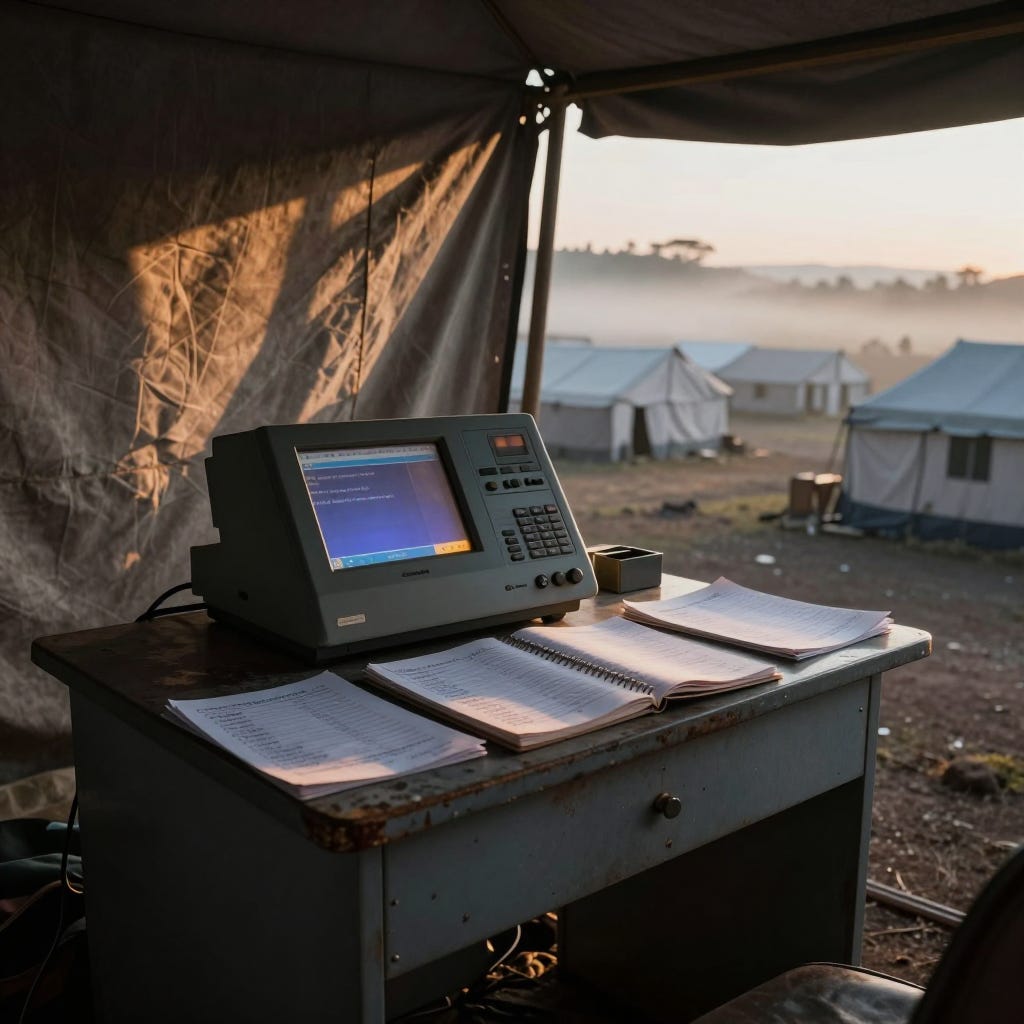
By midnight, she had processed three hundred and twelve new arrivals. Her supervisor, a German aid worker named Klaus who had somehow made it from Geneva, touched her shoulder.
“You should rest.”
“I’ll rest when the line is empty.”
The line was never empty. New survivors arrived hourly. From the coast. From the crater that had been Nairobi. From everywhere and nowhere, drawn by rumor and desperation.
Klaus sat beside her. His own eyes carried shadows she recognized. “The system is overloaded. Geneva, London, Beijing; everyone is trying to count at once. Trying to know how many we lost.”
Eleven billion. The number was already circulating. Tamar found it meaningless. Eleven billion was not a number that fit inside a human mind. It was abstraction. It was noise.
Three hundred and twelve. That number she could hold. That number had faces.
“My daughter,” Tamar said. She hadn’t spoken of Yodit in days. “She was studying in Cairo.”
Klaus said nothing. Cairo was gone.
“I keep expecting her to walk through that door. To be in the next line of survivors.” Tamar’s hands continued typing as she spoke. A man from Djibouti. A family of seven from Sudan. A child traveling alone whose name tag read only Esperanza. “I know she’s dead. I know this. My mind knows this. My heart refuses to update the count.”
“It takes time.”
“Time.” She laughed, and the sound was wrong. “The Vethrak took 47 days to kill eleven billion. How much time does grief require?”
Klaus had no answer. He left her to her work.
Dawn came gray and cold. The highlands were always cold this time of year. Tamar had processed seven hundred and eighty-one new entries overnight. The database groaned under the weight of humanity’s desperate accounting.
She stepped outside for the first time in fourteen hours. The camp stretched across what had been a coffee plantation, tents and prefab shelters arranged in rows that suggested order even as chaos lurked beneath. People moved between structures like ghosts.
A woman was singing somewhere. An old hymn in Amharic, the melody rising above the morning sounds. Tamar closed her eyes and listened. Her grandmother had sung that song. Her mother had sung it. Yodit had known the words, though she’d always changed the melody, making it her own.
The singing stopped. The camp noise resumed. Tamar went back inside.
The afternoon brought a convoy from the coast. Forty-seven survivors from Mombasa, packed into vehicles that had somehow survived the bombardment. They emerged blinking into the highland light, their skin still carrying the salt of the Indian Ocean.
Tamar counted them. Forty-seven. She entered their names, their ages, their injuries. A woman with burns across half her face. A man missing both legs below the knee. Children with eyes too old for their bodies.
The last in line was a boy, perhaps sixteen. He carried a notebook pressed against his chest like a shield.
“Name?”
“Daniel Kariuki.” His voice was steady in a way that suggested practice. “I am from Mombasa.”
“Family members?”
He opened the notebook. Inside, in careful handwriting, were names. Hundreds of them. Each one accompanied by a date, a location, a single-line description. Maria Ochieng, April 12, Nyali Beach, tried to save the children at the orphanage. Jomo Kamau, April 14, Old Town, gave his water ration to strangers.
“These are the people I saw die,” Daniel said. “I wrote them down so someone would remember.”
Tamar looked at the notebook. The boy had done what she was doing. Counting. Cataloging. Trying to make sense of the senseless through the act of recording.
“May I see?”
He handed it over. She turned the pages slowly. Each entry was precise. Each death witnessed and documented by a child who had chosen to remember rather than forget.
“Why?” she asked.
Daniel’s jaw tightened. “Because someone has to. The database counts the living. The dead deserve their own record.”
Tamar thought of Yodit. Of Cairo’s crater. Of the fact that her daughter’s name existed in no registry, no memorial, no count of the fallen. Just absence. Just silence.
“Would you like to stay here?” The question emerged before she could stop it. “Help me with the registration?”
Daniel considered. “The living first. Then we count the dead.”
“Yes. Then we count the dead.”
That night, Tamar slept for the first time in three weeks. Four hours, dreamless and dark. She woke before dawn and found Daniel already at the registration desk, entering names with the same methodical precision he’d applied to his notebook.
The line of survivors stretched toward the horizon. The count continued.
Somewhere in the database, eleven billion entries waited to be made. Eleven billion names that deserved more than a number. Eleven billion stories that refused to be reduced to statistics.
Tamar sat beside Daniel and typed the next name.
Fareeda Hassan. Khartoum. Mother of three.
One at a time. That was how you counted eleven billion. One at a time, until your hands gave out. One at a time, until the grief became bearable. One at a time, until the dead found their way into memory.
One at a time.
Author’s Note
In the aftermath of the invasion, the task of counting the dead fell to ordinary people: census workers, aid coordinators, and survivors who refused to let the fallen become anonymous statistics. The Global Memorial Registry, established in Year 1, would eventually record the names of over 10 billion victims. Many entries came from handwritten notebooks like Daniel’s, personal records kept by witnesses who understood that numbers alone could never capture the weight of what was lost.