


Console light painted Amaka Adebayo’s knuckles in sickly Vethrak green. Recovery Command packed a dozen controllers into the pit beneath Luna Station Alpha’s dome, yet the only illumination came from salvaged fold consoles. Year 14 after the invasion, and humanity still depended on colors the enemy had chosen.
The queue of fold slots cascaded down her display, each entry a ship with thawing cargo or bleeding crew. Amaka kept the column of status glyphs aligned with fingertip nudges, coaxing order out of a system that never slept. One mistake meant a convoy appearing inside a debris halo.
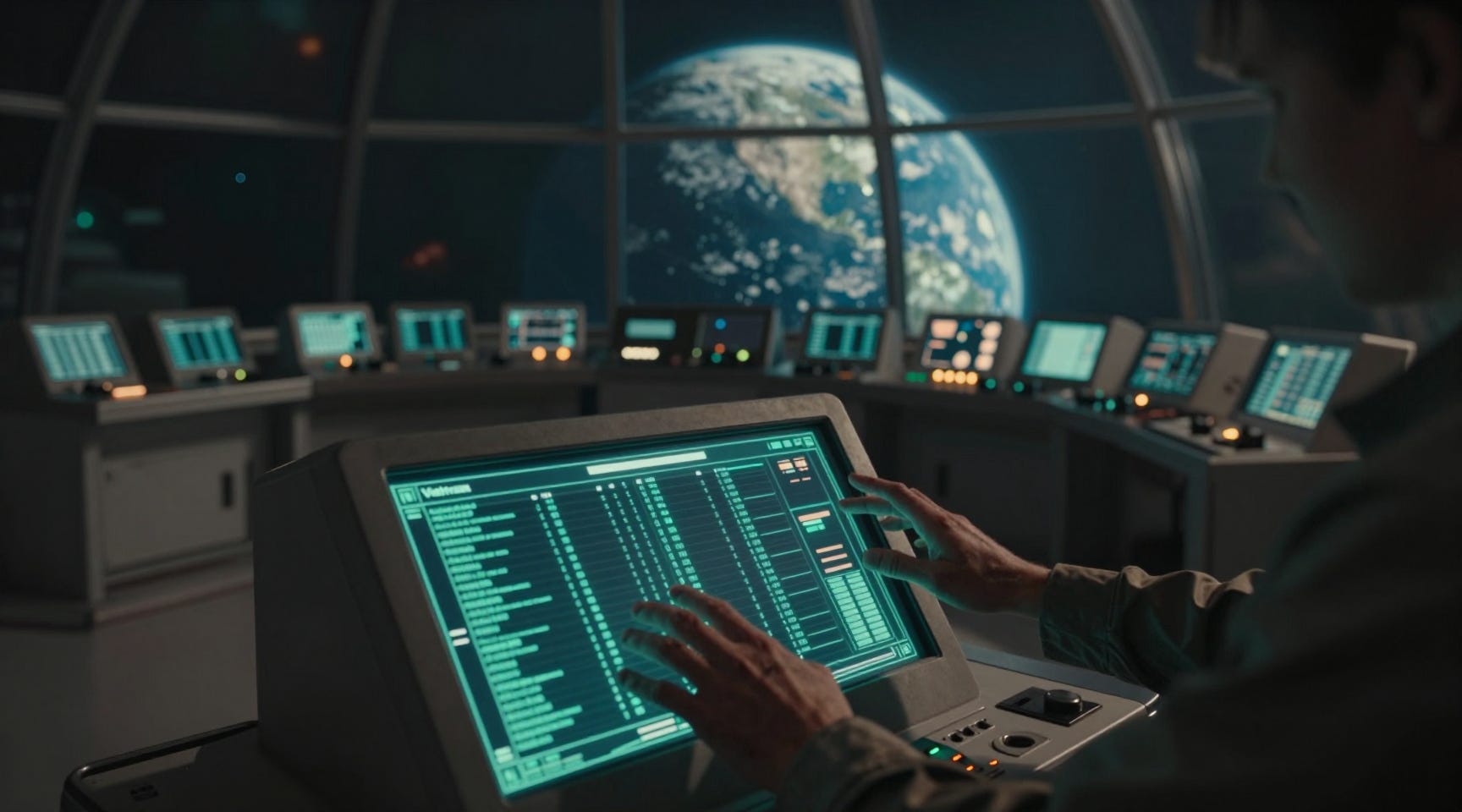
Ozone clung to the air. Ventilation rasped overhead, struggling to drain dump heat from the morning’s aborts. The auxiliary cascade reactor hummed through the deck plating, a reminder that even the power keeping her console lit came from alien equations half understood.
An amber icon flickered near the base of the queue. Unauthorized handshake. Label: CSV Ukhanyo, license 7721-G. Captain Thulani Kruger still owed her a kettle of real coffee from their training rotation on Prometheus, which meant he only called in favors when death had teeth.
Amaka authorized the channel. Thulani’s voice rasped through static. “Slotkeeper, I need corridor delta-seven reopened. QEC pair intact. Reactor bleeding mass. Pirates seeded a net across the standard midpoint.”
Sensor telemetry streamed into her peripheral pane. The Ukhanyo skated along the Phocaea debris bank, thrusters jittering, hull temperature spiking. A sheet of tethered scrap hung twenty thousand kilometers ahead of the tug, perfectly aligned with the authorized corridor. Pirates had anchored hooks to Vethrak armor slabs, letting the mass shadow blend with corridor charts until a ship folded into it.
Delta-seven already belonged to MedRun 1412, a hospital transport queued with thaw-critical plasma. Reassigning that corridor meant pushing a hundred wounded back eight hours. Protocol carved that rule into every console: once a medical convoy locked a slot, no civilian ship could displace it.
Thulani breathed hard through the channel. “Brought home an intact lattice, Amaka. Full navigation spine from a harvester scout. If the net strips us, the black market wins and Recovery loses two years of math.”
Her stomach knotted. An intact navigation lattice could rewrite fold safety, reduce deaths across the fleet. Letting pirates take it because of a rule etched before Year 12 felt like murder by paperwork. MedRun’s timer blinked scarlet in her queue, reminding her that people on that transport might never see a surgeon if she delayed.
She split her attention between corridors. Corridor beta-nine sat empty after a diplomatic courier aborted. The chart flagged it as high turbulence, the kind of fold route most captains avoided because the gravitational shear demanded manual trim. Thulani could fly it; he routinely bragged about threading nets blindfolded. Pride did not equal capability, but he remained the only captain in range with nerves tempered inside Vethrak wreckage.
Amaka pinged the Ukhanyo with a request for triple-solution telemetry. Two green responses populated her feed. The third slot produced a string of corrupted data, nav core evidently fried when pirates spiked their sensor mast. According to protocol, that alone ended the conversation.
Her supervisor leaned over the console railing. The woman’s face stayed expressionless, yet her tone held warning. “Slotkeeper, med priority stays untouched. Log the pirate net and cut the tug loose.”
The invasion had already taken Lagos, her mother, and the idea that rules could save everyone. Amaka flexed the scar tissue along her index finger, a souvenir from the day she pulled a live power coil out of a ruined fold pad. No one survived Year 0 by reciting policy. People survived because someone somewhere bent a rule at the exact moment it would save lives.
She rerouted the med convoy to corridor gamma-two, a longer path but clear of traps, then shoved a temporary lock onto beta-nine. “Ukhanyo, you are cleared for beta-nine through the Faraday Reef. Manual trim only. Run fresh math with the turbulence coefficients I am sending.”
Thulani swore in Afrikaans, then barked laughter that sounded more like someone on the edge of tears. “Copy. You always liked the scary corridors.”
Amaka injected revised coefficients into his nav buffer and forged the third solution herself, leaning on training she had not touched since the academy. The math scrolled across her display in alien glyphs, each character a knife. Heat built in the fold pit as the Ukhanyo’s drive charged. Engineering fed her live stress telemetry from the tug. Hull flex within tolerance. Reactor leak stabilized. The pirates’ net drifted closer, tether lines flaring from thruster exhaust like predatory jellyfish.
The countdown hit zero. Space at beta-nine twisted on her scope, a pulse of blue ripping across the visualization. The Ukhanyo vanished clean. The pirate net contracted on empty vacuum, thruster anchors firing late as their prize blinked away. Amaka kept her breathing slow, refusing to celebrate before confirmation.
Five agonizing seconds later, the tug surfaced near Prometheus. The arrival ping came with cascades of error code, but the ship existed, which counted as victory. Thulani’s triumphant yell shook the channel. “Lattice secured. Drinks on me if the auditors do not throw you out the airlock.”
She muted the line before emotion leaked into her voice. Her supervisor still hovered. “You displaced a medical convoy,” the woman said.
“I moved them to a safe corridor and added three escort drones from idle inventory,” Amaka replied. “Their ETA shifts forty minutes, not eight hours. Ukhanyo delivers a navigation lattice that halves future casualties.”
The supervisor studied her reflection in the console glass for a long beat, then nodded once. “Write the incident report. Own every line. I will sign if the math holds.”
The relief hit harder than the caffeine pills dissolving on her tongue. Amaka logged the violation in exhaustive detail, including the pirate net coordinates, the turbulence compensation she had spoon-fed the tug, and the rationale behind the med convoy swap. Each keystroke felt like tightening a noose around her career, yet none of it mattered compared to the ghost of Lagos inside her ribs.
An hour later, MedRun 1412 checked in from gamma-two with stable cargo temps and a bored pilot complaining about empty space. Amaka let herself smile, small and fierce. Thulani’s lattice reached Luna Station Alpha under armored escort. Recovery Command technicians crowded the hatch like kids at a miracle.
Shift end alarms chimed. Controllers stretched, rubbed eyes, shuffled toward ration dispensers. Amaka lingered at her console, watching the queue roll forward. Another unauthorized ping flashed into existence, proof that tomorrow would demand the same impossible triage.
She pressed her scarred finger to the edge of the display. The glass felt warm, alive with current. Rules mattered. Lives mattered more. The Corridor Debt, as the veterans called it, never finished collecting. She paid another installment tonight.
Author’s Note: Recovery Command controllers call every risky reroute a “corridor debt” because each favor adds another tally to repay later. Amaka’s day shows how the Salvage Protocol strains even the most disciplined crews in Year 14.
If you enjoyed this story, you can follow the main story arc in The Exodus Rush, the first book in The Vethrak Requiem series.