


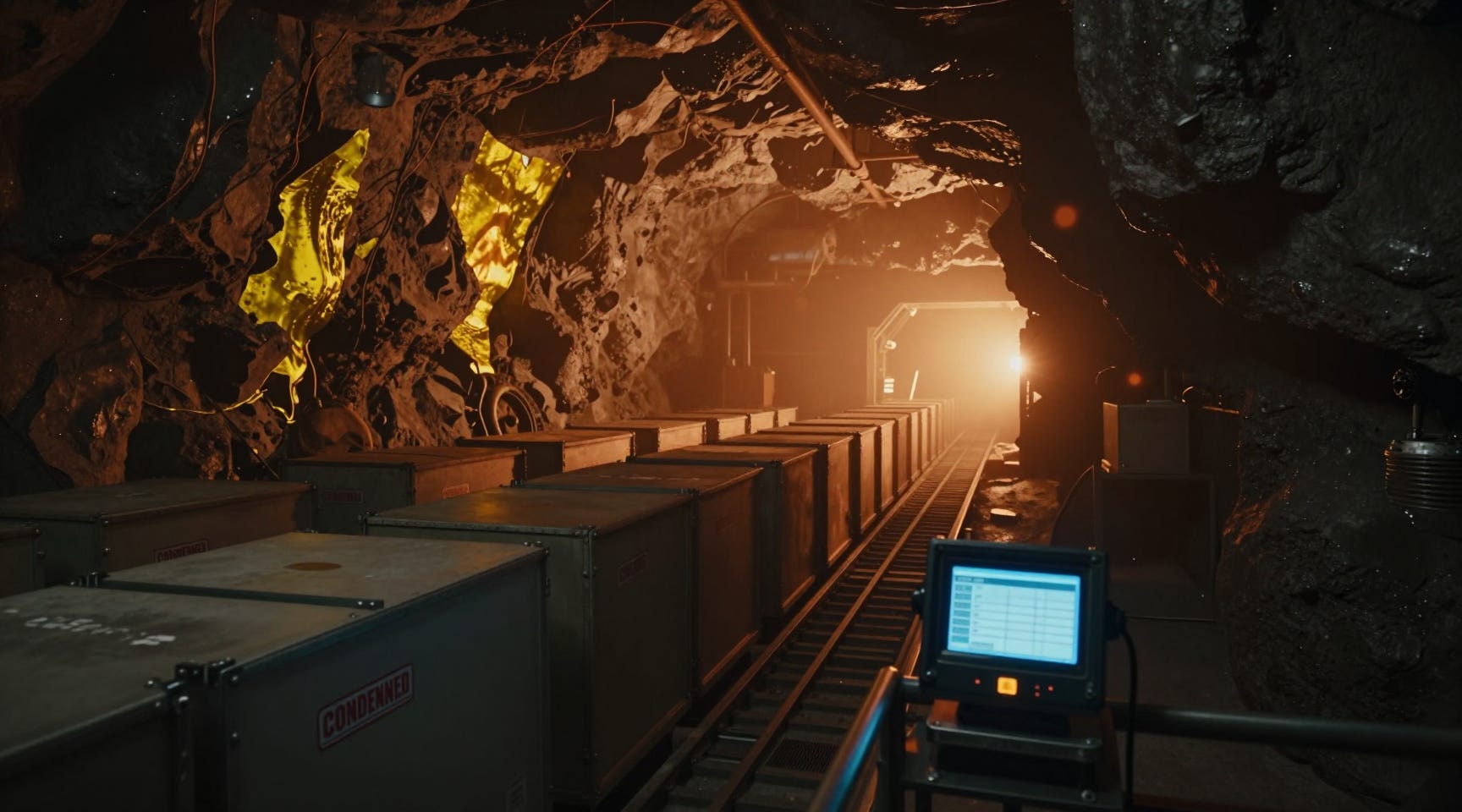
The incinerator queue held forty-three containers, and Felix Lockwood needed to burn them all before third shift.
He stood in Ceres Processing Bay Seven, a subterranean cavern carved from carbonaceous rock and lined with thermal shielding that had yellowed under a decade of radiant heat. The disposal manifest glowed on his handheld: forty-three sealed containers, each stamped CONDEMNED in red block letters across the UEC tracking label. Contents ranged from expired pharmaceutical compounds to failed water filtration membranes to atmospheric scrubber cartridges that had tested below minimum efficiency thresholds. The official designation was Class-C Hazardous Waste, Scheduled for Thermal Destruction.
Felix ran the scanner across the first container’s seal. Intact. He logged the confirmation and moved to the second. Intact. Third. Intact. Fourth.
Broken.
The tamper strip along Container 2741’s upper seam showed a clean cut, resealed with adhesive that matched the original material in color but not in texture. Someone had opened this container, removed or added something, and closed it again. The work was careful. A cursory scan would miss it. Felix didn’t do cursory scans.
He checked the manifest entry. Container 2741: 180 kilograms of expired broad-spectrum antibiotics, condemned six weeks ago when a batch audit flagged them as three months past their UEC shelf-life certification. The medications had been pulled from Ceres Medical Distribution and routed here for destruction.
Felix pulled up the lot history. The antibiotics had been manufactured on Luna, shipped to Ceres Distribution Hub, and sat in a warehouse for nineteen months before the audit caught them. Their original shelf life was thirty-six months. They’d been condemned at month thirty-nine. Three months past certification. Most pharmaceutical guides listed broad-spectrum antibiotics as effective for sixty months under proper storage conditions.
The medications inside this container were expired by UEC standards and perfectly functional by any practical measure.
He opened the container.
Half the antibiotics were gone. Ninety kilograms of pharmaceutical-grade medication, vanished from a sealed condemned lot in a restricted disposal bay. In their place, someone had stacked ballast bags filled with processed rock dust, matched to approximate the missing weight. The remaining antibiotics sat undisturbed in their original packaging, labels intact.
Felix closed the container. He scanned the next five in the queue. Two more showed resealed tamper strips. Container 2744 held condemned water purification tablets, half replaced with ballast. Container 2749 held atmospheric scrubber cartridges rated at 68% efficiency, four percentage points below the minimum threshold for UEC certification. The threshold existed because the Ceres Environmental Safety Board had set it at 72% in Year 6, when surplus inventory made high standards affordable. A 68% scrubber still cleaned air. It cleaned air at 68% efficiency, which was better than the zero percent efficiency it would achieve after Felix fed it into an incinerator.
Three containers out of forty-three. Someone was picking through condemned cargo before destruction, pulling out items that still worked, and replacing them with dead weight to maintain mass consistency on the disposal logs.
He should report it. The disposal bay operated under UEC Waste Management Protocol, and tampering with condemned materials was a criminal offense. Security could pull the access logs for Bay Seven, identify who had entered outside scheduled shifts, and shut the operation down within a day.
Felix checked the access logs himself instead.
The entries showed normal traffic: his own shifts, maintenance crew visits for incinerator servicing, and the cargo transport teams that delivered new condemned lots. Nothing abnormal. No unauthorized access codes. No gaps in the timeline.
Which meant whoever was doing this had authorized access and was working during normal operations, moving condemned materials in plain sight.
He found her on the transport level.
Florencia Barbosa drove a cargo mover for Ceres Logistics, shuttling containers between the distribution hub and the processing bays. She’d been assigned to the Bay Seven route for fourteen months. Her performance reviews were clean. Her schedules were consistent. She arrived with full containers and left with empty ones, and nobody questioned the forty-minute gap between her delivery time and her departure time because forty minutes was a reasonable window for unloading, paperwork, and turnaround.
Forty minutes was also enough time to open three containers, swap ninety kilograms of condemned cargo for ballast bags, load the cargo onto her mover’s undercarriage storage rack, and seal everything back up.
Felix waited in the corridor outside the transport staging area. Florencia’s mover sat in its charging bay, humming quietly. He walked the perimeter and checked the undercarriage rack. Three unmarked bags, secured with magnetic clips. He didn’t open them.
She came around the corner carrying a thermos and a maintenance checklist. She stopped when she saw him standing beside her vehicle.
“Disposal tech, Bay Seven,” he said. “I run the incinerator.”
“I know who you are.” Her voice was flat, measured. She set the thermos on a wall bracket. “You found the reseals.”
“Three containers. Antibiotics, water purification tabs, and scrubber cartridges.”
“All condemned. All functional.”
“All scheduled for destruction.”
“Which is why I’m taking them.”
She didn’t flinch. She didn’t negotiate. She stated it like inventory data, like tonnage on a manifest.
“The antibiotics go to Hygeia Freeport,” she said. “Their medical stockpile was reclassified as non-priority when the census dropped them below twelve hundred residents. They have nine hundred and sixty people and no antibiotic supply chain. The UEC condemned the batch because a label said it was three months past certification. Sixty-month effective shelf life. You know that.”
He did know that.
“The scrubber cartridges go to Pallas Deep. Their environmental systems run on cartridges rated at forty-one percent because that’s what the Salvage Protocol allocated three years ago and nobody’s updated the order. Sixty-eight percent would double their air quality overnight.”
“Who runs this?”
“A crew called the Quartermasters. Seven people. Three on Ceres, two on Vesta, two in transit. We pull condemned materials that still function, sort them, and route them to settlements that can’t get allocation through UEC channels. Everything we move is stuff that’s heading for an incinerator. We’re not stealing from anyone’s supply. We’re stealing from a fire.”
Felix looked at the three bags on the undercarriage rack. Ninety kilograms of antibiotics that the UEC said should be ash by tomorrow morning. Water tablets that would be carbon residue. Scrubber cartridges that would be slag.
“The disposal log requires mass confirmation,” he said. “If I burn forty containers instead of forty-three, the log shows a discrepancy.”
“The ballast bags match within two kilograms. Your mass confirmation will hold.”
“If someone opens the containers post-incineration for residue testing, the chemical signature won’t match pharmaceutical compounds.”
“Residue testing happens once per fiscal quarter. Your next scheduled test is in eleven weeks. By then, three more condemned lots will have cycled through the same containers. The chemical signatures blend.”
She’d done the math. She’d mapped the audit schedule, the testing intervals, the mass tolerances. The operation was built on understanding exactly how much institutional inattention could be converted into breathable air and functional medicine.
“Nine hundred and sixty people on Hygeia,” he said.
“Nine hundred and sixty people who will have antibiotics next week if those bags leave on my mover today. If they don’t leave, you burn them, and a disposal log gets a clean entry, and Hygeia Freeport continues rationing their last forty doses across six hundred patients.”
Felix looked at Container 2741, sealed and waiting in the queue. He looked at his handheld, where the disposal manifest listed forty-three items for thermal destruction.
He deleted three entries.
“Incinerator log shows forty containers processed,” he said. “Mass confirmation within standard tolerance. Three containers reclassified as processing errors, returned to transport staging for re-evaluation.”
Florencia picked up her thermos. “Re-evaluation takes how long?”
“I’ll submit the reclassification form next month. Processing errors go to the back of the administrative queue. Current backlog runs fourteen weeks.”
Fourteen weeks. Enough time for the Quartermasters to clear the materials, disperse them across three settlements, and let the paper trail dissolve into bureaucratic noise.
She didn’t thank him. She unclipped the magnetic holds on the undercarriage bags, ran a quick inventory check on her handheld, and climbed into the mover’s cab. The vehicle hummed off its charging pad and rolled toward the transport corridor.
Felix returned to Bay Seven. Forty containers waited in the incinerator queue. He scanned the first seal, logged the confirmation, and began the burn cycle. The thermal array powered up, filling the cavern with a low, resonant hum that vibrated through the rock floor and into his boots.
Forty containers fed into the furnace over the next three hours. Pharmaceutical residue, dissolved membranes, and compromised equipment became carbon ash and filtered gas. The disposal log recorded each entry: mass confirmed, seal verified, destruction completed.
Three lines stayed blank. Processing errors, pending re-evaluation.
The incinerator finished its cycle. Felix powered down the array, filed his shift report, and walked to the corridor. The air tasted the same as always: recycled, filtered, faintly metallic. Standard for Ceres.
On Hygeia Freeport, nine hundred and sixty people breathed through filters that were failing. In eleven days, a cargo mover would dock at their service port carrying unmarked bags filled with medications the UEC said no longer existed.
The medications would work. They would work for another twenty-one months, regardless of what any certification label claimed.
Felix sealed Bay Seven and headed for the transit corridor. His next shift started in ten hours. The incinerator would be cold by then, ready for the next condemned lot.
He wondered how many of those containers would have broken seals.
Author’s Note: Ceres Processing Bay Seven destroys an average of four hundred condemned lots per month, everything from expired medications to failed equipment components. The UEC’s condemnation standards were written in Year 3, when survival margins were razor-thin and using anything below peak certification felt like gambling with lives. Fifteen years later, those same standards destroy functional supplies that settlements on the margins would use without hesitation. The Quartermasters are one of several crews operating in the gap between what regulations say is waste and what people on the edges know is still medicine, still breathable air, still drinkable water. They don’t steal from the living. They steal from the fire.
If you enjoyed this story, you can follow the main story arc in The Exodus Rush, the first book in The Vethrak Requiem series.