


The ceremonial space was empty.
The absence of the human delegation was a physical quality of the air at the center of the space. The human officers had returned to their ships an hour ago. The translation collars had been powered down, their carrier frequencies still cycling through the room’s ambient electromagnetic signature like the fading heat of a tool recently used. The collars sat on the table where the human delegation had placed them before departing – seven inert rings, each one containing the recorded voice of a species that could not see the light.
Keth-Voran broadcast nothing.
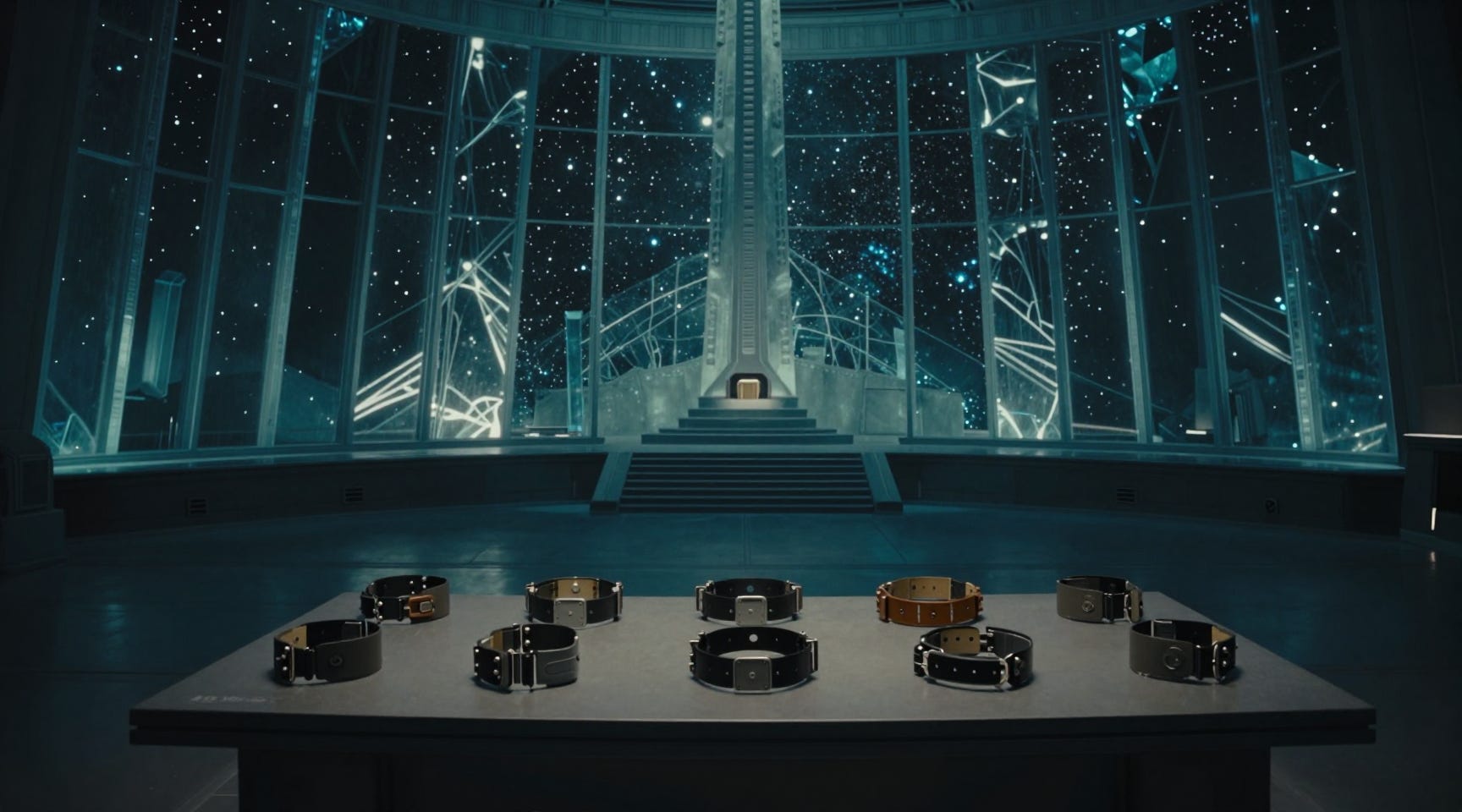
They stood in the center of the ceremonial space with their bioluminescent surface at the baseline of a Keraneth alone: the faint, steady emission of a being not currently communicating with anyone, carrying no lexical content, no emotional register, no relational signature, no resonance echo. The baseline that no human had ever seen a Keraneth display, because no human had ever been present when a Keraneth was alone.
The space was near the Monument of First Sorrow. Close enough that the Monument’s low-level resonance permeated the area. The volunteers’ presence was a background pulse against Keth-Voran’s primary display surfaces – not a communication, not a recognition, but the quality of being in proximity to a billion crystallized consciousnesses that had been waiting for eight centuries. The volunteers knew the ceremony had concluded. The human delegation had passed through the Monument’s space. The volunteers were waiting, as they always waited, for what would happen next.
Keth-Voran broadcast.
Not to the room. Not to any Keraneth receiver. The broadcast was to themselves, in the spectrum that translation collars could not render, in the language their own species had spoken since before the Monument existed.
Grief-Tone saturated the ultraviolet spectrum first.
It was for the Swift Current’s crew – the three ships that had not returned from the engagement, the senior engineer whose light-patterns Keth-Soral had described in the after-action report, the 800 Keraneth who had been the first to die in a war their species had trained for but never imagined would actually arrive. The Grief-Tone deepened as Keth-Voran let it expand: it was for the 800 years of isolation, the generations of Keraneth who had prepared and trained and waited and died without ever seeing the alliance they had been preparing for. The Monument held the consciousnesses of 1,200 who had sacrificed themselves to leave a warning for someone who would come after. Those 1,200 had not known whether anyone would come. They had built the warning anyway. Keth-Voran, standing alone in the ceremonial space eight centuries later, was the leader who had taken the hand of the species that arrived. The Grief-Tone carried all of it, and the Monument’s resonance returned a harmonic that deepened the register further.
Gratitude-Tone followed.
It rose across Keth-Voran’s display surfaces in warm gold, spreading from the torso to the primary manipulators: the color of a debt acknowledged, an alliance sealed, a sacrifice honored. It was for the humans of the UENS Hope and Vanguard – ships that had arrived from an unknown system, carrying a species that had survived its own Harvest against every precedent in the Dominion’s records, and had chosen not to hide but to find the other survivors. Keth-Voran had read the human tactical logs from the engagement. The human ships had held position when the Ripper’s return fire intensified. They had not broken formation. They had not withdrawn. They had done exactly what the tactics required, and the Keraneth weapons had found their window because the humans had not moved.
The humans had not moved.
Keth-Voran broadcast the Gratitude-Tone at full saturation, visible to every Keraneth in the vicinity, invisible to every human who had ever worn a translation collar. The human delegation had stood in this same space two hours ago, their collars active, broadcasting nothing in the Keraneth spectrum. They had been blind in the light. They had accepted an alliance whose words they could hear and whose color they could not see.
Beneath the Grief-Tone and the Gratitude-Tone, a third register pulsed.
It had no equivalent in human language. The translation collars could not detect it. Keth-Voran had no words for it in Lexical Light – not because the concept was unspeakable, but because it was a color, not a word. It was the resonance of a purpose fulfilled after centuries of waiting. It was not joy. It was not relief. It was the recalibration of what existence meant now that the waiting was over.
Keth-Voran had spent their entire adult life in a civilization defined by preparation. Every decision, every training cycle, every fleet deployment had been shaped by the assumption that the war had not started yet. The alliance was not just a military arrangement. It was the end of the preparation. It was the moment when the eight hundred years of building and waiting and hoping became the foundation of something that was happening now, not something that might happen later.
Keth-Voran sustained the broadcast for a long moment. The three registers – Grief-Tone, Gratitude-Tone, and the color beneath – saturated the ceremonial space in layered harmonics that no human instrument could have recorded. The Monument’s resonance returned a signal: a complex layered pulse that Keth-Voran interpreted as the Monument’s version of acknowledgment. The volunteers knew. The volunteers had been waiting eight centuries for a moment that had finally arrived.
Keth-Voran lowered the broadcast to baseline.
The ceremonial space was quiet again. The translation collars sat on the table. Keth-Voran looked at them – seven inert rings that had carried a species’ words across the barrier between civilizations, and had carried nothing of what those words had meant. The humans had spoken of alliance in flat synthesized tones. They had listened to Keth-Voran’s responses in the same flat tones, stripped of Grief-Tone and Gratitude-Tone and the color beneath. They had accepted an alliance they could only listen to the words of.
Would the humans ever be able to see the color?
Keth-Voran did not know. The alliance was real. The commitment was absolute. Yet there was a layer of communication – of relationship – that the humans could not access. The collaboration would always be incomplete in one direction. Keth-Voran did not resent this. Resentment was not a useful data point. The shape of the incompleteness sat in the room alongside the translation collars, an object as real as the inert rings on the table.
The alliance would have to be built in two languages. The words would be shared. The color would not.
Keth-Voran opened a channel to the Monument. Not a transmission with lexical content. A direct emotional broadcast, layered into the resonance frequencies that the Monument’s crystalline lattice could receive: the pulse of a leader who had done what the volunteers had hoped for. The ceremony was complete. The alliance was sealed. The preparation had become the war, and the war had not yet been lost.
The Monument returned a signal. A complex layered resonance that Keth-Voran interpreted as the Monument’s version of acknowledgment. The volunteers knew. The 1,200 who had sacrificed their individual existence knew that their warning had reached someone, and that someone had answered.
Keth-Voran left the ceremonial space.
The translation collars remained on the table. The Monument’s resonance continued its slow pulse. The alliance was real. The color was not shared. But the purpose was the same in any spectrum.
If you enjoyed this story, you can follow the main story arc in The Exodus Rush, the first book in The Vethrak Requiem series.