


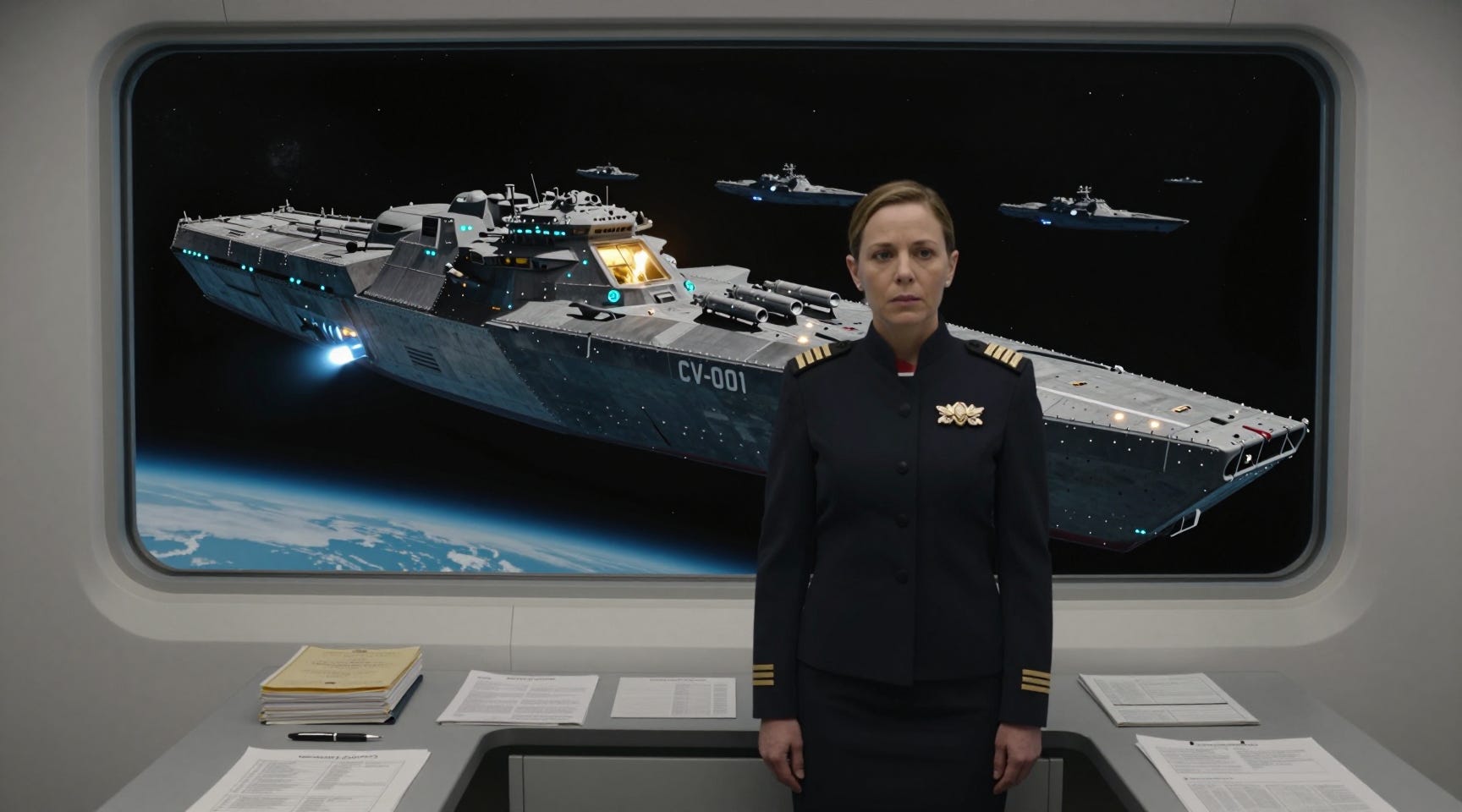
The office was small and clean and had belonged to someone else until three weeks ago. Captain Elizabeth Shaw had not changed the wall panel or the desk orientation or the position of the chair. She did not intend to keep the office long enough for it to become hers.
The stack of pads on the desk was twelve centimeters high.
Shaw picked up the first one and began reading from the top. Crew manifest. Engineering complement. Fold-readiness certification. Contingency protocols for loss of primary power, loss of atmosphere, loss of command. Every pad had been written by someone who had never served on a warship under fire. Every pad had been written by someone who had.
She read them all the same. The pen beside the stack was a thirty-year-old Parker her father had carried through thirty-six months of the Orbital Construction Authority, when humanity was still building things in space because space was the future and the future was bright. He had given it to her the day she made lieutenant. His note had said: Use it for the ones that matter.
Shaw had used it for exactly nineteen orders in fourteen years. She remembered every one.
She uncapped it now and set it beside the first pad. She did not sign yet.
The crew manifest ran forty-three pages. She read the names. Not for errors. For faces.
A lifeboat captain learned to count. Three hundred survivors in a single boat, packed into a vessel rated for one hundred eighty, running on a drive jury-rigged by an engineer who died three hours later when the secondary power coupling failed. She had counted them while the boat accelerated out of Earth orbit. She had counted them again after the fold. She had counted them again when the rescue ship arrived, and the number was still three hundred, and she had stood at the airlock while they boarded and kept her face still until the last of them had crossed.
That was twelve years ago. The scar tissue had long since closed. The counting habit had not.
Forty-three pages. Two hundred twelve crew. The youngest name on the manifest belonged to an ensign in engineering whose file Shaw had pulled separately: Thomas Okonkwo, Lagos, graduated near the top of his Academy class in reactor operations, flagged by his instructors as difficult, assigned to Vanguard by someone at Prometheus who had seen the reactor scores and not the attitude notes.
Shaw read the name twice. He was twenty-three years old. He had been eleven when the sky fell.
She set the manifest down and did not write anything in the margin.
The fold-readiness certification ran three hundred pages of technical assessment that reduced to a single sentence: the Fold Drive works in simulation and has never been tested at full load under combat conditions. The Cascade Reactor was green. The Aurora Drive was green. The Barrier Shield Systems had failed two of the seventeen stress tests and passed the third after adjustments the certification officer had described as within tolerance.
A shield system pushed past its tolerance was not an abstraction for Shaw. She had been on the bridge of a civilian transport when a Vethrak growth-ship focused its primary weapon on the convoy’s escort and the shield held for four seconds. The escort had been a destroyer named Valiant. The shield’s failure was a diagrammatic event. On the sensor screen it resolved into a three-second interval: collapse of the barrier, then structural failure, then nothing. The interval had measured 2.8 seconds. It measured 2.8 seconds every time Shaw replayed it. She had carried it for twelve years.
Within tolerance, the certification officer had written.
Shaw set the pad down next to the manifest and did not write anything in the margin there either.
Her aide arrived with the final pad at 0923.
The aide was young and meticulous and had been assigned to Shaw’s office for three weeks without once asking a question Shaw did not want to answer. He set the pad on the corner of the desk.
“That is the last one, Captain. Supply manifest and commissioning authorization.”
Shaw nodded.
The aide hesitated. Shaw looked up.
“The orbital slip is lit for inspection if you want to see her before you sign,” the aide said.
Shaw looked past him to the window. The orbital slip was visible across the arm of Prometheus Station, a long bright scaffold around a ship that was no longer a skeleton. Vanguard hung in her berth. The hull plating was complete. The running lights were on. The name was painted.
She looked at the ship for a long moment.
“I will,” she said. “After.”
The aide left. The door closed without sound.
Shaw uncapped the pen.
The supply manifest. The crew manifest. The fold-readiness certification. The commissioning authorization. Four signatures. Four uses of a pen her father had given her with the instruction to use it for the ones that mattered.
She signed them all. The pen did not feel any different in her hand. The signatures were identical to the nineteen that had come before. She set the cap back on and placed the pen in the drawer.
The stack of signed pads sat on the corner of the desk where the aide had left the last one.
Shaw walked to the window.
The orbital slip was bright with work lights. A maintenance crew was running a final check on the forward sensor array, their suit lights small and slow against the curve of the hull. Vanguard was almost complete. The commissioning ceremony was four months away. Two hundred twelve crew would report aboard, and Thomas Okonkwo would bring his reactor scores and his attitude notes, and somewhere in the ship’s engineering deck was a station that did not know it was about to get a twenty-three-year-old who had been eleven when the invasion came.
We are sending children into a silence we do not understand, Shaw thought. If the silence ends, I will be the one who decided to.
She turned back to the desk.
The next stack was smaller. Transfer protocols. Accommodation assignments. The small administrative machinery of getting two hundred twelve souls onto a warship that had never flown. A junior lieutenant would handle most of it. Shaw picked up the first pad anyway.
She began reading from the top.
If you enjoyed this story, you can follow the main story arc in The Exodus Rush, the first book in The Vethrak Requiem series.