


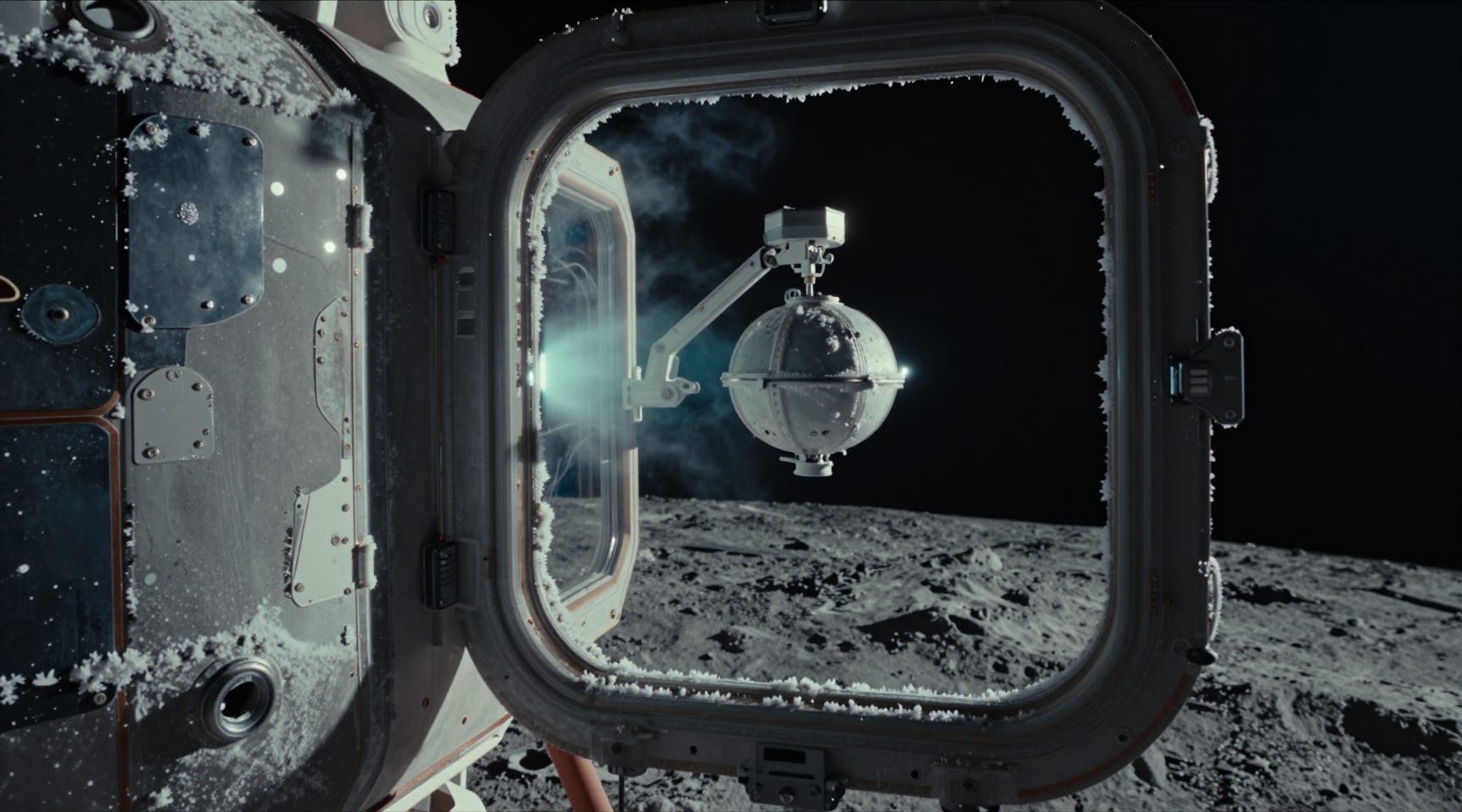
Naledi Beaumont kept the canister strapped to the deck with three cargo webbing lines and a promise she did not trust.
CONTAINER STATUS: STABLE
Stable meant the seal had not failed yet.
CSV Hearthline drifted through Luna Station Alpha’s approach corridor, guided by traffic pings and the Aurora Drive’s steady hum. The cockpit air carried disinfectant and burnt coffee. The clean never returned after Year 0.
The canister vibrated under her boots. Not the hull. Not the drive. The canister.
The salvage team had passed it over on a pad in low orbit, faces behind mirrored visors.
“Cold chain,” the lead had said through a respirator. “Do not let it warm. Do not open it. Do not reroute power.”
Naledi had nodded and signed. Her signature had come out childish on the tablet, like a lie.
Traffic control flashed.
DOCKING ASSIGNMENT: BAY 12
QUARANTINE PROTOCOL: LEVEL 2
Level 2 meant strangers in suits stepping onto her ship and treating her like a spill.
Luna Station Alpha filled the viewport, patched and swollen with add-on shield blisters. The station had started as a research platform. Salvage Protocol had turned it into a throat that swallowed alien hardware and tried not to choke.
Docking clamps bit. The ship jolted once, then settled. External power flowed in. Panels dimmed and relit as systems transferred.
The canister’s vibration sharpened.
A thump hit from beyond the cargo hatch.
Naledi’s mouth went dry.
CONTAINER STATUS: STABLE
A second line scrolled.
POWER BUS: TRANSFER COMPLETE
The canister drew from her auxiliary line. Docking transfer had nudged the bus. Field generators loved stable inputs. Alien field generators loved nothing.
The cargo hatch sat behind her, a circle of metal with a manual wheel in the center.
Frost beaded along the seam.
Cold belonged inside the canister.
Naledi keyed the intercom. “Hearthline to Station Control. Frost at cargo hatch seam. Container reads stable. Request thermal seal kit on boarding.”
Static. A tired voice answered. “Copy, Hearthline. Keep internal hatches sealed. Do not enter cargo bay.”
The frost line thickened anyway, creeping in a rough ring.
“Inspection ETA?” Naledi asked.
“Ten minutes.”
Ten minutes inside a sealed ship with a crate that knocked.
A second thump landed, harder. The hatch wheel quivered.
The canister’s hum rose, too low for hearing and too present to ignore. Teeth ached.
Stable meant nothing.
Stable meant everything.
Naledi pulled her emergency suit from the locker and stepped into it. Rubberized fabric gripped her arms. The collar sealed with a click. The helmet locked and her breathing sounded like a stranger.
O2: 73%
Enough.
The intercom stayed silent. The instruction stayed the same.
Do not.
A third thump struck. The deck shuddered.
A new thermal warning painted her visor.
CARGO BAY TEMP: DROPPING
Cold leaked into the ship. Cold pulled heat out of seals and joints. Enough contraction, then docking collars warped. Hatches stuck. Bad choices multiplied.
Naledi thumbed her mic again. “Station Control, request hard disconnect from external power. Dock transfer destabilized auxiliary bus. Field generator needs stable input.”
A pause.
“Denied,” Station Control said. “Docking arm power is shared. Hard disconnect risks a brownout in bay.”
A brownout risked people.
A seal failure risked something else.
No heroics, Beaumont.
The voice had used her name earlier. Someone had read her file.
Heroics had nothing to do with it. Cargo ran on physics and time.
Her eyes went to the manual override panel beside the hatch. Two levers. HATCH LOCK. AUX POWER ISOLATION. A red safety cover guarded the second.
Footsteps and muffled voices carried through the intercom speaker. Someone had reached the station-side airlock.
A new voice cut in, younger and clearer. “Pilot Beaumont. Inspection team at the hatch. Keep it sealed. We are cycling now.”
The canister thumped again, as if answering.
The safety cover was thin plastic.
Naledi flipped it up.
Her gloved hand hesitated over the AUX POWER ISOLATION lever.
If she pulled it, she broke procedure.
If she did nothing, she waited for the next thump.
Procedure existed because people died. Reality existed because it did not care.
Naledi pulled the AUX POWER ISOLATION lever down.
Cockpit lights flickered. The suit display dimmed for a heartbeat, then stabilized.
The canister’s hum dropped a register. The vibration softened. The thermal warning shifted.
CARGO BAY TEMP: HOLDING
Naledi exhaled, slow.
“Station Control,” she said. “Aux line isolated. Field stabilized.”
Silence answered her. Not approval. Not condemnation.
The younger voice returned, sharp with disbelief. “What did you do?”
“I kept the canister on a stable bus,” Naledi said. “Docking transfer nudged it.”
Another beat.
“Hold,” the voice said. “We are cycling.”
The airlock indicator flashed. Pressure equalized with a hiss that scratched at her ears even through the helmet.
Two figures entered the cockpit in full quarantine suits. Their visors reflected station light, faces erased.
One carried a thermal scanner. The other carried a hard case stamped with Salvage Protocol markings.
The younger voice came through Naledi’s comm. “Lieutenant David Caldwell. Quarantine response. Identify.”
“Naledi Beaumont,” she said.
“Copy.”
The scanner operator turned toward the cargo hatch. Their wrist display flared red.
“Temperature anomaly at the seam,” they said.
Naledi’s stomach clenched.
Caldwell stepped to the override panel. “Power isolation engaged. Who engaged it?”
Naledi raised her hand.
Caldwell’s visor angled toward her. “Never touch unknown interfaces.”
“I did not touch the canister,” Naledi said. “I touched my ship.”
A pause, then a clipped, reluctant shift in posture. “Noted.”
Caldwell opened the case. Inside lay a clamp ring and a flexible thermal blanket threaded with coolant channels.
The ring fitted around the hatch seam. The blanket unrolled and adhered to metal, sealing frost beneath engineered cold.
The hum dulled further.
CONTAINER STATUS: STABLE
Caldwell keyed their mic. “Station Control, containment stable. Request tow to Bay 12 cold room.”
Station Control answered immediately. “Copy. Cold room prepped. Beaumont remains in quarantine pending decon.”
Relief pressed into Naledi’s ribs like extra gravity.
Caldwell lingered a moment, then spoke quieter. “Good call. Bad procedure. Good call.”
A laugh tried to rise. It died halfway.
Naledi kept her voice steady. “Next time, bring a stable power module to the pad. Dock transfer always ripples.”
“Next time,” Caldwell said.
Hope sounded dangerous in a quarantine bay.
The docking arm moved, slow and careful, carrying the Hearthline deeper into the station’s ribs.
The canister’s status line blinked steady green.
Stable meant nothing.
Stable meant one more hour.
Author’s Note: Luna Station Alpha sits at the center of humanity’s learning curve. Every sealed crate is a gamble: a step toward survival, or the spark that burns the last safe room.
If you enjoyed this story, you can follow the main story arc in The Exodus Rush, the first book in The Vethrak Requiem series.