


The interior of the scout vessel was seventeen cubic meters of pressurized space, and Thres-Van had been breathing the same recirculated air for eleven days.
The compartment was built for a single Skarreth. The pressure was set to the standard the species preferred, a constant squeeze that a human would have registered as physical discomfort. Thres-Van had stopped noticing it on day three. The only sound was the whisper of the vessel’s own systems, each one held at the minimum output threshold necessary for continued operation. The drive was cold. The emissions baffles were engaged. The hull absorption coating had been verified at full efficiency before insertion and had not been tested since, because testing would have required an active emission that the mission protocol prohibited.
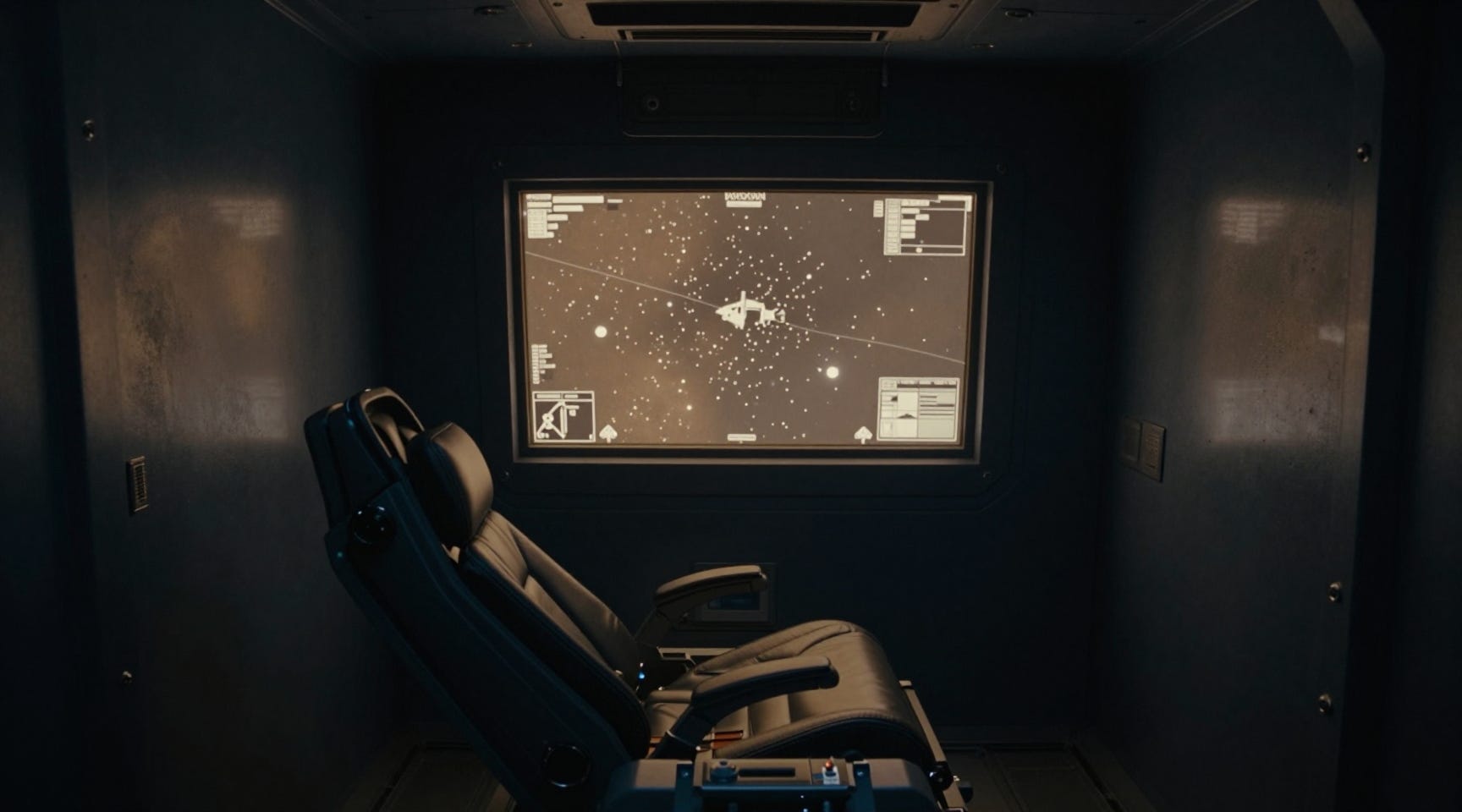
The scout’s acceleration couch was a shallow recess in the compartment’s forward section, shaped to Thres-Van’s resting profile. The courier had been in it for two hundred and sixty-four hours, rising only for the briefest cycles of fluid exchange and metabolic maintenance. The rest of the time, Thres-Van watched the display.
The debris field was visible through the passive sensors as a three-dimensional scatter of rock and metal fragments, the residue of a processing operation that had been concluded some years ago and abandoned to drift. The Vethrak logistics depot hung at the field’s far edge, a massive industrial structure processing cargo from a recent harvest operation. Thres-Van had been watching it since insertion. The depot’s departure frequencies. Its guard rotations. Its cargo types, identified by the passive signature of the containers transiting between the depot and the arriving transport vessels.
Eleven days of data. Eleven days of stillness. And now the Fang was coming.
The Vethrak destroyer appeared on the tactical display as a cold trace, its drive signature suppressed for standard patrol profile. A Fang-class vessel, two hundred meters of bone-colored organic hull drifting through the debris field’s outer edge on a scheduled sweep. Not a response to detection. The Fang’s course was too methodical, too aligned with the depot’s protection protocol. A scheduled patrol. The depot had been running them every five days. This one was early by approximately sixteen hours.
Thres-Van registered the discrepancy and filed it. The patrol timing anomaly would be relevant intelligence regardless of the sweep’s outcome.
The Fang’s current vector would pass within three-tenths of a light-second of the scout’s debris-embedded position.
The assessment process began automatically. Not a conscious narrative. A calibrated evaluation that Thres-Van’s training had turned into reflex. Probability that the Fang was responding to detection: minimal. The scout was running zero emissions. The absorption coating was at ambient debris temperature. The hull geometry was oriented to present the smallest possible cross-section toward the depot’s direction. There was nothing for the Fang to detect unless the Vethrak had improved their sensor technology since the last intelligence update.
Probability of passive sensor contact during sweep passage: calculable from known Fang sensor profiles and the six data points Skarreth intelligence had accumulated on this specific ship class’s detection threshold. The probability was low enough to be operational. Thres-Van had done this calculation a hundred times in training and a dozen times in the field. It always came out the same way: trust the coating, trust the discipline, hold position.
The withdrawal protocol would take sixteen hours to execute. It would consume the remaining six surveillance days of the mission timeline. The depot had been cycling cargo for eleven days and the intelligence from those cycles was already more than the pre-mission estimate had projected. Withdrawal was the conservative option. With the Fang on an unscheduled patrol, withdrawal was also the logical option.
Thres-Van did not withdraw.
The Fang continued its approach. The tactical display updated every cycle, the cold trace resolving into a more detailed passive signature. At 0.4 light-seconds, the Fang’s hull geometry became identifiable. At 0.35, the faint bioluminescent pulse of the Fang’s command section was visible through the scattered light of the debris field. The ship was alive in the way all Vethrak vessels were alive, grown rather than built, its hull the color of old bone with darker organic patches moving slowly across its surface. Thres-Van had seen this image in intelligence briefings. Seeing it through the scout’s passive optics, knowing that the vessel was passing close enough that a single active sensor pulse would end the mission and the scout, produced a quality of attention that no briefing could replicate.
The closest approach was 0.29 light-seconds.
Thres-Van watched the Fang’s drive signature slide across the display, a faint distortion in the background radiation that was barely distinguishable from the ambient noise of the depot’s operations. The Fang did not alter course. It did not accelerate. It continued its patrol vector, passed the scout’s position, and began receding into the debris field’s deeper structure. The cold trace faded.
Thres-Van watched it fade. The display returned to its standard baseline: the scatter of debris, the distant mass of the depot, the absence of any Vethrak asset on an intercept vector. The scout was still undetected.
Thres-Van registered this as a successful concealment assessment. The voice of the training instructor surfaced as a memory, not a thought: The test is not whether you can survive the approach. The test is whether you can handle what you find at the end without needing to be told what to do.
The Fang had passed. The mission was still viable. Thres-Van resumed the surveillance rotation. The depot was still processing cargo. The next cycle of departure data was accumulating. The stillness returned to the compartment.
Six days remained. Thres-Van settled back into the acceleration couch, the compartment’s systems cycling at their minimum threshold, the recirculated air moving in a pattern too subtle to hear. The scout continued its drift in the debris field. No one on the depot knew it was there. No one on the Fang had registered its presence.
Eleven days of stillness. Six more to go.
If you enjoyed this story, you can follow the main story arc in The Exodus Rush, the first book in The Vethrak Requiem series.