


The inspector checked the bolt before asking about the delay.
Onur held at the scaffold junction while she brought its local custody tag against her reader. The identifier matched. She checked the next restraint, then Article Four’s locked outbound code. No permission appeared where the schedule expected a departure.
Her clean boot settled into a scaffold capture beside his.
“Which exception are you requesting?”
“A retention change,” Onur said. “Not a release.”
Behind her, the second inspector clipped his slate short. Their suits carried none of Slip Two’s accumulated gray. Onur had cleared their route himself, limiting the tour to the barrel, the replacement cradle and the conference booth. No receiving history traveled with the access authorization.
The first inspector looked through the open frame toward the three held transitions.
“More information kept here.”
“Different information kept separately.”
“Show us the difference.”
Wanjiku met them at the access boundary. She did not move it for the visitors.
Her slate held the interrupted proof, the changed ultrasonic scans and the signed halt. The barrel remained captured at zero load. Replacement plate waited in its own cradle, positioned but untouched by a production torch.
“A precautionary delay?” the second inspector asked.
“Measured microcracking after proof. Structural nonconformance.”
“Your current disposition?”
“No further flight load. No transfer. A corrected procedure still needs qualification before repair.”
Onur kept his hands around the rail. The report’s short schedule field had called it additional inspection. He had allowed the phrase to stand because it disclosed less.
“The schedule summary is incomplete,” he said. “The halt record governs.”
The inspector marked the discrepancy. Neither congratulation nor accusation followed. That almost made it harder.
Samrawit secured her reader beside Wanjiku’s. She opened the returned technical packet through the bounded review already authorized, leaving origin and route sealed.
Normalized plate. Worked, accelerated-cooled plate. Separate joining conditions beside the common treatment actually applied.
“Both acceptable in their own conditions,” she said. “Not interchangeable under that treatment.”
The first inspector examined the response wrapper.
“No direct source channel?”
“Brokered return,” Onur said. “Batched and delayed among other traffic. The source received its certificate references and technical questions. Not our address, geometry or proof record.”
“The source could recognize its own work.”
“It had to. We couldn’t ask an empty question.”
She left the technical fields open.
“Working direction. Thermal sequence. Combine enough attributes and you may have a facility fingerprint without writing a facility name.”
Onur’s thumb pressed against the rail until the glove seam bit.
She was right. Deleting the address had never made every remaining fact harmless.
Inside the sealed booth, Onur fixed both boots and clipped his slate into the partition bracket. The inspectors took the opposite restraints. Samrawit and Wanjiku secured themselves along the side rail; Cho remained at the narrow entrance.
Onur brought up the proposed field categories, not another live source record.
“Fixed technical categories. No free-text source descriptions. The governing signed values remain behind them for an approved technical need. The sealed source token stays in separate custody.”
“Your categories won’t contain every joining limit,” Samrawit said.
“Then a missing limit holds the work. A bounded exception brings the required value through review. We don’t round a restriction away to fit the form.”
The second inspector selected a group of records.
The demonstration refused bulk export.
He selected one linkage and entered a purpose. Onur applied only the compartmentation authorization. The link stayed closed until Wanjiku entered the matching engineering purpose.
“Expiry?”
Onur opened the limit beside the grant. When he changed the stated purpose in the demonstration, the link closed. Both openings and refusals remained in the log.
“The grant expires,” he said. “The technical revision doesn’t disappear with it.”
“This asks us to retain more than your old rule.”
“The old rule kept custody and removed part of what custody was meant to protect.”
His own finding occupied the next pane. He did not shorten it.
The second inspector brought its authorship forward. Onur Tekin, compartmentation review. The same name stood on the proposed replacement.
“You accepted the earlier schema.”
“I defended it.”
“Why should this one survive your next schedule problem?”
Onur unclipped his hand from the restraint, then secured it again. A promise would cost him nothing in this booth.
“Retain this finding with the new rule. Log the denials as well as the grants. Give the review to someone who didn’t write either.”
The inspector attached that condition to the pilot instead of accepting it as reassurance.
Samrawit indicated the earlier and later upstream summaries. “Without process history, the next defect asks for more access, not less. We have to reconstruct everything while the work waits.”
The first inspector turned to the personnel proposal.
Tuva’s authorship signature remained at its foot.
“Now a builder roll.”
“Separate purpose,” Onur said. “Engineering keeps the work reference. Identity custody keeps the person. Neither opens the join alone.”
“A retained shift map can identify exactly whose absence stops you.”
He could have answered with the medical partition. It would have been a familiar defense and the wrong one. A medical contact did not establish who had executed a weld under which qualification.
“No shift export. No biography. The applicable qualification, role, work package, scoped signature and date. Legal identity stays inside its own custody. A materials grant cannot open it.”
“Recognition?”
“Evidence. No names on the hull.”
Cho caught the entrance rail more firmly. Onur kept the old deletion rule visible beside the proposed exception. Approval would have to change it explicitly; the better form did not change it by existing.
The first inspector opened the remaining stock inventory.
“All structural lots. Before use.”
Cho’s slate made a small contact sound against the booth bracket.
“Article Four’s selected pieces have the required links,” he said.
“The category that failed here supplies other slips. The pilot cannot apply only where you’ve already found damage.”
Onur followed the inventory to Slip Four. Its next work package drew from stock still carrying the old short acceptance. Some histories might be complete behind those entries. Until someone verified them, the word accepted concealed the same unanswered question.
“Reclassify every remaining structural lot,” the inspector said. “Retain the old receipt. No use through the old category while the new record is unresolved.”
Cho moved the Slip Four block into hold.
“That uses the next inspection allocation.”
“Record it.”
He did. The lost block stayed attached to the work it displaced.
The second inspector returned to the outbound package.
“Your custody code expires after handoff. How does the next node ask a question about this barrel later?”
Onur opened the existing transfer design. Its one-time code proved a passage between custodians. It did not provide a durable engineering identity.
Another short record, useful until the moment it stopped being enough.
“A persistent random lifecycle token,” he said. “Separate from custody. In the engineering package and a recessed internal tag. Nothing that encodes site or personnel.”
“Through what return path?”
“The broker. No direct call back here. A query binds the token and the technical need. Any protected join still requires both authorities.”
“Audited returns,” the inspector said. “Including rejected requests. Test that path before outbound release.”
Onur added the requirement without marking the test complete. No token had been installed. No later recipient had queried anything yet.
The first inspector entered the pilot scope.
Site Anvil structural work. Article Four’s completion. Review after outbound acceptance. No authority to copy the procedure across the Fleet, no general personnel access, no relaxation of Wanjiku’s release gates.
She authorized the bounded retention exception within that scope. The new decision preserved the proposal it amended and the deletion rule it superseded there. Local implementation still needed Cho’s disposition.
Onur read the conditions back. Each inspector confirmed them. He saved their signatures with the costs, not on a cleaner page without the holds.
Outside the booth, the inspectors transferred along the scaffold by its fixed handholds. Their clean boots caught and released without marking the worn metal.
Cho waited beside Onur at the junction, looking toward Slip Four.
“Bring me the implementation package,” he said.
Not a repair order. Not yet.
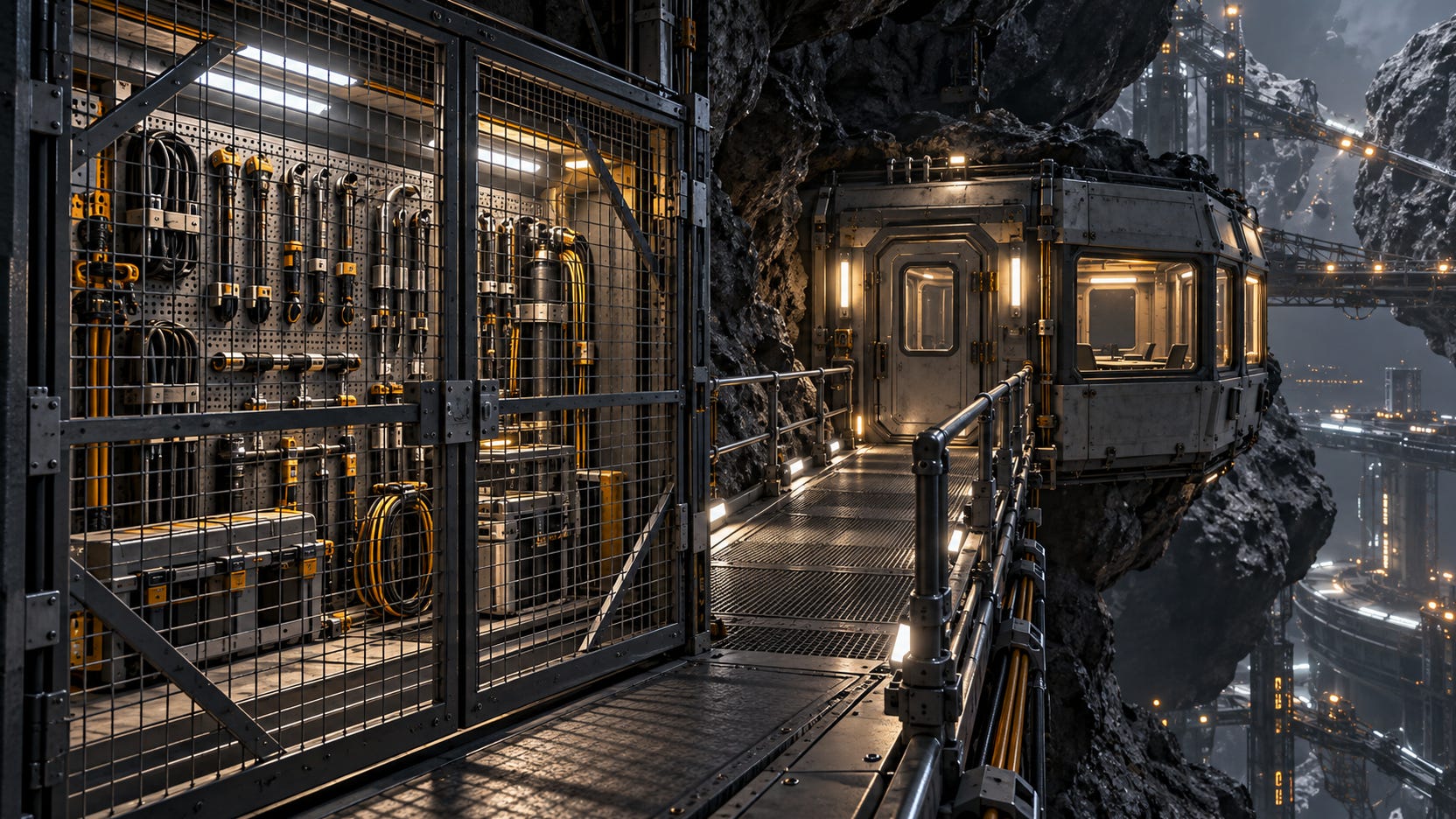
Onur closed the inspection route after the last tether cleared it. Beyond the newly secured tool gate, Slip Four’s unused equipment remained clipped in its holders. Nothing had broken there. Nothing could move until they knew what its next piece of steel remembered.
The boots had left no prints. The approval had left a whole work block locked behind it.
Author’s note: This story follows Onur Tekin in late Year 3 as Ghost Fleet oversight reviews Site Anvil’s proposed records. A bounded local pilot and retention exception do not qualify the corrected joint, authorize production repair, or establish Fleet-wide policy.
New to The Vethrak Requiem? Start with The Exodus Rush, Book 1, where humanity fights for survival after an alien invasion using technology it barely understands. These short stories explore the wider universe; the novel begins the main story.