


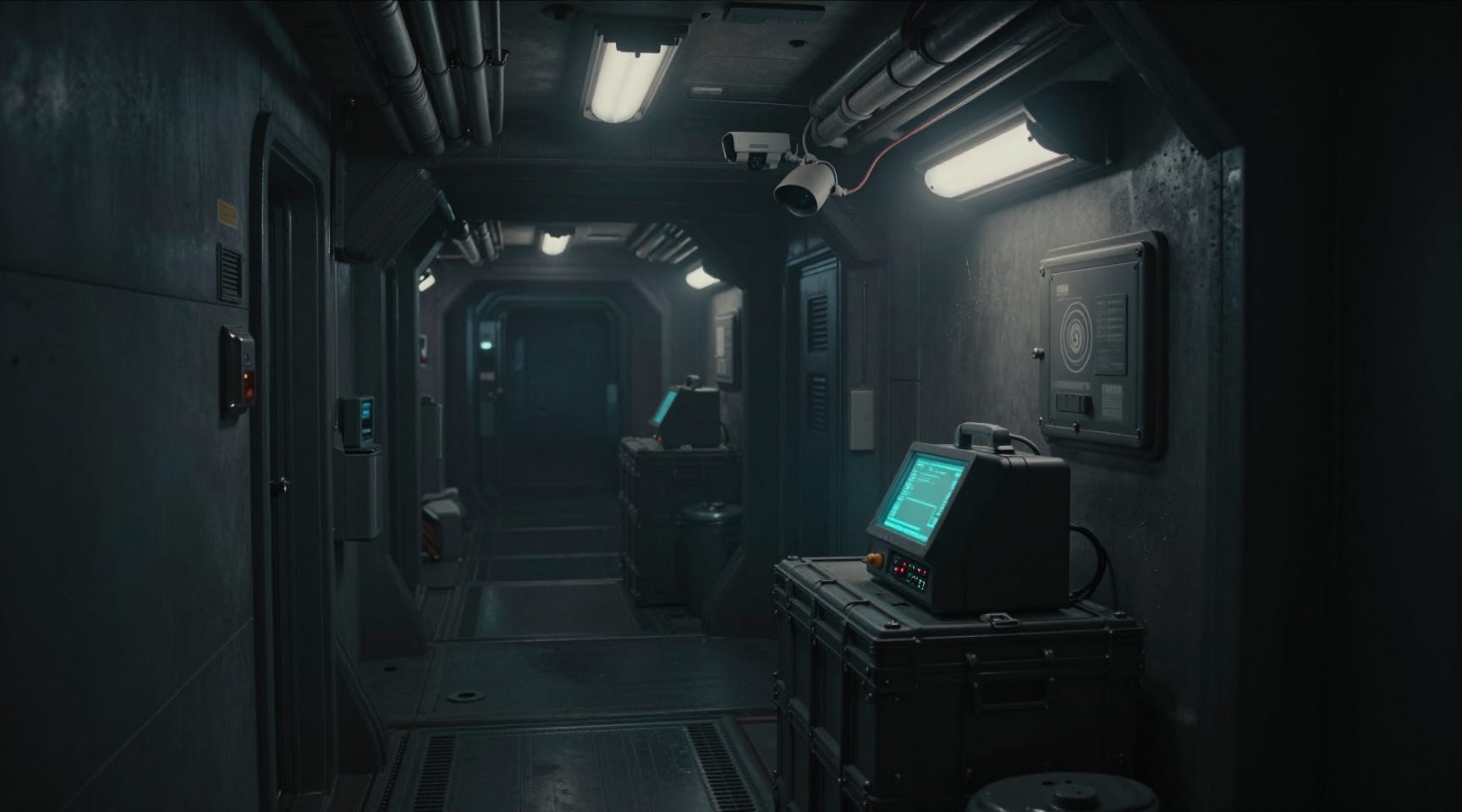
Tobias Harrington’s biometric scan rejected him at the commissary door for the third time in four days.
The terminal flashed amber, held for two seconds, then resolved to green. Standard processing lag, the intake clerk said each time. System congestion. Nothing to worry about.
Tobias worried.
He’d worked Loading Bay Fourteen on Titan’s eastern docks for six years. Every shift began with a biometric scan: palm geometry, retinal pattern, pulse signature. The system matched his profile against the authorization database, confirmed his ration tier, and opened the door. Six years of clean scans, six years of the terminal flashing green without hesitation.
The hesitation had started nine days ago.
He mentioned it to his shift supervisor during the morning cargo sort. Dekker shrugged. “System’s been patchy since they upgraded the security firmware last month. Half the bay crew gets flagged at least once a week.”
True enough. Tobias had watched two other workers get delayed at the same terminal yesterday. The firmware explanation made sense. It should have been enough.
It wasn’t.
The second anomaly appeared on his ration statement. His weekly allocation showed a withdrawal he hadn’t made: forty units of protein concentrate, logged at a distribution point on Deck Nine. Tobias had never been to Deck Nine. The timestamp placed the withdrawal during the middle of his shift, when the bay cameras would show him unloading cargo containers two kilometers away.
Someone was using his biometric profile.
He filed a discrepancy report with the Ration Integrity Office. The clerk took the information, assigned a case number, and explained that identity verification audits were running eight to twelve weeks behind. Until the audit cleared, his account would remain active. The phantom withdrawals would continue.
“Can you freeze the account and reissue?”
“Not without a completed audit. If we froze every account with a discrepancy flag, a third of the settlement would lose ration access overnight.”
Eight to twelve weeks. The math was simple. Forty units per withdrawal, three withdrawals in nine days, projected across twelve weeks: his ration balance would be gutted long before the audit reached his case.
He started paying attention. The lag at the commissary terminal. The phantom withdrawal on Deck Nine. He pulled his transaction history and found two more anomalies he’d missed: a housing credit check from a residential block he’d never visited, and a medical supply authorization bearing his biometric stamp at a pharmacy on the lower levels.
Someone had built a complete copy of his identity. Not a crude forgery. A ghost print, the kind that passed primary and secondary verification because it was built from actual biometric data, not approximated from templates.
The commissary terminal hesitated because two versions of Tobias Harrington existed in the system, and the database needed an extra cycle to reconcile the conflict before defaulting to the one standing physically at the door.
He knew who made ghost prints. Everyone on the docks knew. Greyline Parish ran biometric forgery out of three locations on Titan, manufacturing identities for people who needed to exist as someone else: smugglers moving cargo through checkpoints, syndicate operators dodging security flags, anyone willing to pay for a clean record that wasn’t theirs.
Tobias’s record was clean. Six years on the docks, no infractions, Tier-3 ration access, housing authorization, medical clearance. A profile like his was valuable precisely because it had never been flagged. Ghost prints worked best when they borrowed credibility from someone who’d earned it.
Finding the Greyline Parish contact took two days and a conversation with a cargo handler named Voss who owed him a favor from a shift-swap three months back. Voss gave him a location: maintenance corridor 7-G, lower levels, third hatch past the water reclamation junction.
The woman waiting inside the corridor was younger than he’d expected. Late twenties, maybe. She sat on an overturned supply crate, a portable terminal balanced on her knees, its screen angled away from the corridor’s single security camera.
“You’re the dock worker.” She didn’t look up from the terminal. “Harrington.”
“You know my name.”
“I know everything about you. That’s the product.” She closed the terminal and met his eyes. Her expression held no hostility, no apology. “Rocío. I handle client relations for this district.”
“Client relations.” He kept his voice flat. “Your clients are using my identity to steal my rations.”
“They’re using a copy of your biometric profile to conduct transactions. The distinction matters legally, though I understand it doesn’t feel different from your end.”
“I want it stopped.”
She studied him for a moment. Her fingers tapped the edge of the closed terminal, rhythmic, unhurried. “Stopping it requires pulling the ghost print from active circulation. That means refunding three clients who’ve already paid for access. That means absorbing the cost ourselves. Greyline Parish doesn’t absorb costs.”
“That’s not my problem.”
“It becomes your problem when you consider the alternative. You filed a discrepancy report. Case number 4471-T.” She waited for confirmation. The number was correct. “The Ration Integrity Office audits take twelve weeks. During that time, your profile stays active, and so does the copy. If you escalate to security, they’ll freeze your account immediately. Protective hold, pending investigation. No rations, no housing credit, no medical access until the hold lifts. Investigations take longer than audits.”
The trap was elegant. Reporting the theft to security would punish him faster and harder than it would punish the thieves. The system protected itself by making the victim’s account the easiest thing to lock down.
“There’s a third option,” she said. “Compensation.”
He waited.
“We pay you a percentage of every transaction conducted under your profile. Eighteen percent, deposited into a secondary account. You maintain your clean record, your ration access stays intact, and you receive income for the use of your identity. The ghost print runs for six months, then we retire it and your profile returns to exclusive use.”
“You want to rent my name.”
“I want to acknowledge that your identity has market value and compensate you accordingly. The alternative is fighting the bureaucracy for three months while your rations drain and your housing credit takes hits you can’t explain.”
Eighteen percent of transactions he couldn’t control, conducted by people he’d never meet, for purposes he’d never know. Every authorization stamped with his biometric data. Every crime committed under his name, building a shadow record that would outlast any compensation.
“If I say no?”
“Then the ghost print stays active, the transactions continue, and your audit processes at the speed it processes. We don’t threaten people, Harrington. We don’t need to. The system does our work for us.”
She was right. Reporting got him frozen out. Waiting got him drained. Accepting got him paid for damage he couldn’t prevent.
Three paths. None of them clean.
Tobias looked at the security camera mounted at the corridor junction. Its red indicator light was dark. Disconnected, or rerouted to a feed Greyline Parish controlled. The maintenance corridor existed in a gap between official surveillance zones, one of dozens across the lower levels where the station’s infrastructure couldn’t quite cover every angle.
Gaps. The whole economy ran in the gaps.
“Six months,” he said. “Then the print is retired.”
“Six months. Guaranteed.”
She opened her terminal and typed something, fingers quick and practiced. “The first deposit will post within forty-eight hours. Secondary account, untraceable to your primary profile.” She glanced up. “Welcome to the arrangement, Harrington.”
She returned to her screen. The conversation was over.
Tobias walked back through the maintenance corridor, past the dark camera, past the water reclamation junction, and up into the main concourse where the settlement’s population moved through checkpoints and commissary lines and ration terminals. All of them scanning their palms, waiting for green lights.
His terminal would still hesitate. The extra processing cycle would still run every time the database found two versions of him and chose the one standing at the door.
He’d know which version was real. He wasn’t certain it would matter.
Author’s Note: Greyline Parish’s ghost print operations represent one of the more insidious forms of identity crime in Titan’s post-evacuation settlements. Unlike ration counterfeiting or salvage fencing, biometric theft weaponizes the victim’s own clean record, turning compliance with the system into a product sold to those who’ve opted out of it. The cruelest efficiency is that the official response to identity theft, freezing the compromised account, punishes the victim more effectively than any syndicate ever could.
If you enjoyed this story, you can follow the main story arc in The Exodus Rush, the first book in The Vethrak Requiem series.