


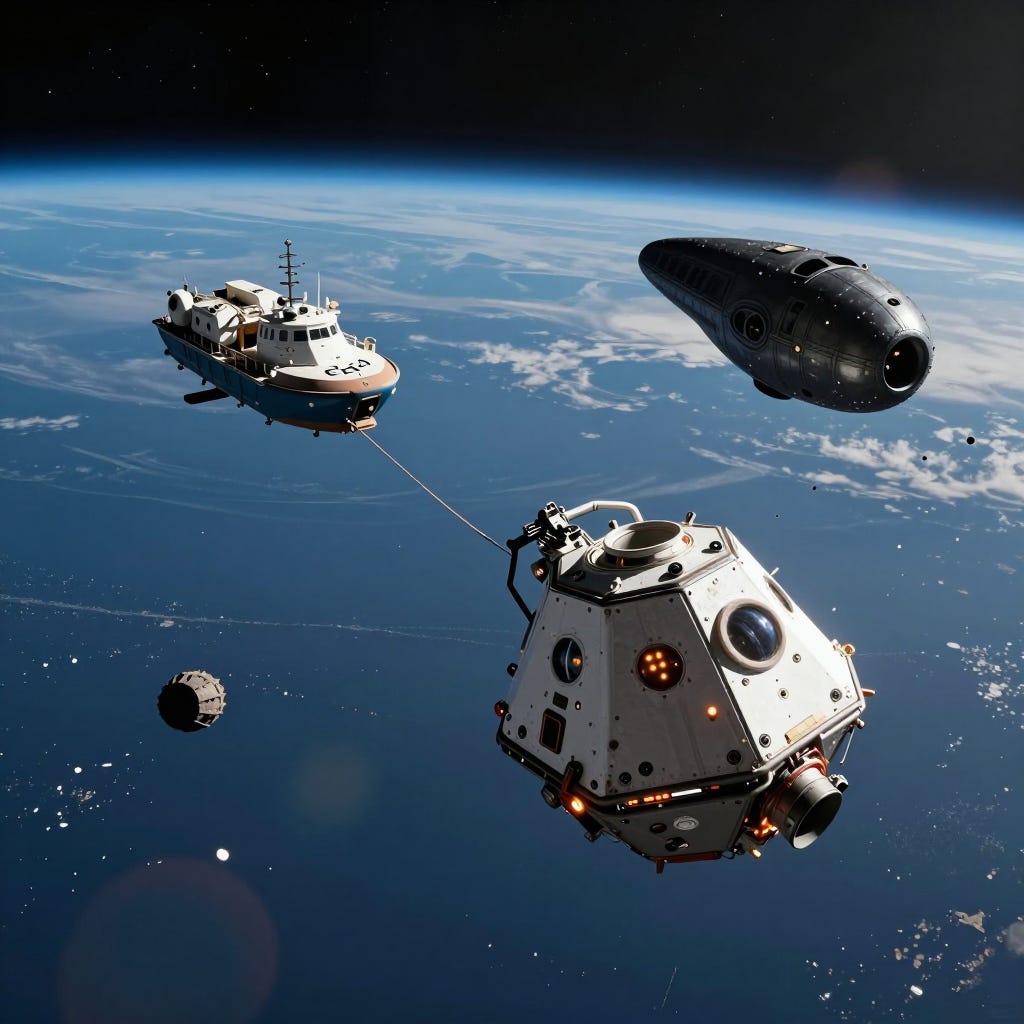
The claim packet hit Security Cutter Sable 3 at 02:19 orbital time, stamped low priority by an algorithm that had learned to stop caring.
Petty Officer Halen Rios watched it slide down the comms queue anyway, a thin line of text between collision warnings and maintenance nags. Salvage Protocol claim. Debris field sector Kilo Nine. One Vethrak fragment, mass estimate eleven tons. Contractor beacon mode active.
Beacon mode meant desperation. Contractors did not burn through a tag battery unless they expected someone else to show up first.
Halen flicked the packet open. The display filled with bland fields and hard numbers. Claim ID. Time stamp. Vector. Attached telemetry.
Life support signature.
His throat tightened. The cutter’s cabin stayed the same, all recycled air and scuffed console plastic, yet the space around him narrowed to that line. The readout did not belong on a salvage claim. It belonged on a rescue ping.
Dara Venn, comms watch, leaned over his shoulder. Her hair floated in a loose halo in the weak grav. “Contractor trying to game the system?”
“Beacon mode tags do one thing,” Halen said. “They ask Security to adjudicate.”
“Orders say prioritize alien hulls,” Dara replied. She tapped the status strip where command messages sat, bright and cold. SALVAGE RECOVERY MAXIMIZATION DIRECTIVE, still pinned from last week.
Directive language never mentioned oxygen.
Halen dragged the telemetry window larger. Internal pressure held at a sickly low plateau. Temperature hovered at the edge of survivable. Oxygen number ticked down in slow, merciless decimals.
Four percent.
“How far?” he asked.
Dara pulled the nav overlay without waiting for permission. A dotted line arced across the orbital map, threading between fenced-off debris volumes and old burn zones. “Nine minutes if you keep thrust under the corridor limit. Seven if you break it.”
Seven minutes in a sealed pod with a failing scrubber was an entire life.
Halen kept his hand flat on the console. The urge to snap the cutter into motion rode his muscles like an itch. Patrol schedule sat open on his display. A supply convoy was due to clear Prometheus Station’s approach lane in forty-two minutes. Command would notice a deviation. Someone would log it. Someone would ask why he risked the convoy corridor for a civilian claim.
His wrist slate buzzed with an automatic reminder: quarterly memorial roster update pending. The roster had gained a name the last time he let a ping go unanswered.
Halen keyed internal comms. “Engineering, this is Rios. I need burst thrust capability in five minutes. No questions.”
The reply came back with a sigh and a curse. “You get two burns. Hotter than that and I am writing you up in the afterlife.”
Halen looked at Dara. She held his gaze for a beat, then turned back to her station and began preloading the log template.
He engaged thrust.
The cutter’s Aurora Drive pushed against vacuum with a controlled roar that lived in vibration and readouts. Debris warnings flashed and cleared as the cutter slipped through tracked lanes.
Sector Kilo Nine resolved into tumbling metal and dark, matte shapes that did not belong. Vethrak crysteel caught sunlight like oil slick on water. The fragment in the claim packet matched the scan, a slab of alien hull still bolted to ruined trusswork.
A civilian skiff clung to it by a bright yellow tether line. The skiff’s profile looked like survival itself: patched plating, old thrusters, a hull that had been welded too many times to keep a clean seam.
The escape pod floated beneath the fragment’s shadow, half hidden. Its status light blinked, slow and stubborn.
Halen opened the hailing channel. “Civilian skiff, this is UEN Security Cutter Sable 3. Cut engines and hold position.”
A pause stretched, filled by the hiss of life support and the cutter’s thruster micro-adjustments. The reply arrived, clipped and tired. “Skiff Rook, holding. This is Bako. That fragment is tagged.”
The name sat on the claim packet too, one line above the contractor ID. N. Bako. Independent. Class C license.
Halen kept his tone even. “Your claim is logged. Beacon mode flagged life support telemetry. Confirm pod status.”
Silence, then a breath that made static pop. “Pod is active. Life support is low. I cannot tow both.”
“Security will take the pod,” Halen said. “Stay clear of its vector.”
“Negative,” Bako replied. The word landed hard. “Security takes the fragment first. Everyone knows that.”
Everyone knew a lot of things that kept people alive right up until they did not.
Halen switched to ship-wide. “Dara, secure a salvage cutter assignment for the fragment. Mark it for recovery in three hours. Flag it as adjudicated under emergency clause.”
Dara’s fingers flew over her console. “Emergency clause requires a reason.”
“Write: human life support active,” Halen said. “Make it legible.”
He brought the cutter closer, careful with thrusters. The pod drifted a meter, then steadied. Its hull carried scorch marks and micrometeoroid pits that spoke of time spent alone.
The pod’s oxygen number flashed on Halen’s screen. Three point eight.
“Bako,” he said, “you did the right thing flagging beacon mode.”
“Do not make me regret it,” she answered.
Halen guided Sable 3 into position and extended the capture arm. The arm’s joints moved with the slow patience of machinery that had been maintained by people who understood scarcity. The claw found the pod’s forward ring. It locked with a dull thunk that traveled through the cutter’s frame.
A warning light pulsed on Dara’s station. “Convoy corridor alert. Command ping in thirty seconds.”
Halen’s gaze flicked to the external camera feed. The skiff’s airlock faced him, a dark oval with no movement behind it.
He opened a direct channel and spoke low. “Your tag is valid. Your claim stays valid. Stay on station until the recovery cutter arrives.”
“I cannot,” Bako said. Her voice tightened around the words. “Propellant is low. If I wait, I lose everything.”
Halen checked the skiff’s registry. Its transponder pinged a fuel estimate that matched her fear. Thirty percent.
He keyed a new packet, the kind that cost him more than thrust. “Transmit your docking lane request now. Prometheus will accept it under Security escort. I will take the reprimand.”
“Why?” Bako asked. One syllable, sharp.
Halen watched the pod’s telemetry tick down again. Three point seven. “Rules exist to keep people breathing. Anything else is paperwork.”
Dara coughed once, a soft sound in the cabin. “Command ping incoming.”
Command ping arrived. Halen answered before it escalated to a formal override. “Sable 3 to Control. Deviating for emergency rescue. Active life support detected on civilian claim. Pod recovery in progress.”
Control came back flat. “Acknowledged, Sable 3. Keep it minimal.”
He brought the cutter around and burned for Prometheus Station, the pod secured in the external cradle. Dock control cleared a lane without questions. Medical teams waited at the hatch with a pressure cradle and practiced hands.
Halen held his posture while they took the pod away. The relief came later, once the numbers stopped ticking down on his screen.
Dara stood beside him, slate in hand. “Claim adjudication ready. Credit issuance option?”
“Class B medical redemption,” Halen said. The value would sting procurement. It would save a family.
Dara raised an eyebrow. “You do not know her story.”
Halen watched the med techs disappear around the corner. “Her story includes a beacon mode tag. That is enough.”
He sent the packet.
CLAIM CONFIRMED.
RECOVERY ASSIGNED.
CREDIT ISSUED: MEDICAL REDEMPTION CLASS B.
One more line went out on the same channel, stripped of official phrasing before he could second-guess it.
Thank you.
Prometheus Station rotated beneath the viewport, steady and indifferent. Earth curved beyond it, blue and scarred by orbital debris that never stopped moving. Halen returned to the cutter, the patrol schedule already updating to absorb his absence.
The convoy would still make its lane. Someone else would keep breathing.
Author’s Note
This story takes place in Year 5 (2130), during the Salvage Protocol’s peak. Beacon mode tags were designed for disputes and fraud. Desperate contractors used them anyway when the only thing left to claim was time.