


The bridge of Defiant at 0200 was a different ship than the one David Rivera commanded during daylight hours.
The night watch kept three stations. Helm, sensors, and comms. The overhead lights ran at twenty percent. The main viewscreen showed Prometheus Station’s shipyard through the armored glass, a constellation of amber work lights and construction frameworks stretching into the dark, the blue-white curve of Earth visible beyond the station’s edge. During the day a bridge crew of twelve kept the ship alive, the displays bright, the comm traffic constant, the thousand small demands of a warship in drydock pulling attention in every direction. At 0200 the ship ran on a skeleton crew who knew him well enough to not ask why he was here.
The chair sat at the center of the bridge, dark leather worn to a particular smoothness on the left armrest where Marcus Rivera had rested his hand through thousands of hours of command. His brother’s hand had rested there during the Kuiper Gap battle, during the Sanctuary extraction, during every patrol and every crisis and every long quiet watch in between. The leather had shaped itself around Marcus’s grip the way river stone shaped itself around water. It would not shape itself around David’s. He had been sitting in it for three months and the armrest still seemed like a borrowed thing.
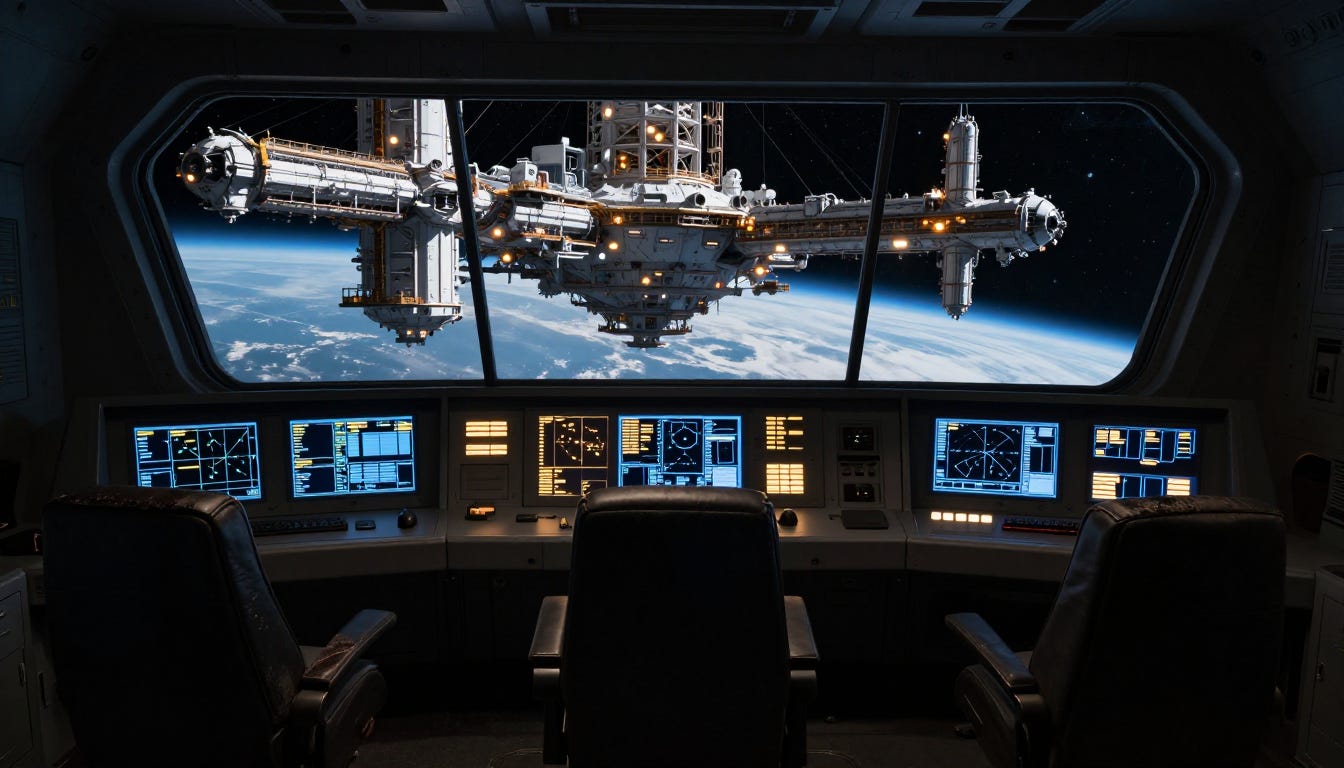
The night watch crew had stopped being surprised. Lieutenant Jaya Mehta at sensors. David had drawn her name from the database that morning, a navigation specialist from the Mumbai orbital yards who had transferred to Defiant six months before the depot raid. She possessed an instinct for threat geometry that David trusted. When he entered the bridge at 0200 she did not look up from her display. She simply shifted the sensor overlay to the secondary screen so he could see it from the chair without asking.
He sat. The chair received him the way it always did: correctly, the lumbar support aligned, the display angles within reach, the armrests at the height his brother had set twelve years ago and never changed. David placed his left hand on the worn spot. The wrongness of it was immediate. His hand was the same size as Marcus’s. The same genetics. The same training. But the hand that had worn this leather belonged to a man who had stood on the bridge while the fleet burned and carried twelve years of what came after. David’s hand had only ever known Marcus carrying it. That was not the same thing.
The command display showed Defiant’s status board: reactor standby, shields cold, weapons safed for dock. Fourteen days since the depot raid. The hull repairs were ahead of schedule. The fold drive had come through the extraction runs with less stress than projected. Every system on the board was green. David looked at the board and thought about the first time green across a ship’s status display had meant relief. These days green registered as a question he did not know how to answer.
Jaya spoke without turning. “Commander. Long-range sensors are picking up a Skarreth courier vessel approaching the station. Scheduled arrival. ETA forty-one minutes.”
The information was routine. The fact that she had volunteered it, at 0200, without being asked, was not. She was giving him something to do. A reason to be on the bridge at an hour when no captain needed to be.
“Thank you, Lieutenant.” David pulled up the courier’s approach vector on his secondary display. The data was clean. The vector was efficient. The Skarreth did not waste reaction mass on elegance. He studied the numbers longer than they needed. Jaya let him.
Two months ago he had been XO. The chair had been Marcus’s and David had stood at the tactical station five meters to port, running threat assessments while his brother made the decisions. He had been good at it. The XO’s job was to see everything the captain missed, and he had caught everything Marcus missed. He had also registered everything Marcus registered, and he had known that seeing it cost his brother more than Marcus would ever admit.
Now the tactical station was dark and David was in the chair and the person standing where he used to stand was a junior lieutenant he had not yet learned to trust the way the crew trusted him.
He reconfigured the primary display. Not the whole layout. Just the color scale. Marcus had used a red-through-green threat gradient that prioritized urgency. David preferred a blue-through-amber spectrum that emphasized nuance. A small change. A preference, not a philosophy. His fingers moved through the configuration menu with the deliberateness of someone hanging a picture on a wall that had been bare for a long time.
The display shifted. The courier’s approach vector rendered in cool blue, the threat assessment banded in amber gradients that showed probability instead of alarm. David looked at the new colors and something settled behind his ribs.
He reconfigured the engineering summary next. Marcus had run it at minimum data density. Status only, no trends. David increased the density to show variance bands over time. The same information. Different context. The engineer who had designed the display would have approved. Marcus would have said it was too much information. David thought Marcus was wrong about that. The thought arrived without the guilt that usually accompanied it.
The courier’s ETA ticked down. Thirty-one minutes. David pulled up the docking schedule and cross-referenced the berth assignment. Routine work. The kind of administrative detail a captain’s yeoman normally handled. The yeoman was asleep, which was where a yeoman belonged at 0200.
Jaya spoke again. “Commander. The courier’s flight plan has been acknowledged by station traffic control. No conflicts.”
“Thank you.”
A pause. Jaya’s voice was careful in the way of someone choosing words. “Sir. Would you like me to log the approach?”
It was a test. A quiet one, offered with the professionalism of an officer who knew her captain needed to be asked things she had no business asking. She was asking: do you know why you’re here?
David looked at the display. The courier vector. The docking schedule. The shift log entry that would show Commander Rivera on the bridge at 0200, monitoring a routine arrival that required no monitoring at all.
“Yes,” he said. “Log it. Standard entry.”
“Aye, sir.”
The words appeared on her screen. Another piece of data in a ship that generated thousands every hour. David’s gaze stayed on the screen, and behind it his thoughts tracked to Prometheus Station, to his brother in a medical bay, the tactical feed of the depot raid streaming in front of him, David’s maneuvers on Defiant, the chair that used to be his. Marcus had seen all of it and said nothing. David did not know whether that was the hardest thing his brother had ever done or simply the most recent hard thing in a life that had been nothing but.
The courier’s approach vector hit the ten-minute mark. David stood. The chair released him with the same indifference it had always shown him. He walked to the viewport and looked out at the shipyard. The construction frameworks held three cruisers at various stages of repair. Work pods drifted between them, their amber lights painting the hulls in slow arcs. Beyond the station, Earth turned. Home. The word was different now than it had been two months ago.
He turned back to the bridge. The command display still showed his color scheme. His data density. His preferences. Small changes. He had made them one at a time, over weeks, the way you moved into a house that still smelled like the previous owner. He was not erasing Marcus. He was adding himself.
Jaya’s voice, for the third time: “Courier has docked, Commander. Berth Seven. No anomalies.”
“Thank you, Lieutenant.” David paused. “You’re good at this.”
She turned. For the first time since he had entered the bridge she looked at him directly. “I learned from someone who was good at it.”
David did not ask who. He took one last look at the chair. The armrest was still worn in the shape of Marcus’s hand. The display was now in the shape of David’s mind. Two things could be true at the same time. He was learning that. Slowly.
He walked to the hatch. Paused with one hand on the frame. “I’ll be back at 0600,” he said. “Normal watch rotation.”
Jaya nodded. “We’ll be here, sir.”
The bridge door closed behind him. The corridor was empty, the ship quiet around him, the reactor humming at standby in the deep register that meant everything was working. He walked toward his quarters and did not look back. The chair was still Marcus’s chair. But for the first time, he thought it might eventually be his. The thought did not arrive like stealing. It arrived like the thing Marcus had been trying to tell him, in his own way, for months.
The next watch would start in four hours. Until then, the ship ran on its own, and the chair sat empty at the center of the bridge with David’s colors glowing on the displays. Waiting.
If you enjoyed this story, you can follow the main story arc in The Exodus Rush, the first book in The Vethrak Requiem series.