


The sixth-sector atmospheric check was always the slow one.
Thirty-two transition seals, pressure differential across each, manual verification on anything the automated array flagged as marginal. Eleven minutes added to every sweep, sometimes fourteen if a seal ran cold. Isidora Preston had rebuilt her morning route around it three months ago: start at nine instead of eight-forty, clear the sixth sector before Checkpoint Four rotated to the afternoon crew.
She knew the morning rotation. She had spent two weeks learning it.
Checkpoint Four was staffed by the same tech every morning, a man who ran his scanner wand with the rhythm of someone who had done the same movement eighteen thousand times and intended to do it eighteen thousand more. Thorough, not curious. Thorough meant he covered every surface of her maintenance kit. Not curious meant he was satisfied when the scan returned a clean read.
The kit rested on the scanner bed. Inside: torque wrench, calibration tablet, two sealed polymer packs that registered as hardware components, and one sealed polymer pack that registered as hardware components and was not.
The Sleeve ran packages through Titan’s transit grid because transit workers moved through sectors without explanation. Maintenance kits, sample containers, survey cases. The pressurized corridors of the settlement complex required constant attention from people whose job it was to walk between sectors carrying things. A corridor tech with a bag of equipment was not a story. It was any morning of the week.
The wand passed over the bottom layer of the kit. The scanner chimed green.
“Cold out there,” the tech said, handing it back.
“Always is.” She slung the kit over her shoulder and moved through the gate.
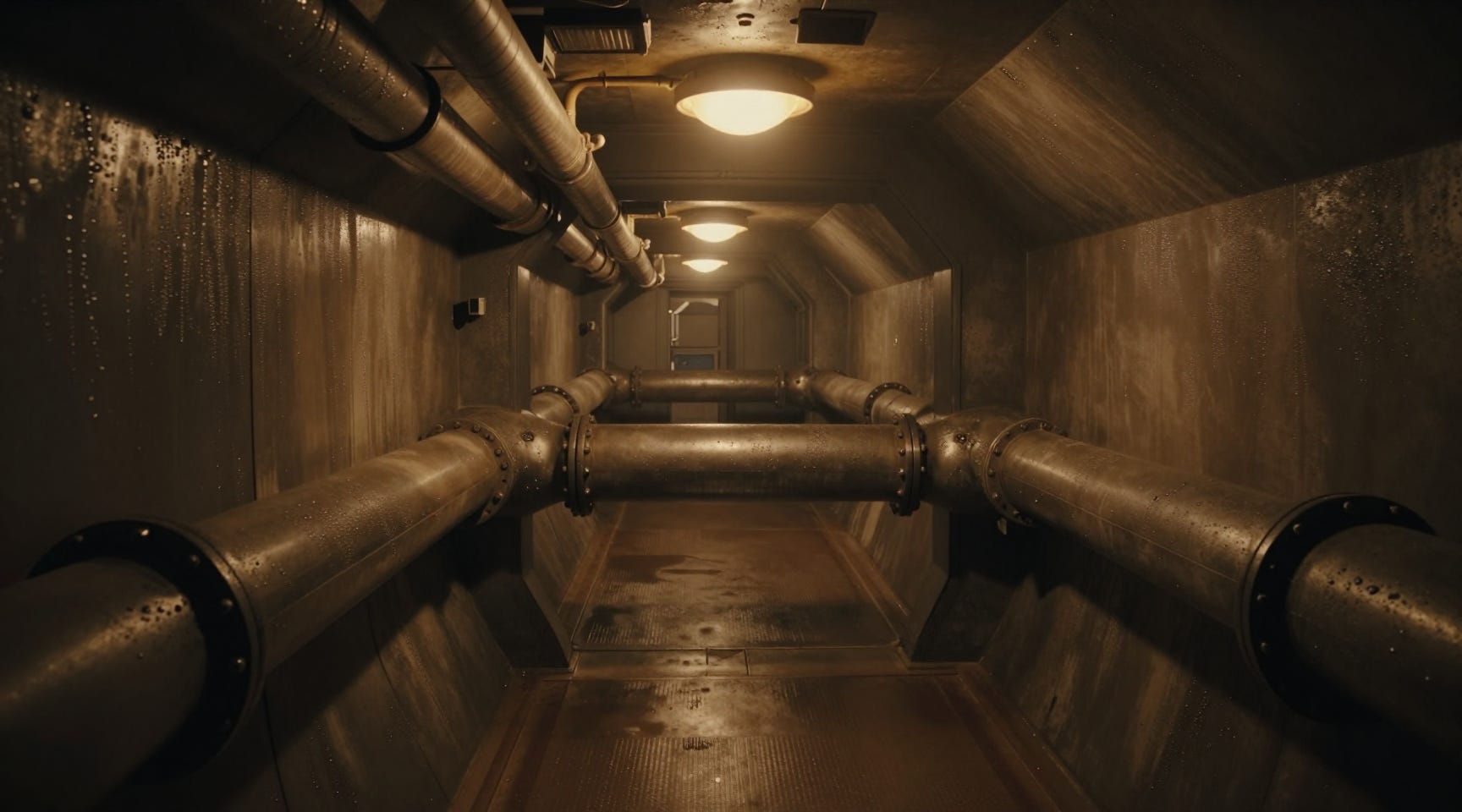
The drop point was inside the maintenance access sleeve that ran parallel to the transit corridor between sectors eleven and twelve. Narrow, lit by amber work lights, warm from the atmospheric exchange units bolted to the ceiling. At the third junction, a horizontal pipe housing had a seam that did not appear in any design schematic she had been given access to. The package went in there. She pressed until she heard the magnetic catch engage, then pressed the adjacent surface twice.
She had done this six times. The first time, her hands had shaken on the second press.
They didn’t anymore.
Lukas Ferreira was at the sector eleven canteen when she came out, which was also part of the arrangement. Post-drop check-in. He bought two cups of thermal paste coffee, handed her one without asking, and they stood at the counter near the window that looked out over the transit approach ramp.
“Clean run,” she said.
“Clean run.” He wrapped both hands around his cup. He was not a warm man, which she had come to understand as a quality worth having. Warm men made promises. Lukas described conditions.
“Your mother,” he said. “Responding well?”
“Better. They said another two weeks on the course.”
He nodded. The antiviral had been pre-loaded onto a supplement unit delivered to her transit slot the morning after her first run. She had held it for a long time before she opened it. The dosage information was in the packaging. The provenance was not.
“Next run is in four days,” he said. “Different weight. Denser. Same drop point.”
She drank the coffee.
“What’s in it,” she said.
He looked at her over the rim of his cup, not unkindly. “Does it change anything?”
The corridor outside the canteen pressed close and gray, recycled air carrying the faint ammonia edge that meant the atmospheric exchange on this sector was running behind schedule again. Four months ago, her mother had been running a fever in a unit with a failed secondary heating coil, and the official repair queue had placed the work order at nineteen days out. The medical allocation office had assessed the antiviral as a non-critical priority: thirty-to-forty-five days for redistribution review.
She had known she didn’t have thirty-to-forty-five days.
She had found Lukas through a corridor tech in Sector Eight who had described him the way people in the settlement described the manual override handles on the pressure seal housings: quietly, practically, as something you didn’t want to need but should know the location of.
“No,” she said. “It doesn’t change anything.”
He nodded, finished his coffee, and set the cup down.
She would learn later, through the specific way that information moved in a pressurized settlement where nobody had anywhere else to be, that the Sleeve ran four package types through the Titan transit grid. Pharmaceutical supplements and antivirals. Cascade-reactor maintenance components with compromised serial registrations. Counterfeit ration authorization chips, each paired to a ghost household profile. Data storage units containing biometric records belonging to people who had not agreed to share them.
The Sleeve called itself local. The corridor tech in Sector Eight had described it as a branch. A branch implied something it connected to, something that ran further than Titan, further than any single pressurized ring. She didn’t ask about the rest of it. The rest of it wasn’t her arrangement.
She would learn which package type she had been carrying.
She would carry the seventh anyway.
Author’s Note: This story takes place in Year 13, in Titan’s pressurized settlement grid during the post-invasion resource crisis. Criminal networks like the Sleeve operate by filling gaps the official system leaves open: they don’t recruit workers so much as they wait for the system to produce people who have no other option. Isidora’s story isn’t about a choice made in desperation. It’s about what happens after, when desperation fades and the carry becomes routine, and the only honest thing left to say is that it doesn’t change anything.
If you enjoyed this story, you can follow the main story arc in The Exodus Rush, the first book in The Vethrak Requiem series.