


The cargo hold on deck five was the largest enclosed space on the Defiant that was not a shuttle bay, and David Rivera had never understood why nobody had told the junior supply officer that the first time she reported a discrepancy.
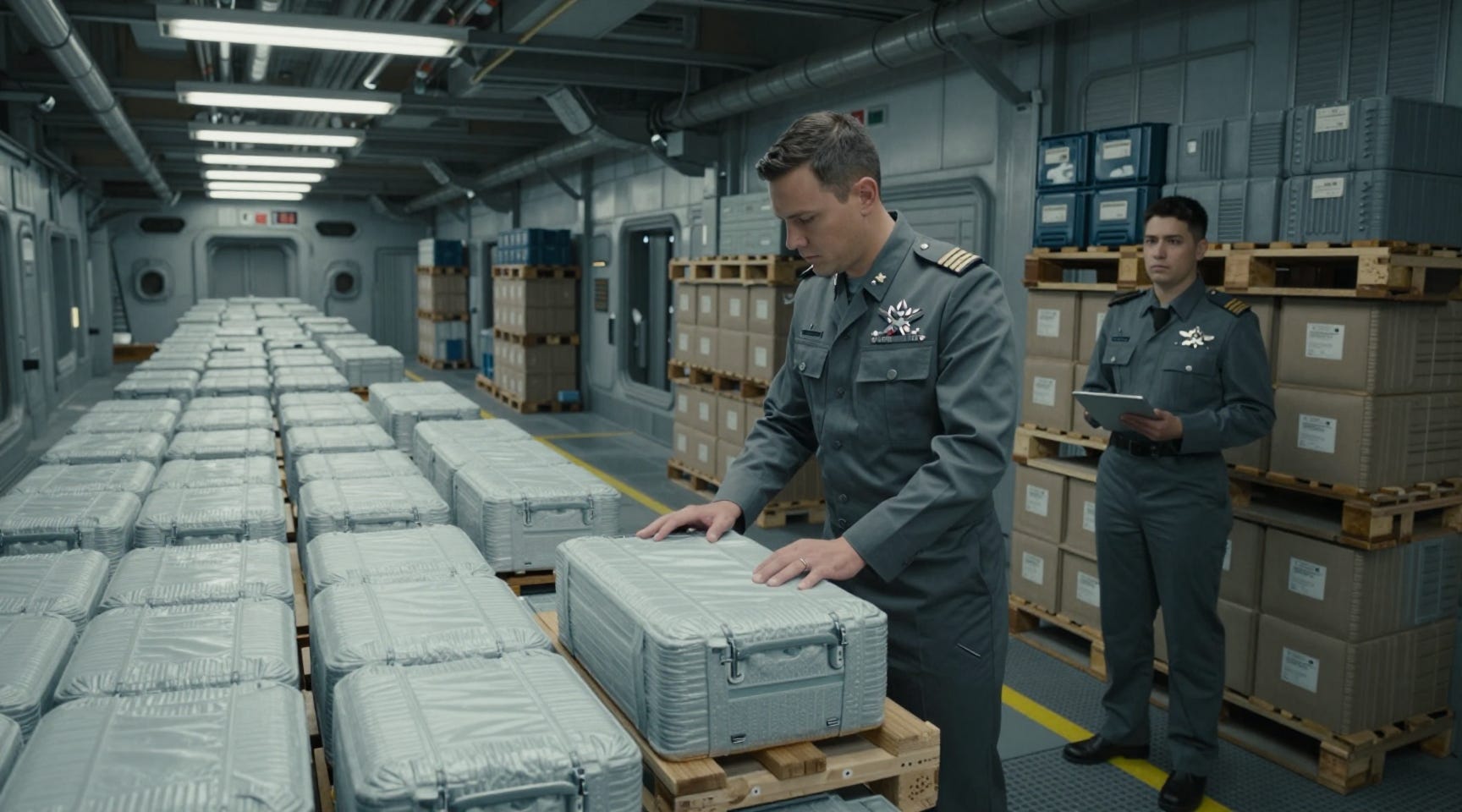
The hold ran thirty meters from bulkhead to bulkhead, stacked with supply pallets in a grid that was supposed to match the manifest on the senior quartermaster’s terminal. Standard rations. Emergency kits. Medical stores sealed in climate-controlled containers. The air was cooler here than in the rest of the ship, a deliberate calibration to extend the shelf life of the dry goods. It carried the faint metallic scent of sealed packaging and the low hum of the environmental system that cycled the hold’s atmosphere on a separate loop from the crew compartments.
Ensign Calla Voss was waiting at the entrance bay when the lift doors opened. She was standing at attention, which told David she had been standing there for a while, and she was holding a datapad with the discrepancy flagged in red. She was young. All the ensigns were young now. She had probably been in the Academy during the Year Six wave, which meant she had never served on a ship that was not being built from salvaged wreckage.
“Commander,” she said. Her voice carried an attempt at steadiness that did not quite land.
“At ease, Ensign.” David stepped past her into the hold. The grid of pallets stretched ahead. “Show me.”
She fell into step beside him. The datapad came up, the flagged line visible without magnification. Line item 47-B. Emergency rations, forty-seven units, logged as received on commissioning day and recorded as stored in sector four. Sector four had been checked three times in the past two weeks. The count did not match.
“I recounted twice, sir,” she said. “I checked the receiving log. I checked the transfer authorization. The discrepancy is real.”
“Good.”
She blinked. “Sir?”
“You verified the data before you escalated it. That is the right process. Most junior officers would have sent the flag and waited. You did the work first.” David stopped at a pallet stacked with insulated containers. “Where did you start the recount?”
She processed the shift. She had been expecting tension, maybe a reprimand, certainly an inspection. Instead she was being asked a question about her procedure, and her brain was catching up to the fact that the XO was not here to find fault.
“Sector four, sir. The listed storage location.”
“Then we start there.”
It took them forty-three minutes.
David did not use the datapad. He worked the grid with his hands. Pulling the containers, reading the serial numbers printed on the seals, calling them out while Voss checked them against the manifest. The work was physical in a way that bridge duty never was. The insulated containers were heavy. The straps securing the pallets were stiff from the ship’s cool temperature. By the twenty-minute mark he had taken off his rank pin and set it on a crate near the entrance, because it had caught on a strap for the third time and he would rather not lose a commander’s insignia in a cargo hold.
Voss said nothing. He read her shoulders dropping by a measurable degree.
They found the discrepancy in sector six.
The forty-seven units of emergency rations were stacked behind a pallet of medical cold-packs that had been logged to a different sector entirely. A transfer error from commissioning week, when the quartermaster’s team had been working through three thousand line items in a seventeen-hour shift and someone had typed the wrong bay number into the manifest. The rations had been sitting in the wrong location since Day One, recorded in one place and physically present in another, invisible to every automated check that had been run since commissioning.
Voss stared at the pallet. Her expression shifted from professional concentration to something she was trying hard not to show.
“I filed this as a potential write-off,” she said. “I wrote the report. I flagged it for investigation.”
“It was a filing error, not a theft. Not a loss. You wrote the correct report.”
“But I wrote it as a loss scenario. I was wrong.”
David picked up the rank pin from the crate and turned it in his hands. She was waiting for him to close the issue. She was waiting for him to tell her that the write-off documentation had to be reversed, that there would be a correction log, that the quartermaster would need to sign off on the inventory adjustment. She was right about all of those things.
He put the pin back on his collar.
“Ensign,” he said. “Next time you find a discrepancy, what is the first thing you do?”
“Recount, sir.”
“And then?”
“I report to my supervisor, sir.”
“Right.” He picked up one of the emergency ration containers and checked the seal. Intact. The rations had been sitting in the wrong location for twenty-four days and were still perfectly usable. “You did the right things in the right order. Do not worry about being wrong. Worry about not telling someone that you might be.”
She did not salute. She was holding the datapad and her hands were full and David had never liked salutes inside a working space anyway. She simply nodded and said: “Yes, sir. I will.”
“I know you will.”
The walk back to the lift was quiet. Voss stayed in the hold to begin the relocation paperwork. David stepped into the lift and pressed the button for the bridge deck and listened to the hum of the ship around him. The Defiant was four hundred fifty people in a hull that had been built to fight a war that had not started yet, running on procedures that were still being written by the people who would have to follow them in combat. A misfiled pallet of emergency rations was not a crisis. It was the texture of command on a ship that had been operational for twenty-four days.
Someone had to do the inventory audits. Someone had to teach the ensigns that the right procedure was better than the right answer. Someone had to be in the hold when the discrepancy was forty-seven emergency rations that were not lost, not stolen, simply sitting in the wrong place because nobody had checked.
Most of command was not the bridge. Most of command was the hold.
The lift doors closed. David Rivera was the executive officer of the UENS Defiant, and the adjustment log for sector six would be filed before the end of his shift, and that, on a ship that had been operational for twenty-four days, was the work.
If you enjoyed this story, you can follow the main story arc in The Exodus Rush, the first book in The Vethrak Requiem series.